
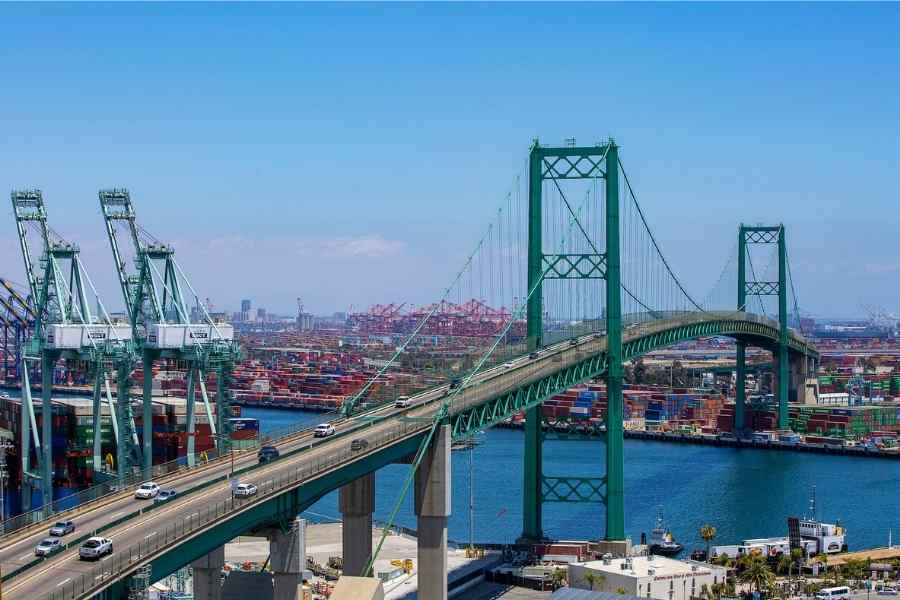
Caltrans has awarded a USD 534M contract for the Vincent Thomas Bridge Deck Replacement Project to a joint venture of Skanska and California Engineering Contractors.
The works involve full deck replacement, installation of new expansion joints, and implementation of corrosion protection systems. The project is being delivered under a GC/CM model (also known as CMaR), with an accelerated construction strategy that includes an approximately 16-month full bridge closure to facilitate the installation of precast deck elements.
Vincent Thomas Bridge Deck Replacement Project – Background
The Vincent Thomas Bridge (SR‑47) has been in service for roughly 60 years. Caltrans states the structure is structurally sound, but the deck is rapidly deteriorating due to concrete fatigue from heavy traffic loading and environmental deterioration linked to age and the marine environment.
The project is positioned as a critical asset preservation initiative, aimed at extending the service life of the structure while improving safety and operational reliability.
Given the bridge’s role as a key freight link serving the Port of Los Angeles, the works also require careful consideration of traffic management, detour planning, and stakeholder coordination.
According to Skanska, the scope of works includes the removal and replacement of the existing deck, installation of new expansion joints and corrosion protection systems, integration of real-time structural health monitoring technology, and the use of lightweight, high-performance precast prestressed concrete deck panels designed to perform under heavy freight loads and marine exposure conditions.
Contract Details - The GC/CM Approach
The project is being delivered under a General Contractor/Construction Manager (GC/CM) model, with Skanska and California Engineering Contractors (CEC) engaged during both the preconstruction (early contractor involvement) and execution phases.
Under this model, the contractor provides early input into design development, including constructability, cost planning, and programme sequencing, prior to establishing a Guaranteed Maximum Price (GMP). For Caltrans, the adoption of GC/CM reflects a preference for delivery models that allow greater flexibility and risk mitigation on complex infrastructure upgrades.
From a delivery perspective, the GC/CM model is particularly suited to the Vincent Thomas Bridge project, where construction methodology is a key driver of both cost and schedule outcomes. The proposed full closure strategy, combined with the use of precast prestressed deck panels, benefits from early contractor involvement to optimise logistics, sequencing, and installation methods.
The model also supports improved risk allocation compared to traditional Design & Construct arrangements. Design–construction interface risks are reduced through early collaboration, while the GMP mechanism provides a degree of cost certainty once scope and methodology are sufficiently defined.
Contract Values and Timelines
According to Skanska, the contract is valued at approximately USD 534 million and will be included in its US order bookings.
The project adopts an accelerated delivery strategy centred on a planned full bridge closure of approximately 16 months. Construction is scheduled to commence in spring 2026, following completion of preconstruction and planning phases, including finalisation of methodology, stakeholder coordination, and traffic management strategies
The closure period represents the most critical phase of the works, with the bridge expected to reopen to traffic in the first half of 2028. Overall project completion is targeted for March 2029.
This approach is intended to compress the overall programme by enabling continuous construction activities and efficient installation of prefabricated deck elements, offering a more controlled execution environment compared to staged construction under live traffic conditions.
From a technical standpoint, the use of precast prestressed concrete deck panels is a key enabler of this strategy, supporting improved quality control, reduced on-site construction durations, and enhanced durability in a marine environment.
Related Project and News