

Ferrovial Construction–Webber JV has been selected as the best value proposer for the SH 99 Grand Parkway Segment B-1 Design-Build Project in Texas.
The proposed contract package has a total price of $1.466 billion, comprising a $1.438 billion design-build contract and $28.25 million capital maintenance contract covering years 1 to 15. The Texas Department of Transportation [TxDOT] expects final award and contract execution in summer 2026, with substantial completion anticipated in winter 2031/2032.
SH 99 Grand Parkway Segment B-1 – Project Background
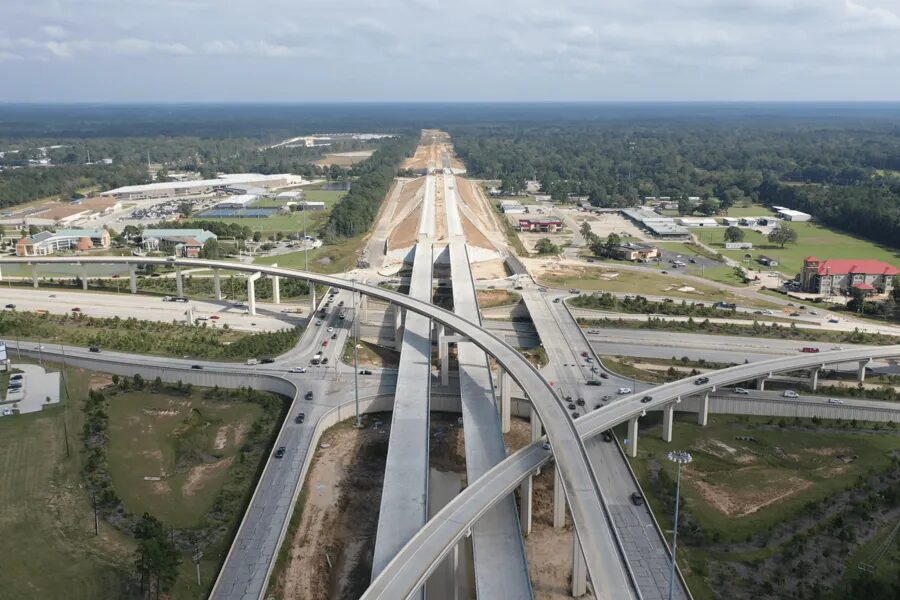
The SH 99 Grand Parkway Segment B-1 project is being advanced by TxDOT in Brazoria and Galveston Counties, southeast of Houston. TxDOT describes the project limits as extending from south of Farm to Market Road FM 2403 to FM 646.
The project forms part of the wider SH 99 Grand Parkway corridor, a major circumferential highway system around the Greater Houston region. According to TxDOT, the purpose of Segment B-1 is to improve safety and mobility, strengthen system connectivity, accommodate economic development, and provide an alternative emergency evacuation route.
The package includes approximately 15 miles of new and upgraded highway infrastructure. It is being developed as a toll project on the state highway system under a market valuation waiver agreement executed in March 2009.
The B-1 package follows earlier Grand Parkway delivery activity involving Ferrovial and Webber in the Houston region. Webber is Ferrovial’s US construction subsidiary, and the selected team brings relevant corridor experience from previous SH 99 Grand Parkway works.
Ferrovial-Webber 99 Team Structure
The Ferrovial Construction-Webber JV team is detailed in the table below, with Ferrovial Construction US Corp. as the lead equity member and Webber, LLC, Ferrovial’s US construction subsidiary, holding the remaining equity share.
| Team Member | Role / Share |
|---|---|
| Ferrovial Construction US Corp. | Lead equity member – 51% |
| Webber, LLC | Equity member – 49% |
| Ardurra Group, Inc. | Lead engineering firm |
| Ferrovial Construction US Corp. | Lead contractor |
| Webber, LLC | Lead maintenance contractor |
| Keith & Associates, Inc. | Construction quality control firm |
| Astron General Contracting Co., Inc. | Independent quality firm |
| EXP US Services, Inc. | Independent engineering firm |
Scope of Works and Contract Details
The Segment B-1 package will be delivered through a design-build contract with an associated capital maintenance contract. TxDOT’s presentation identifies the total proposal price as $1.46 billion, including $1.43 billion for design-build and $28.25 million for capital maintenance over years 1-15.
The scope includes:
- four new SH 99 tolled lanes with discontinuous frontage roads,
- two direct connectors at the SH 99 / SH 35 interchange,
- 1.3 miles of non-tolled SH 35 main lanes and frontage roads, and
- 4.6 miles of operational improvements along SH 35.
TxDOT’s conditional award presentation also identifies total funding of $1.77 billion through the Grand Parkway Transportation Corporation for the tolled project elements. A further $186.8 million is identified for the non-tolled SH 35 components funded through TxDOT.
That matters because Segment B-1 is being procured as an integrated transport package, combining new toll lanes, interchange connectivity, frontage road works, operational improvements, and long-term maintenance responsibilities. This type of procurement structure places design, construction coordination, asset condition, and handback performance within a single commercial framework.
North American Highway Infrastructure Outlook
The SH 99 Segment B-1 selection reinforces the continued scale of US highway and toll road procurement, particularly in fast-growing metropolitan regions such as Houston. Major road packages are increasingly being structured to address not only capacity, but also resilience, evacuation routes, system connectivity and long-term maintenance.
Construction Front has covered similar momentum across North American transport infrastructure, including the Walsh-Kokosing JV awarded the $3.6 billion Brent Spence Corridor design-build contract, the Fluor-led team selected for the I-35 NEX South project in Texas, and Skanska winning the $1.06 billion design-build contract for MBTA’s North Station Draw One project.
For contractors, the pattern is clear: large transport projects continue to favour integrated delivery models where design, construction, systems coordination and maintenance obligations are considered together. That creates opportunities for teams with both civil delivery capacity and long-term asset performance capability.