

Sunraycer Renewables has closed a $901 million project financing facility for the Eagle Springs, Lupinus 1 and Lupinus 2 solar-plus-storage projects in Texas.
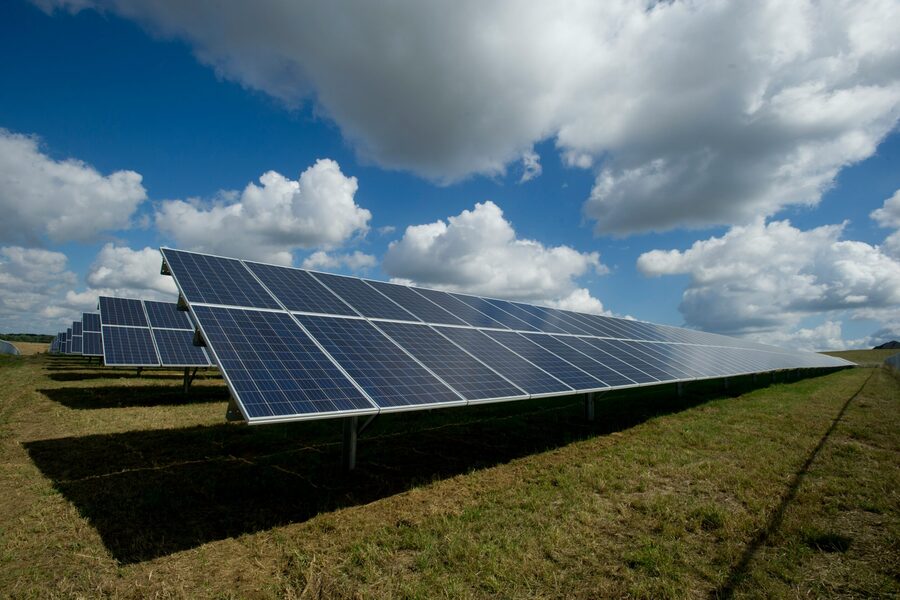
The financing supports three projects totaling 479.5 MWac of solar generation and 236.5 MWac of paired two-hour battery storage. The package combines a construction-to-term loan, a tax credit bridge loan and a letter of credit facility, giving Sunraycer construction and operating capital for assets entering the ERCOT market.
Eagle Springs and Lupinus Solar-Storage Portfolio – Project Background
The financed portfolio comprises three projects in Northeast Texas: Eagle Springs in Delta County, and Lupinus 1 and Lupinus 2 in Franklin County. The projects are designed as hybrid solar and battery energy storage assets, with storage paired directly with solar generation to support dispatchability and grid reliability.
Sunraycer’s March construction update described Eagle Springs as already under construction, with the Lupinus I and II groundbreaking scheduled for March 2026. The May financing release states that all three projects began construction in late 2025. Read together, the releases confirm that the portfolio has moved from development and procurement into active construction and financing execution.
Commercial operation is expected to be staggered. Eagle Springs is expected to reach commercial operation in late 2026, while Lupinus 1 and Lupinus 2 are expected to follow in late 2027. The projects sit within ERCOT, the Texas grid operator serving more than 26 million customers, where demand growth from manufacturing and data center loads continues to shape generation procurement.
Sunraycer is a Crayhill Capital Management portfolio company and says it has an approximately 3 GW development, construction-stage and operational pipeline of utility-scale solar and battery power plants.
Portfolio Scope and Financing Structure
The $901 million financing facility was arranged with MUFG Bank, Ally Bank, Nomura Securities International, Norddeutsche Landesbank Girozentrale and Societe Generale. It is structured to fund construction and operation through a mix of construction-to-term debt, tax credit bridge financing and letter of credit support.
This is relevant because renewable project finance is increasingly being structured around both construction funding and tax-credit monetisation. The facility also marks Sunraycer’s second portfolio financing in about 12 months and brings its total capital raised across project finance and tax equity to roughly $1.6 billion over that period.
McCarthy Building Companies is serving as the EPC contractor for the projects, according to Sunraycer’s earlier construction announcement. That release said the developments are expected to support more than 200 local construction jobs and involve regional suppliers and community engagement in nearby Northeast Texas communities.
Offtake and ERCOT Market Context
The Lupinus portfolio also has a corporate offtake connection. In March 2026, Sunraycer announced two long-term Power Purchase Agreements with Google Energy for approximately 400 MWac of Texas solar capacity tied to the Lupinus projects.
Those PPAs are expected to support construction and operation of the Lupinus photovoltaic facility in Franklin County. For project developers, long-term offtake remains a central bankability tool, particularly where merchant exposure, basis risk and curtailment risk can affect revenue certainty in high-renewables markets.
The financing also reflects the scale of load growth in Texas. Sunraycer’s release identifies manufacturing and data center expansion as key drivers of rising electricity demand across ERCOT, reinforcing why solar-plus-storage portfolios are being financed as integrated capacity rather than generation-only assets.
US Solar and Storage Financing Outlook
The Sunraycer close fits a broader pattern in US renewables procurement: project finance is moving toward portfolios that combine solar generation, battery storage, offtake agreements and tax-credit bridge structures. Construction Front has covered similar activity, including Aypa Power reaching financial close on a $535 million California hybrid solar and storage project and Heelstone reaching financial close and starting construction on two U.S. solar projects.
For contractors, lenders and developers, the practical signal is that bankable renewable projects increasingly need a complete commercial package: grid position, offtake, tax-credit planning, storage integration and executable construction arrangements. That creates opportunities for EPC contractors, battery suppliers, grid consultants and project finance teams able to coordinate around delivery and revenue certainty.
Related Articles and News
- Power Purchase Agreements (PPAs): What They Are and Their Relevance to the Construction Sector
- Aypa Power Reaches Financial Close on $535 Million for California Hybrid Solar and Storage Project
- Heelstone reaches financial close and starts construction on Alligator Creek and Murch solar projects in the U.S.
- Google Partners with CIP for 250MW Wind Power PPA in the Netherlands
- EPC Contracts – How do they Work?
Source: Sunraycer Renewables
Supporting Source: Sunraycer construction update