
TKF has been awarded the inter-array cable contract by Vattenfall and Copenhagen Infrastructure Partners for phase 1 of the Zeevonk offshore wind project in the Dutch North Sea.
The contract covers the design, engineering, manufacturing, testing, delivery and project management of approximately 162 km of 66 kV inter-array cables, including associated accessories. The award supports the first 1 GW phase of Zeevonk, with completion planned for 2029.
Zeevonk Offshore Wind Project – Project Background
The Zeevonk project is being developed by Vattenfall and Copenhagen Infrastructure Partners through CIP’s Energy Transition Fund. It is located off the Dutch North Sea coast, around 63 km to 84 km from Bergen aan Zee, and covers an area of approximately 650 km².
The project is being developed in two phases. Phase 1 is planned to deliver 1 GW of offshore wind capacity by 2029. Phase 2 is scheduled for 2032 and is expected to add a further 1 GW of offshore wind capacity and 500 MW of system integration capacity.
The system integration component includes an electrolyser in the Port of Rotterdam for green hydrogen production. That matters because Zeevonk is being positioned not only as a generation project, but as part of a broader offshore wind, grid integration and industrial decarbonisation platform in the Netherlands.
Vattenfall and CIP won the IJmuiden Ver Beta tender in 2024 with the Zeevonk proposal. The cable award to TKF is one of the early supply chain packages needed to convert that tender win into executable offshore construction scope.
TKF Cable Contract and Scope of Works
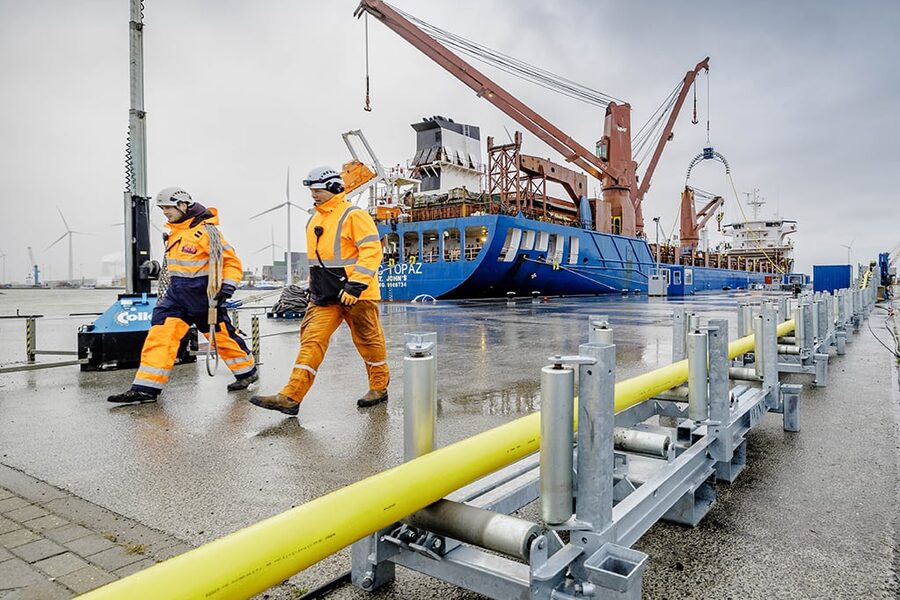
Under the contract, TKF is responsible for the full supply package for the inter-array cable system. The scope includes design, engineering, manufacturing, testing, delivery, associated accessories and project management for the 66 kV cables.
The cables will be produced at TKF’s facility in Eemshaven in the Netherlands. The contract also includes sustainability measures in the cable design, including low-emission aluminium, recycled steel and copper, and a bitumen-free cable design, according to Vattenfall’s announcement.
Inter-array cables connect offshore wind turbines to the offshore substation or collection system. In practical delivery terms, they sit at the interface between turbine installation, offshore electrical works, testing, commissioning and grid export readiness. For a large offshore wind project, cable manufacturing capacity and installation readiness are therefore critical path items.
Zeevonk Development Structure and Phasing
Zeevonk is a joint project between Vattenfall and CIP. CIP is participating through its Energy Transition Fund, while Vattenfall brings offshore wind development and operating experience in the Dutch and wider European market.
The project’s two-phase structure is important because it links generation capacity to later system integration. Phase 2 is planned to add another 1 GW of offshore wind and 500 MW of system integration capacity, including hydrogen production infrastructure in Rotterdam.
That creates a wider project interface than a conventional wind farm. The offshore generation package, inter-array cable system, grid connection, port infrastructure and hydrogen-related development pathway all need to be sequenced across procurement and delivery milestones.
European Offshore Wind Power Outlook
The TKF award reinforces the continued buildout of European offshore wind power, where generation capacity, grid connection, port logistics and cable manufacturing all need to advance together. Construction Front has covered related offshore wind and energy transition activity, including Aker Solutions securing a contract for the BalWin 1 offshore wind project and Gode Wind 3 beginning commercial operation.
CIP also remains active across European renewables and storage markets. Construction Front has previously covered CIP acquiring full ownership of the Morecambe offshore wind project in the UK and CIP reaching FID for two 500 MW BESS projects in Scotland.
For owners, contractors and suppliers, the pattern is clear: large offshore wind projects are increasingly being shaped by early procurement, circularity requirements and domestic or regional manufacturing capacity. Cable packages are not just procurement items; they influence project schedule, installation strategy, testing windows and grid energisation risk.
Related Articles and News
- Google Partners with CIP for 250MW Wind Power PPA in the Netherlands
- Aker Solutions Secures Contract for BalWin 1 Offshore Wind Project
- Gode Wind 3 Offshore Wind Farm Begins Commercial Operation
- Copenhagen Infrastructure Partners Acquires Full Ownership of Morecambe Offshore Wind Project in the UK
- CIP raises almost €6B in its new Renewable Energy Fund
Source: Vattenfall
Supporting Source: TKF