

Global electricity demand is climbing, driven by economic growth, electrification, and digital services. The International Energy Agency expects demand to rise by more than 25% by 2030. At the same time, renewable energy — especially solar and wind — is expanding rapidly, with IRENA projecting it will dominate new generation capacity. While this energy transition cuts emissions and operating costs, it also brings challenges. One of the most pressing is curtailment in renewable energy.
Curtailment happens when renewable plants capable of producing power are told — or forced by system limits — to reduce output. Common causes include transmission congestion, lack of system flexibility, and mismatches between supply and demand.
The National Renewable Energy Laboratory (NREL) notes curtailment rises when renewables supply over 20–30% of system capacity. While aiding grid stability, it creates technical and commercial risks, including lost revenue, uncertain PPAs, and challenges at project commercial and financial close.
Examples show its scale: in California, utility-scale solar curtailments exceeded 2.5 million MWh in 2020 (California ISO); in China, wind curtailment surpassed 15% in some provinces; in Australia, grid bottlenecks reduced solar output in regions like West Murray.
Curtailment is more than an operational adjustment—it’s an engineering, financial, and regulatory risk. This article defines curtailment, explains why it occurs, reviews its impacts, and outlines strategies—from grid upgrades and storage to contractual and policy measures.
What is curtailment in Renewable Energy Projects?
Curtailment in renewable energy happens when a generation plant capable of producing electricity is asked—or forced—to produce less than its full nameplate power generation capacity. This is becoming increasingly common in grids with high solar, wind, and hydro penetration, where operators must carefully manage output to maintain grid stability and prevent overloads.
It is important to note that curtailment is not always a technical necessity. In many instances, it arises from economic or commercial considerations, such as low or even negative energy prices, oversupply, or the inability of a purchaser to offtake electricity.
As such, curtailment is typically divided into two major categories:
Technical Curtailment – Occurs when system reliability or operational constraints require reducing output. Common triggers include transmission congestion, frequency or voltage limits, or limited system flexibility.
Economic Curtailment – Happens when generation could technically be delivered but is reduced due to market conditions, oversupply, or prices below contractual thresholds. This type of curtailment can have direct consequences on the commercial viability of Power Purchase Agreements (PPAs).

Technical Curtailment
Technical curtailment arises from operational or reliability requirements within the power system. It is implemented by grid operators to prevent instability, damage, or safety risks. Typical causes include:
Transmission congestion: When the local grid cannot transport all the electricity generated to areas of demand, operators must reduce output to avoid overloading lines.
Frequency and voltage constraints: Renewable generation, particularly wind and solar, can fluctuate rapidly. Curtailment is sometimes required to maintain system frequency within safe limits or to prevent voltage deviations that could damage equipment.
Limited system flexibility: In regions with low levels of flexible generation, energy storage, or interconnection with neighboring grids, operators may have no alternative but to curtail renewable output to maintain balance between supply and demand.
Technical curtailment is typically mandated by grid operators and is essential for safe and reliable operation of the electricity system. While unavoidable in some scenarios, excessive technical curtailment can indicate underdeveloped grid infrastructure, inadequate storage capacity, or poor integration planning.

Economic Curtailment
Economic curtailment occurs when generation is reduced even though technically it could be delivered, usually due to market and commercial factors rather than grid limitations. Common situations include:
Oversupply of electricity: When generation exceeds local or regional demand, operators may direct generators to reduce output to prevent negative pricing or imbalances.
Market price signals: If wholesale electricity prices fall below the level that makes generation profitable, renewable operators may agree or be instructed to curtail to minimize economic losses.
Contractual constraints: Curtailment may occur under terms specified in PPAs, where excess generation is not purchased or where compensation for curtailed energy is limited.
Economic curtailment is increasingly relevant as grids integrate more variable renewable energy (e.g. solar and wind farms), particularly in markets without sufficient demand response mechanisms, storage (BESS), or flexible dispatchable generation. For developers and investors, this type of curtailment can have direct financial impacts, potentially reducing forecasted revenues and complicating project financing.
Key Challenges associated with Curtailment
While curtailment may be necessary to maintain grid reliability, it introduces several operational, financial, and strategic challenges. Some of key key ones are detailed below.
Lost Power and Revenue
Every megawatt-hour curtailed represents potential income lost for a generator. In regions with high renewable penetration, even small curtailment percentages can significantly reduce revenue over a project’s lifetime, impacting financial forecasts and investor confidence.
Impact on Project Viability and Investment Risks
When curtailment exceeds planned parameters, developers and generators may struggle to recover projected revenues. High-curtailment regions are often perceived as higher-risk markets, affecting project bankability, financing costs, and the ability to reach final investment decisions and commercial close.
Technical and Operational Issues
Excessive curtailment can indicate underlying grid inflexibility. Grids experiencing high curtailment often face higher operational costs, as generators and system operators must frequently adjust output to balance supply and demand.
There is also an increased risk of local congestion or instability, although widespread blackouts are uncommon in well-managed systems.
Furthermore, insufficient energy storage or a lack of dispatchable backup generation can reduce overall system efficiency and complicate operational scheduling, making management more challenging for both operators and project developers.
Energy Strategic Considerations
Curtailment represents lost clean energy potential, which could otherwise replace fossil-fuel generation. This has broader implications beyond emissions, as it can increase overall system costs if reliance on flexible, dispatchable, or fossil-fuel generation rises.
Additionally, curtailed renewable energy can reduce the competitiveness of electricity prices, since more expensive generation sources might be needed to meet demand, potentially impacting both market efficiency, long-term energy affordability, and erode investor confidence.
What is an acceptable level of curtailment?
There is no universal benchmark for what constitutes “acceptable” curtailment, as it depends heavily on local grid conditions, regulatory frameworks, and market design. However, most industry stakeholders consider low single-digit levels (typically under 3–5% of annual generation) to be manageable and economically tolerable. At these levels, curtailment can usually be absorbed in project financial models without threatening viability.
The figure below from the Renewable Energy Market Update by the International Energy Association (IEA) illustrates this point. Across a wide range of countries, curtailment generally remains modest even as the share of variable renewable energy (VRE) grows. Yet there are also outliers: in some systems with lower VRE penetration, curtailment has reached double digits, highlighting the role of grid constraints and market design rather than just renewable share.
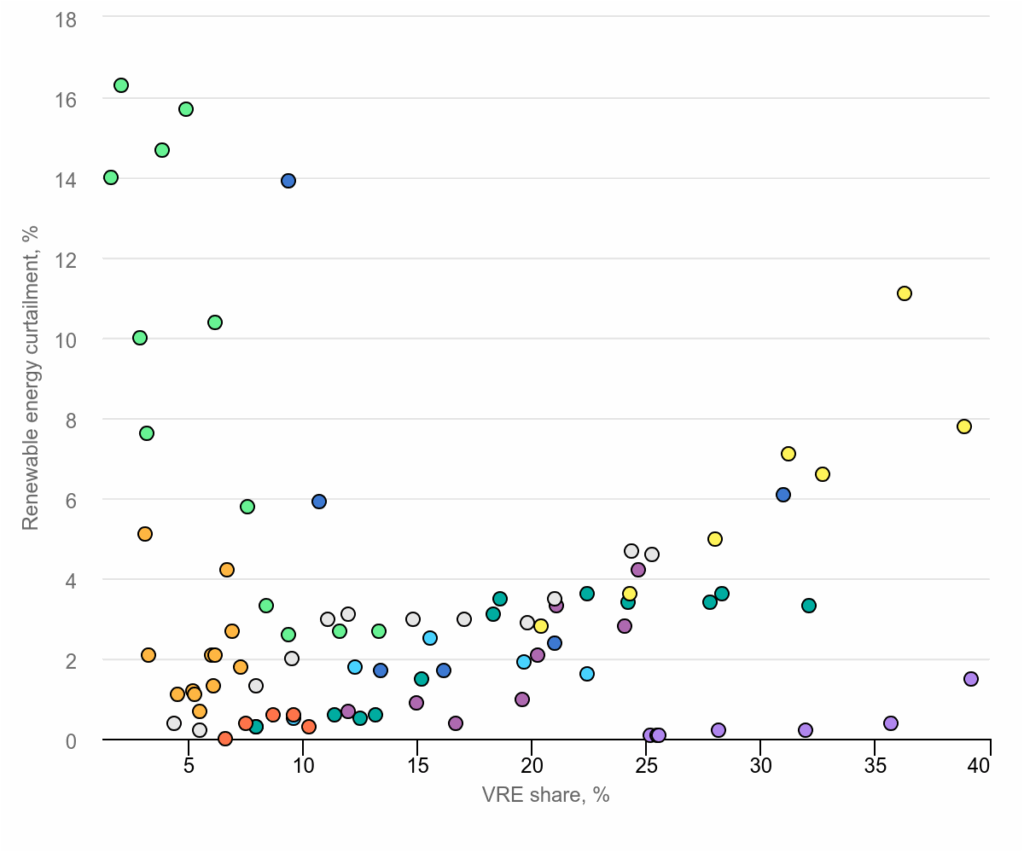
When curtailment consistently rises above the 5% threshold — as has occurred in parts of China, Spain, and some U.S. states — it can undermine investor confidence, reduce returns, and increase financing costs, and ultimately, impact on investment decisions.
Persistent double-digit curtailment is typically a sign of deeper structural issues such as insufficient transmission capacity, lack of storage, or misaligned market incentives. In practice, the “acceptable” level is therefore the point at which curtailment does not materially compromise project economics or broader decarbonization goals.
Technical alternatives to deal with Curtailment
Curtailment is not always an unavoidable consequence of renewable integration. In many cases, it reflects gaps in grid infrastructure, limited system flexibility, or insufficient planning rather than a strict technical necessity. A range of technical solutions exist that can either reduce the frequency of curtailment or mitigate its impact.
These solutions vary in scale—from reinforcing transmission lines to deploying storage or advanced grid management tools—and each comes with different costs, regulatory hurdles, and implementation timelines. The choice of approach often depends on the specific context: whether the constraint arises from local congestion, lack of flexibility in generation or demand, or insufficient system stability.
Some of the common technical/engineering alternatives to manage curtailment are:
Solution | What it Does | Real World Examples / Projects |
Grid Reinforcement and Expansion | Strengthens transmission and distribution networks to move renewable power to demand centers. Includes line upgrades, regional interconnections, and smart grid technologies for better monitoring and control. | |
Energy Storage Systems (BESS, Pumped Hydro, etc.) | Stores excess renewable generation when supply exceeds demand and discharges when needed. Provides short- and long-duration flexibility. | |
Flexible and Dispatchable Generation | Gas turbines, hydro reservoirs, and emerging solutions like green hydrogen provide backup capacity to balance variability and reduce curtailment. | |
Advanced Grid Management | Tools such as demand response, dynamic line rating, and advanced forecasting improve integration of variable renewables. Enables shifting consumption to periods of high renewable output. |
|
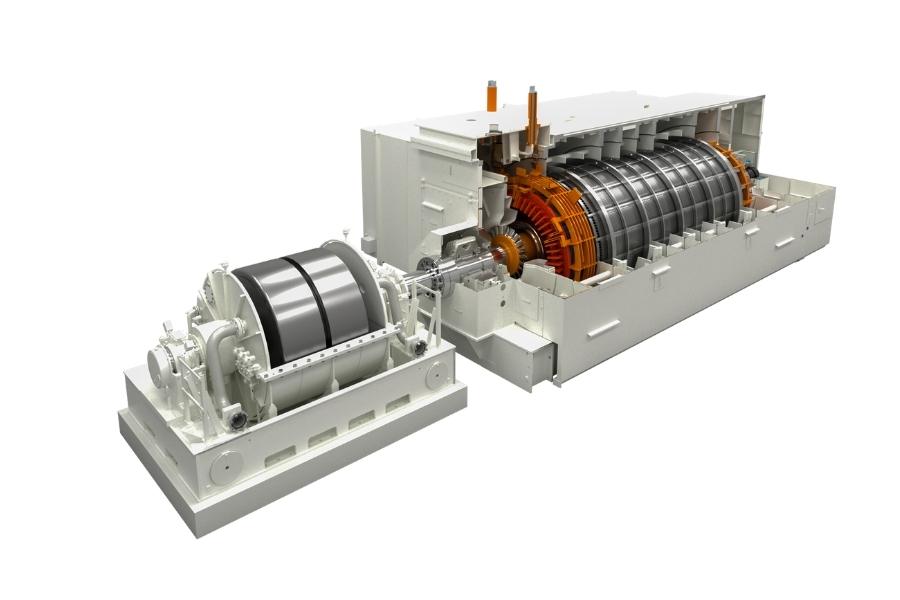
Synchronous Condensers & Grid-Forming Inverters | Provides grid stability services (inertia, voltage support, short-circuit strength). Advanced inverters add grid-forming capabilities that stabilize without curtailing renewable output. |
Final Considerations
Curtailment is an unavoidable reality in modern power systems, but the extent to which it poses a problem depends on how grids, markets, and policies are designed to manage it.
On the technical side, investments in transmission, storage, and flexible resources can significantly reduce its frequency. On the market side, well-structured PPAs and regulatory frameworks can ensure risks are more evenly distributed between developers, offtakers, and system operators.
Ultimately, curtailment should not be seen purely as wasted energy, but as a signal of where systems need to evolve. If addressed proactively, it can guide smarter infrastructure planning, accelerate the adoption of flexibility solutions, and improve the resilience of future grids.
The challenge is not eliminating curtailment entirely, but keeping it within levels that are both technically manageable and financially sustainable, while ensuring that clean energy continues to scale in line with global decarbonization goals.
Need Help?
Do not hesitate to contact us (click here) for specialised advice in the construction industry.
Sources
- Wind and Solar Energy Curtailment: Experience and Practices in the United States
- Wind curtailment of China׳s wind power
- World Energy Transitions Outlook 2023: 1.5°C Pathway by IRENA
- Curtailment of renewable generation: Economic optimality and incentives
- Case Study of Demand Response in California: Barriers, Policies and Business Models
Disclaimer: The articles on this blog are for informational and educational purposes only and do not constitute legal or technical advice. While we strive to provide accurate and up-to-date information on construction law, regulations may vary by jurisdiction, and legal interpretations can change over time.