
The Virginia Passenger Rail Authority (VPRA) has awarded a $1 billion contract to a joint venture of Skanska and FlatironDragados for the Long Bridge North Project, a major rail infrastructure initiative in the Washington, D.C. region. Part of the broader $2.3 billion Long Bridge Program, the project aims to expand rail capacity between D.C. and Virginia — a corridor nearing full operational capacity and critical to the East Coast network.
Delivered under a progressive design-build model, the Long Bridge North package will construct new track infrastructure parallel to the existing 1904 bridge. The upgrades will improve capacity, reduce congestion, and enable growth in both passenger and freight rail services. Construction is set to begin in July 2025, with completion expected by late 2030.
Long Bridge North Project Details
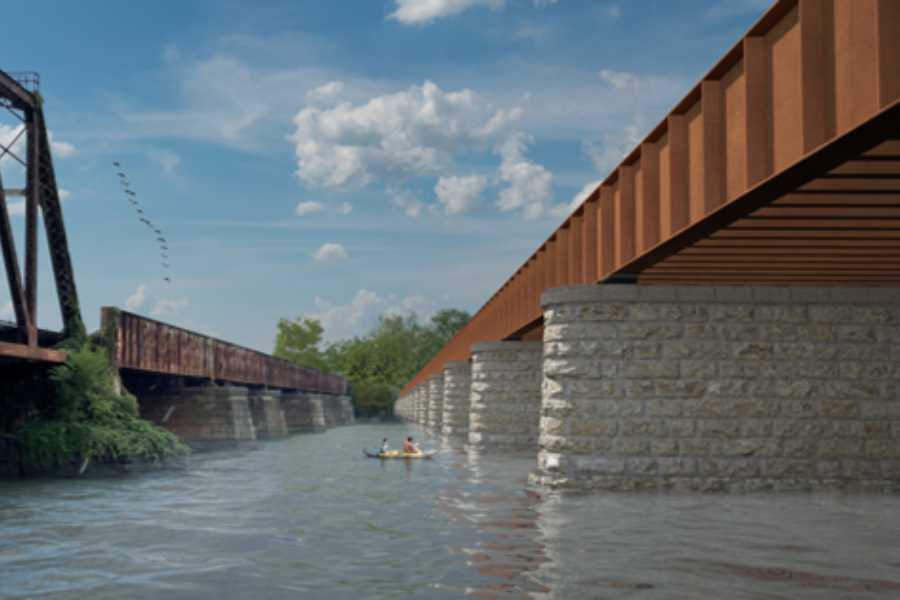
The Long Bridge North Project involves constructing a new, approximately one-mile, four-track rail corridor from the south bank of the Potomac River to the vicinity of L’Enfant Plaza station in Washington, D.C. The alignment crosses East Potomac Park and the Washington Channel, running parallel to the existing 1904-era Long Bridge — a structure currently operating at near-maximum capacity.
The project forms a key component of the broader $2.3 billion Long Bridge Program, which aims to increase capacity and improve rail performance between Virginia and the District of Columbia. The upgraded corridor will physically separate operations: CSX freight services will use the eastern tracks, while Amtrak and Virginia Railway Express (VRE) passenger services will operate on the western alignment.
The Skanska–FlatironDragados joint venture was first engaged by the Virginia Passenger Rail Authority (VPRA) in 2023 under a progressive design-build model, allowing for early collaboration in design development and constructability planning. At the time, the JV only included Skanka and Flatiron, which has now merged with Dragados in the USA. This approach has helped refine scope, mitigate risks, and ensure environmental and urban integration, particularly through sensitive parkland and dense urban interfaces.
What is a progressive design-build approach?
A progressive design-build (PDB) approach brings the contractor into the project early to collaborate with the client and designer during the planning and design stages. This model emphasises early contractor involvement (ECI) to improve constructability, manage risks, and align design with budget and delivery constraints.
Unlike traditional design-build, where pricing is fixed upfront, PDB allows scope and costs to be refined during design development. Construction begins only after the design is sufficiently advanced and a final agreement is reached.
For complex infrastructure like the Long Bridge North Project, PDB offers a flexible and collaborative method suited to projects with interface, environmental, or operational challenges.
Leadership comments
Peter Davoren, Chairman of FlatironDragados, said:
“This integration marks an exciting new chapter for our employees and clients across North America. The combined expertise and resources of FlatironDragados creates opportunities for our people to grow and thrive and enhances our ability to deliver essential infrastructure projects. Together with our partners and clients, our work is vital to improving communities and driving economic growth.”
Santiago Garcia Salvador, CEO of DRAGADOS, S.A., said:
“With a robust foundation built on collaboration, innovation and a shared vision for sustainable growth, FlatironDragados is committed to delivering transformative infrastructure projects. Together with our employees, clients and partners, FlatironDragados will continue to lead the industry in building a brighter, more connected future for people across North America.”