

Selecting the right contract model is one of the most important commercial decisions on any construction project. Different models create very different management strategies, risk allocation outcomes, and delivery behaviours. For example, an EPC contract usually pushes more design, procurement, and construction risk downstream to the contractor, while an alliance contract relies more heavily on collaboration, shared risk, and joint problem-solving.
Against that background, early-phase collaborative models, often associated with early contractor involvement (ECI), have gained greater attention in recent years, particularly where projects are complex, time-sensitive, or not sufficiently developed for a clean fixed-price commitment.
A pre-construction services contract is the agreement used to engage a preferred contractor before the main construction works contract is signed, so that the contractor can contribute to design development, constructability, programme planning, procurement strategy, pricing, and risk review during the preconstruction phase. In practice, this contract is most commonly called a pre-construction services agreement, or PCSA.
In most cases, signing a PCSA does not by itself oblige the client to award the main construction contract. Its purpose is to govern the early-phase services and create a structured route to a later commercial decision.
This guide explains how a pre-construction services contract works, what it usually covers, when it is useful, how it fits within the broader procurement spectrum, and what the main commercial risks are in practice.
How does a pre-construction services contract work?
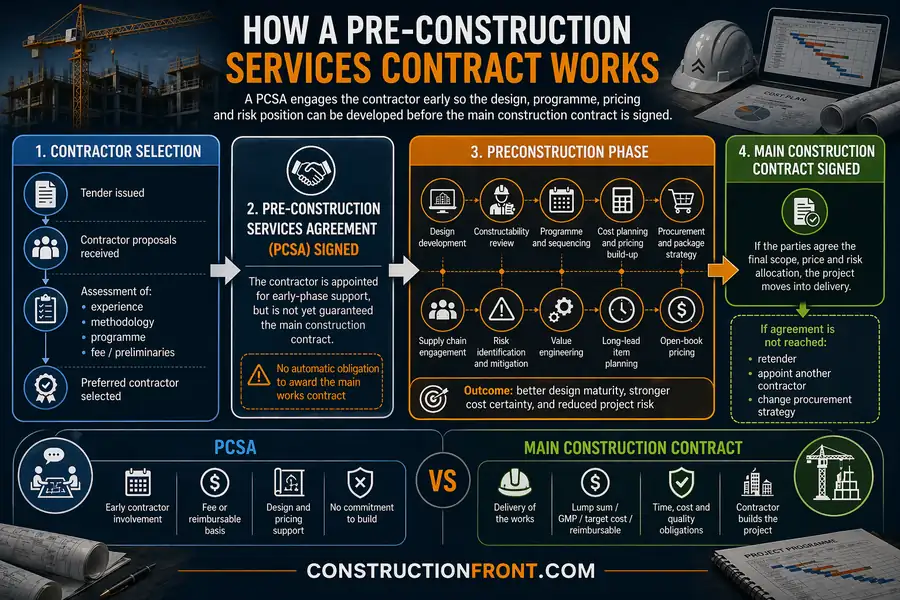
The sequence is usually straightforward. First, the client selects a contractor through a procurement process, often based on capability, methodology, team, and limited commercial inputs rather than final price alone.
In practice, clients will usually place significant weight on relevant experience and delivery track record. For example, if the project is a hospital, transport corridor, or energy facility, the client will often prefer a contractor with strong experience delivering similar assets and managing comparable programme, logistics, and interface risks.
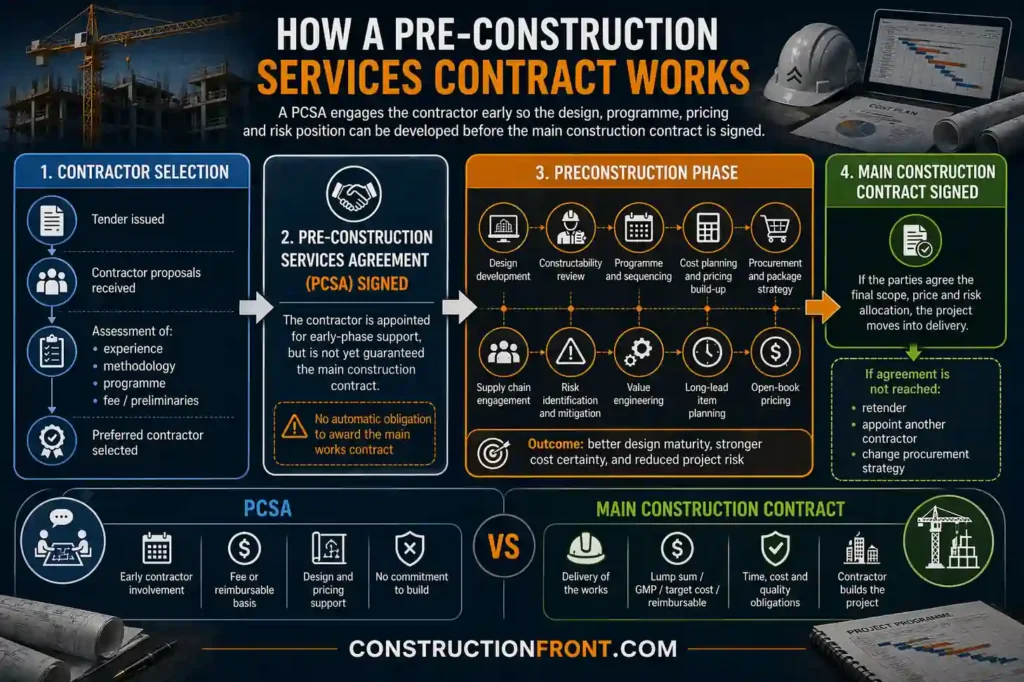
During the preconstruction phase, the contractor works with the client and consultant team to help develop the project. That often means contributing input on constructability, construction methodology, staging, packaging, procurement, pricing assumptions, supply chain engagement, temporary works, risk identification, and programme development before the final construction contract is agreed.
If that process is successful, the parties then execute the main construction contract. If it is not successful, the client may stop, retender, appoint another contractor, or change procurement direction. A simplified sequence looks like this:
| Phase | Main purpose | Typical outcome |
|---|---|---|
| Contractor selection | Choose the preferred contractor | Early appointment decision |
| Pre-construction services contract | Engage contractor for preconstruction services | Contractor starts early-phase support |
| Preconstruction phase | Develop design, pricing, programme, procurement, and risk position | Better-informed route to final contract |
| Main construction contract | Formalise delivery obligations | Contractor appointed to execute the construction works |
What does a pre-construction services contract usually cover?
The exact scope varies from project to project, but the contractor is commonly engaged to assist with matters such as:
- design development
- constructability reviews
- construction methodology
- programme and sequencing
- cost planning and pricing build-up
- procurement and packaging strategy
- supply chain engagement
- risk identification and mitigation
- value engineering
- long-lead item planning
- temporary works planning
- tender support for work packages
- gateway review or stage-gate support, including support for key project approvals or Final Investment Decision
In practice, the contractor is often paid under the PCSA on a cost-plus-fee or reimbursable basis, with the agreement setting out the fee structure, staff rates, recoverable costs, and any limits on expenditure during the preconstruction phase.
To produce a successful outcome for both parties, the agreement needs to be commercially clear from the start. At a high level, that usually means dealing clearly with matters such as scope of services, deliverables, design development responsibilities, intellectual property, confidentiality, pricing methodology, programme obligations, review procedures, and the process for moving into the main construction contract.
The 2023 MDPI study is useful here as supporting context. It does not focus on PCSAs as a legal form, but it does show that pre-construction activities benefiting from contractor involvement typically span design-related, cost-related, schedule-related, and administrative-related service groups.
Why do clients use a pre-construction services contract?
Clients usually use this kind of agreement where the project strategy requires earlier contractor input, but the client is not yet ready to move into full construction commitment. That is especially relevant where:
- the design is still developing
- the programme is tight
- package strategy needs work
- specialist trade input is needed early
- constructability could materially affect design decisions
- market volatility makes early pricing unreliable
- the client wants better cost and risk visibility before committing
This is where the broader procurement strategy matters. Some clients may prefer to transfer risk early through a model such as EPC or a more conventional fixed-price arrangement. Others may prefer more collaborative models that allow risk, scope, and methodology to be refined before the main contract is signed. A PCSA sits much closer to that second category.
The University of Canterbury research is useful here because it focuses on when pre-construction services should be engaged. In that study, schedule pressure was identified as the most important factor influencing the timing of engagement. That is a useful nuance. The point is not only that PCS can be helpful, but that time pressure often drives the decision to engage it earlier, before the design is fully complete.
What is the difference between a pre-construction services contract and the main construction contract?
A pre-construction services contract governs the contractor’s early-phase services before physical delivery of the full works. The main construction contract governs the actual execution of the project.
Under the pre-construction services contract, the contractor is usually being paid to advise, coordinate, review, estimate, plan, and help shape the final project position. Under the main construction contract, the contractor is responsible for delivering the agreed works, usually under a lump sum, target cost, reimbursable, or GMP structure.
| Issue | Pre-construction services contract | Main construction contract |
|---|---|---|
| Main purpose | Develop the project before full execution | Deliver the construction works |
| Timing | Before the main works contract | After commercial commitment |
| Typical services | Design input, pricing, planning, procurement strategy | Construction, procurement, commissioning, completion |
| Price basis | Usually a fee or reimbursable structure | Lump sum, target cost, GMP, reimbursable, or similar |
| Obligation to award main works | Typically no. | N/A. |
| Commercial focus | Risk review, scope development, programme and price formation | Delivery obligations, time, cost, quality, completion |
Is a pre-construction services contract the same as a PCSA?
Usually, yes. On many projects, “pre-construction services contract” and “pre-construction services agreement” mean the same thing. PCSA is simply the label most commonly used in the market. The more important question is not the name, but whether the document clearly defines:
- the services to be provided
- the fee and payment mechanism
- the programme and deliverables
- the information each party must provide
- the pricing and package review process
- open-book pricing requirements where applicable
- intellectual property and use of outputs
- confidentiality
- liability for the preconstruction services
- the route to the main works contract
- the off-ramp if final agreement is not reached
David Mosey’s book explains that conditional preconstruction phase agreements can play a valuable role in governing design development, package cost finalisation, risk management, and agreement of the construction phase programme before unconditional appointment under the main contract.
How does a pre-construction services contract fit within two-stage tendering?
This is one of the most common use cases. In two-stage tendering, the contractor is typically selected at Stage 1 based on capability, methodology, preliminaries, margins, and limited commercial inputs. The pre-construction services contract is then executed at the end of Stage 1. Stage 2 is the period in which the contractor performs the preconstruction services, helps refine the project, and works towards agreement of the final construction contract. So in a typical two-stage route:
- the client selects the preferred contractor
- the parties sign the pre-construction services contract
- the contractor performs the preconstruction services
- the parties negotiate and execute the main works contract if alignment is reached
How does it relate to ECI, D&C, CMaR, progressive design-build, and alliance contracting?
A pre-construction services contract is not a delivery model in its own right. It is better understood as an early-phase agreement that can sit inside different procurement routes.
It often supports early contractor involvement by giving the contractor a formal role before main construction works contract execution. It can sit within D&C procurement where the contractor helps shape the final design and price position before signing the D&C contract. It can also sit close to CMaR and progressive design-build, particularly where the contractor or design-builder is appointed early and the final commercial model is developed later.
It also sits in a very different place on the spectrum from alliance contracting. Under an alliance model, the commercial structure is usually built around shared risk and shared reward during project delivery. A PCSA does not do that by itself. Instead, it creates a structured early-phase arrangement that may lead to a later main contract, but without automatically committing the client to that outcome.
On large industrial and energy projects, similar commercial logic may also sit alongside FEED, pre-engineering, development partner, or other early-phase arrangements. The naming and legal structure may differ, but the objective is often similar: improve design maturity, reduce pricing uncertainty, and support a better-informed route to final commitment.
What Should a Good PCSA Include?
A good PCSA needs more than a broad description of early services. It should be drafted carefully so that both parties understand exactly what work is being performed, what outputs are required, how those outputs will be reviewed, and what happens if the project does not proceed into the main construction contract.
At a practical level, a strong agreement should usually address the following:
- a clear description of services
- named deliverables and deadlines
- a fee structure and payment terms
- assumptions and exclusions
- client information and review obligations
- programme and workshop requirements
- pricing methodology
- package tendering process
- open-book pricing rules where relevant
- risk workshops and risk register development
- ownership and permitted use of designs, estimates, and reports
- liability caps and professional responsibility
- confidentiality
- termination and off-ramp rights
- the process for moving to the main construction contract
Some provisions usually need especially careful drafting. From the client’s perspective, the agreement should make clear what deliverables must be produced, when they are due, what level of detail they must reach, and how they will be tested or accepted. That is important because many PCSAs fail not because the idea is wrong, but because the contractor’s obligations are described too loosely.
The client will also usually want strong drafting around intellectual property, ownership of reports, pricing models, design inputs, and other preconstruction outputs. The agreement should usually allow the client to retain and use those outputs if the contractor is not ultimately awarded the main works contract. Otherwise, the client may pay for valuable project development work without being free to rely on it later.
Pricing provisions also matter – PCSA is often strucutred on a cost-plus-fee or reimbursable basis and the contractor may carry relatively limited commercial risk compared with the eventual main works contract. That can reduce the contractor’s incentive to drive efficiency unless the agreement includes appropriate controls. Clients often protect their position through approval gates, capped budgets, milestone-linked deliverables, open-book review, agreed staff rates, audit rights, and clear rules around what costs are recoverable.
From the contractor’s perspective, the agreement should also clearly define the information to be provided by the client, the assumptions on which pricing and programming are based, the limits of the contractor’s preconstruction role, and the extent to which it may rely on third-party design or project data. Contractors do not want to be held responsible for incomplete design development, unrealistic programme assumptions, or pricing outcomes based on poor input information.
If the project is expected to proceed into a D&C, EPC, or similar delivery contract, the PCSA should also make clear how the outputs of the early phase feed into that later contract. In practice, that may mean identifying which assumptions, reports, programme logic, risk allocations, and package pricing exercises will later be used as reference points for the main contract negotiations.
What happens after the pre-construction services contract ends?
There are usually two broad outcomes:
- If the preconstruction phase is successful, the parties execute the main construction contract and the project moves into delivery. Depending on the project, that may later lead to a formal notice to proceed once project funding, approvals (e.g. Final Investment Decision), and contractual conditions are satisfied.
- If the phase is not successful, the client may stop, retender, appoint another contractor, or restructure the project. That is exactly why a well-structured PCSA matters. If the agreement does not clearly deal with ownership of preconstruction outputs, permitted use of pricing and design material, termination rights, confidentiality, and transition arrangements, the client may find itself commercially exposed at the point the relationship ends.
Where the project proceeds into the main works contract, assumptions and decisions made during the preconstruction phase must be properly recorded and articulated into the Construction Agreement, as they may later influence variation entitlement, notices, extension of time claims, and broader contract administration and construction claims issues if the project changes during delivery.
Final thoughts
A pre-construction services contract is best understood as part of a broader procurement strategy rather than just a preliminary document. It sits in the more collaborative end of the spectrum, where the client wants earlier contractor input before making a final commitment on delivery risk, pricing, and contract structure.
Used properly, it can improve constructability, programme logic, cost visibility, procurement planning, and risk allocation before the main contract is signed. But it only works well if the agreement clearly defines the services, deliverables, pricing process, and route forward. Otherwise, it can become an expensive holding arrangement without a clear outcome.
FAQ
What is a pre-construction services contract?
A pre-construction services contract is the agreement used to engage a contractor before the main construction contract is signed, so the contractor can provide early input on design, pricing, planning, procurement, and risk.
Is a pre-construction services contract the same as a PCSA?
Usually, yes. PCSA stands for pre-construction services agreement, which is the term most commonly used in practice for this kind of contract.
Does signing a PCSA mean the contractor will definitely get the main works?
No. In many PCSAs, the client is free to stop, retender, appoint another contractor, or change procurement route if the parties do not agree the final scope, price, or risk position.
What services are usually covered?
Typical services include constructability advice, design development support, pricing and estimating, programme development, procurement planning, risk workshops, value engineering, and supply chain engagement.
When should a client use one?
It is often useful where the project is complex, the design is still developing, or the client wants early contractor input before committing to the full construction contract.
Need Help?
Do not hesitate to contact us (click here) for specialised advice in the construction industry.
Sources
MDPI, “Exploring Pre-Construction Activities in Infrastructure Projects That Can Benefit from Contractor Involvement” https://www.mdpi.com/2075-5309/13/10/2569
University of Canterbury, “Factors That Determine When to Engage Pre-Construction Services” https://ir.canterbury.ac.nz/server/api/core/bitstreams/694599a8-d65b-4815-b21b-58f76c2c0f9a/content
David Mosey, Early Contractor Involvement in Building Procurement: Contracts, Partnering and Project Management – https://books.google.co.th/books?hl=en&lr=&id=icmwDJvQl7gC&oi=fnd&pg=PR5&dq=service+agreements+early+contractor+involvement&ots=oagwdxe-Hd&sig=HWuZ-eif0H2ZXS1_aAFWBBQrIeo&redir_esc=y#v=onepage&q&f=false
Construction Front, What is an ECI Contract?
Construction Front, How Two Stage Tendering Works? (And When to Use It)
Construction Front, Design and Construct (D&C) Contracts
Construction Front, Construction Manager at Risk (CMaR)
Construction Front, What Is Progressive Design-Build?
Construction Front, What Is a Guaranteed Maximum Price (GMP) in Construction?
Construction Front, What is an EPC Contract?
Construction Front, What is an Alliance Contract?
Construction Front, Front-end engineering design (FEED): What is It and How it Works?
Construction Front, What is a Notice to Proceed (NTP) in Construction Contracts?
Construction Front, What is a Variation Request?
Construction Front, What is a Time Bar Clause?
Construction Front, What is an Extension of Time Claim (EOT)?
Construction Front, Contract Administration and Construction Claims Explained