

Projects rarely move from award to handover without change. Quantities shift, access assumptions fail, interfaces move, design details develop, and site conditions expose the gap between tender assumptions and delivery reality.
Under FIDIC contracts, those changes must be administered carefully. A FIDIC variation is not just a technical change to the Works. It is a contract event that must be instructed, valued, recorded, and managed in a way that protects price, time, and entitlement.
What Is a FIDIC Variation?
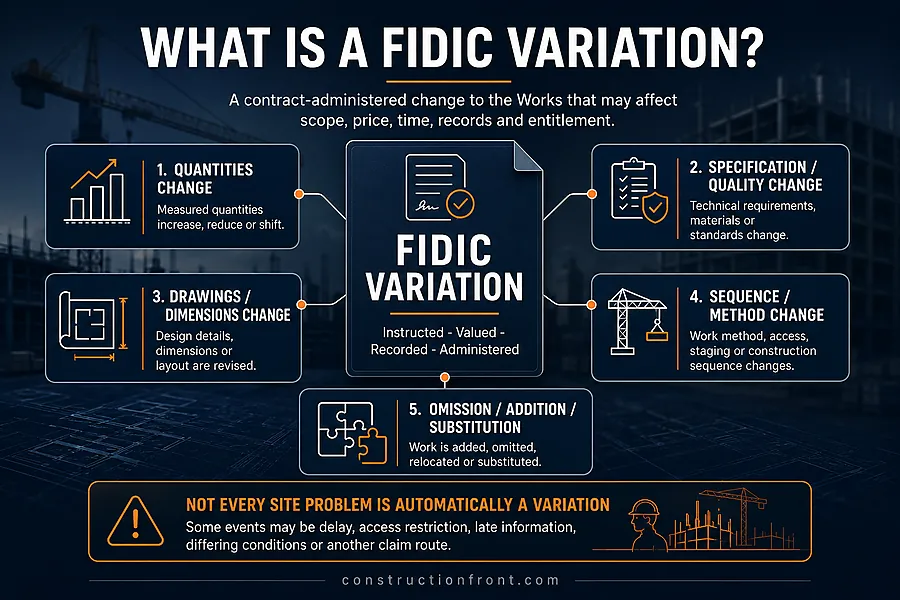
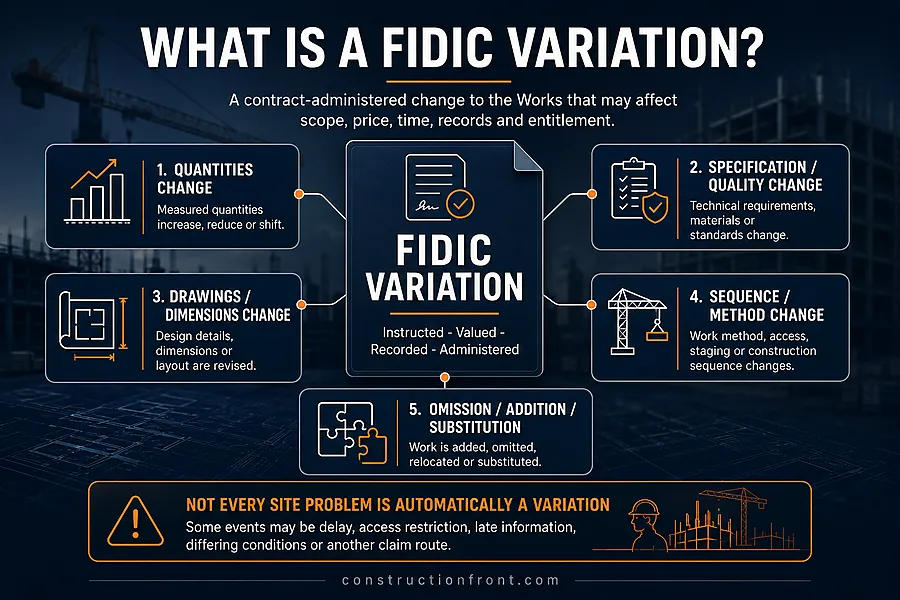
A FIDIC variation is a contract-administered change to the Works, commonly managed under Clause 13 through the Engineer’s instruction powers and the Variation Procedure.
FIDIC’s descriptions of the 1999 Red Book and 2017 Red Book both place the form in the context of building and engineering works designed by the Employer. That is one reason variation control matters so much in practice: the Contractor is delivering an Employer-led design that often develops during execution.
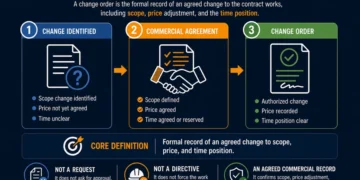
Although many project teams refer to a “Variation Order” in practice, FIDIC generally administers changes through Variations, Engineer’s instructions, and the Variation Procedure rather than relying on domestic change-order terminology.
In Red Book practice, the variation mechanism is commonly associated with Clause 13, including the Engineer’s power to instruct or initiate Variations and the procedure for dealing with their valuation and consequences. However, the exact wording, numbering, and effect should always be checked against the specific FIDIC edition and Particular Conditions.
In plain English, a FIDIC variation will often involve:
- a change to quantities
- a change to quality or specification
- a change to drawings or dimensions
- a change to sequence or method that the contract treats as a formal change
- omission, addition, substitution, or relocation of work
- instructed work required because of coordination or design development
That does not mean every site problem is automatically a variation. Some events are better analysed as delay, access restriction, late information, differing conditions, suspension, or another breach-related issue.
Weak administration can create avoidable exposure on both sides. A weak instruction trail can turn a genuine change into a costly dispute. A late notice can weaken, reduce, or in some cases bar recovery for associated delay or prolongation, depending on the contract wording, governing law, and project circumstances. Amended Particular Conditions can make the position harder again, especially where standard FIDIC procedures have been tightened, shortened, or reallocated.
FIDIC Variation (Clause 13) vs Contractor’s Claim (Clause 20)
A FIDIC variation and a contractor’s claim are related, but they are not the same thing. In simple terms, Clause 13 is usually the starting point for the changed work itself, while Clause 20 / Clause 20.2 is typically the starting point for the Contractor’s claim procedure where additional payment, EOT, or other contractual entitlement must be preserved.
The variation creates the contractual route for defining and valuing the changed work itself. A claim may still be required to recover the wider time and cost consequences flowing from that change, especially where productivity loss, resequencing, disruption, prolongation, or critical-path effects go beyond the direct value of the varied work.
In practice, this distinction matters because a project may agree that work was varied but still dispute whether the same event supports additional time, disruption-related cost, or prolongation recovery. For this reason teams should not assume that progress on valuation automatically protects the broader commercial position.
This is also why disciplined contract administration matters on FIDIC jobs. A team can be commercially right on the facts and still under-recover if the variation file and the wider claim file are not aligned.

FIDIC Engineer Role and Red Book Engineer Powers
The FIDIC Engineer sits at the centre of variation administration. On most FIDIC construction projects, the Engineer controls a large part of the contract machinery around instructions, review, certification, and first-instance determinations that shape commercial outcomes.
In practice, FIDIC Red Book Engineer powers matter most when change has to move quickly but still needs to remain contract-compliant. Toby Shnookal notes that under the 1999 FIDIC forms the Engineer is deemed to act for the Employer, while still being required, when making a determination, to consult both parties and make a fair determination under the contract (Shnookal).
That is the practical balance to keep in mind. The Engineer is not an independent adjudicator in the broad sense, but nor is the Engineer free to administer changes as if contractual procedure and even-handed determination do not matter.
In practical variation administration, the Engineer’s role usually includes:
- issuing instructions within contractual authority
- requesting proposals, pricing, method statements, or programme input
- deciding whether a matter is being dealt with as a variation under the contract machinery
- assessing valuation support against the contractual basis
- considering whether the instructed change has time consequences that need to be addressed under the contract
- making determinations where agreement is not reached
That role has real limits. The Engineer can instruct and administer changes through the contract machinery, but that does not mean every informal comment, sketch, workshop note, or site discussion automatically becomes a valid FIDIC Engineer instruction. Nor does it mean an instruction settles all downstream entitlement automatically. Authority, valuation, notice compliance, time consequences, and proof still matter.
That distinction matters for both sides. Contractors should not assume any Employer-side communication is enough to secure entitlement. Employers and Engineers should not assume that telling the Contractor to proceed resolves valuation and EOT exposure.
If the instruction path is unclear, the project often ends up arguing later about whether there was a valid instruction, what work was actually changed, whether the change sat within the Engineer’s authority, and what consequences properly flow from it.
FIDIC Right to Vary
The FIDIC right to vary is one of the core Employer-side control mechanisms built into the contract, usually exercised through the Engineer rather than by informal direction from the wider project team.
In practical FIDIC Red Book terms, it gives the Employer controlled flexibility to change the Works without renegotiating the whole contract whenever design development, coordination, or delivery conditions require movement.
That right is commercially necessary – Major projects rarely proceed exactly as tendered. FIDIC recognised that long ago, and the 2017 suite launch note explains that the second editions were expanded to provide greater clarity, transparency, and certainty through more prescriptive step-by-step procedures.
That matters directly to variations because the FIDIC variation procedure is not intended to be casual. It is intended to push change through a defined administrative path. But the right to vary is not unlimited in practical effect. Contractors and Employers should test three questions each time:
- Was the instruction issued through proper contractual authority?
- Does the event actually fall within the contract’s variation machinery, rather than some other entitlement route?
- What price and time consequences flow from it, and what procedure is needed to preserve them?
Those questions are important because many disputes do not start with denial that a change occurred. They start with disagreement about authority, scope classification, valuation basis, timing of notices, or whether the change caused wider delay and disruption beyond the direct varied work. At project level, this is where a disciplined variation request process helps frame the issue early, even before the full consequences are known.
FIDIC Variation Procedure and Variation Order Administration
The FIDIC variation procedure – commonly administered through Clause 13 in Red Book practice – is where otherwise valid entitlement is often weakened if instructions, valuation, notices, and records are not managed properly.
The contract framework is procedural by design. The 2017 FIDIC update was expressly intended to create more detailed step-by-step requirements, and that philosophy matters directly for variations, notices, determinations, and linked claims.
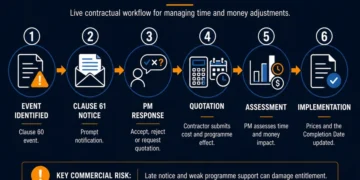
A practical FIDIC variation workflow usually looks like this:
- A change need arises.
- The Engineer issues an instruction or seeks a proposal.
- The Contractor reviews whether the change affects scope, cost, time, sequence, resources, or productivity.
- The Contractor gives any required notices promptly.
- The Contractor submits pricing, method, and programme impact information.
- The Engineer reviews, discusses, and values the changed work.
- If time consequences exist, the Contractor separately preserves delay and EOT entitlement.
- The parties either agree the adjustment or move into determination territory.
That sequence matters because an instructed variation and the associated claim consequences often run on parallel but distinct tracks. One track deals with the changed work itself: what was instructed, whether it falls within the variation mechanism, and how it should be valued.
The other deals with the consequences flowing from the change: delay to completion, resequencing, disruption, prolongation, reduced productivity, and the evidence needed to support EOT and associated cost recovery. The table below is a practical way to keep those two tracks separate while the event is still live.
| Question | Variation valuation | Claim for wider time / cost consequences |
|---|---|---|
| What are you dealing with? | The changed work itself: what was instructed, added, omitted, substituted, or revised. | The wider consequences of that change: delay, disruption, resequencing, reduced productivity, prolongation, or added management effort. |
| Main commercial question | How should the varied work be valued under the contract? | Did the variation also cause time and cost consequences that need separate recovery support? |
| Typical supporting records | Instructions, revised drawings, quantities, rates, quotations, marked-up scope changes, and pricing build-up. | Notices, programme updates, labour and plant records, disruption evidence, chronology, and causation analysis. |
| Typical recovery | Payment for the changed work itself. | EOT, prolongation, disruption-related cost, or other wider claim consequences. |
| Common mistake | Assuming that pricing the varied work fully resolves the commercial position. | Trying to recover delay or disruption later without timely notices, proper records, or a clear programme link. |
A project can agree that work was varied but still dispute whether the change delayed completion. A Contractor may secure payment for additional quantities yet fail on EOT because the programme linkage, notice position, or records are weak. That is why teams should not assume that progress on valuation automatically protects time entitlement.
- If the site team starts work without tying the instruction back to contract authority, the later argument becomes whether there was a proper FIDIC variation order at all.
- If the Contractor prices only the direct work and ignores disruption or resequencing, the valuation may understate the real impact.
- If the Contractor does not connect the varied work to programme effect, later EOT arguments become much harder. If notices are late, the commercial position weakens quickly.
Shnookal treats FIDIC notice provisions as commercially serious. Purba and Prastowo likewise identify claims, payment, and disputes as recurring FIDIC construction risks, and their literature review notes the 28-day notice position under FIDIC 1999 for delay claims (Purba & Prastowo).
In practical terms, failure to comply with strict notice provisions may affect or bar recovery in the relevant circumstances.
That is why Contractors should not treat a variation as “priced work only.” If a variation changes sequence, access, workface availability, procurement timing, testing logic, or critical-path activities, the Contractor should immediately test whether a separate delay route is engaged.
That often means linking variation management to notice of delay discipline and, where needed, a detailed delay analysis. It also helps to keep the drafting standard of a clear variation order in mind, even where the contract calls the step an Engineer’s instruction rather than a domestic change form.
Practical checklist for administering a FIDIC variation
Use this as a live control list when an instruction lands:
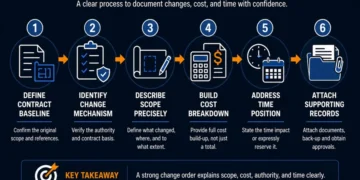
- Confirm who issued the instruction and under what contractual authority.
- Record exactly what changed from the baseline scope, drawings, quantities, sequence, or method.
- Identify whether the issue is only a variation valuation issue or also a time and claims issue.
- Decide whether work must proceed immediately or whether clarification is needed first.
- Issue notice early if there is any risk to cost, time, productivity, access, or completion.
- Separate direct varied work costs from disruption, inefficiency, and prolongation effects.
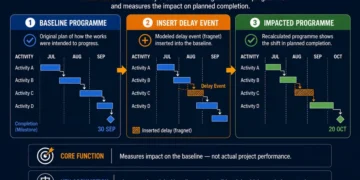
- Map the change against the current programme and identify critical or near-critical impacts.
- Preserve contemporaneous records: labour, plant, quantities, instructions, revisions, photographs, daily reports, and correspondence.
- Submit pricing and programme support in the format the contract and project administration actually require.
- Track whether agreement has been reached on valuation, on time consequences, or on neither.
- Update the variation register and claims register so no instruction disappears into site correspondence.
- Check whether the Variation instruction triggers a separate claim notice, delay notice, EOT procedure, or further particulars requirement.
- Identify whether Clause 13, Clause 20 / 20.2, or both are engaged
A Contractor already using a disciplined Contract Administration framework will usually outperform a team that relies on email trails and retrospective reconstruction.
That is the real danger on FIDIC jobs: once instructions, notices, and records have drifted, the argument is no longer just about value, but about whether entitlement can still be proved at all.
Practical Commercial Risks of FIDIC Variations and Related Claims
Weak variation and claim administration creates more than paperwork problems. It creates real commercial exposure.
- First, there is valuation risk. If the pricing basis is not locked down, the Contractor may end up paid on a narrow direct-cost basis when the real impact included resequencing, additional supervision, out-of-hours working, temporary works changes, or trade stacking. Many teams recognise the changed work but fail to frame the downstream time, disruption, or prolongation consequences as a separate claim issue where required under the Contract.
- Second, there is entitlement risk. Contractors can weaken, reduce, or lose entitlement depending on the contract wording, governing law, and project circumstances. A variation may be accepted in principle, but the related claim for time-related or disruption-related consequences may still fail because notices, records, or causation analysis were weak. In practice, that is why the variation file should sit alongside a live notice and delay strategy rather than being treated as a separate administrative stream.
- Third, there is delay risk. A changed scope item can affect logic, access, procurement, approvals, hold points, or testing. If that effect is not tracked early, the Contractor may lose the ability to prove the path from instruction to delay consequence and later struggle to recover prolongation costs.
- Fourth, there is amendment risk. Research comparing standard forms and customised conditions has highlighted how amendments can materially affect the administration of variations, claims, disputes, and entitlement routes (Al-Sabah and Al-enezi). In practice, that is a warning not to assume that “standard FIDIC” applies simply because the contract is labelled Red Book.
- Fifth, there is dispute risk. Abraham and Alvarenga’s analysis of international FIDIC contracting points to recurring pitfalls around risk allocation, delay, proving entitlement, changed conditions, and dispute resolution (Abraham and Alvarenga). Variations sit in the middle of all of those issues.
The commercial point is blunt: a project can be right on the facts and still lose money on administration.
The dispute involved alleged variations including roadway pipe laying, disposal of unsuitable excavated material, imported backfill, and night work. One of the clearest commercial takeaways is how exposed a contractor can become when changed work is later argued without a strong contemporaneous instruction trail, clear records, and disciplined procedural compliance.
By the time a project is trying to reconstruct whether work was properly instructed, how it should be valued, and whether entitlement was preserved, the commercial position is usually already much weaker.
Practical Example: FIDIC Red Book Variation on a Live Project
A Contractor on a wastewater treatment project under a FIDIC Red Book variation regime is instructed by the Engineer to revise a buried pipe route after clashes with existing utilities and access constraints around an operating facility become clear during delivery.
The direct change looks manageable. The new route adds 180 metres of pipe, extra excavation support, additional fittings, and revised temporary works. The site team’s first instinct is to build up quantities and discuss rates.
But the real impact is wider:
- the revised route moves work into a restricted operating zone
- the Contractor loses planned trenching productivity
- temporary works require redesign and approval
- two specialist crews are resequenced
- testing moves by three weeks
- a follow-on structure package loses access to part of the workface
If the Contractor treats this only as a measured-value variation, it may recover the extra pipe and excavation but miss the wider commercial account. The stronger response is broader:
- secure the instruction trail and confirm authority
- issue timely notices on both variation and time-risk consequences
- submit the changed-work valuation
- identify programme consequences against the accepted programme
- preserve labour and plant records by area and activity
- assess whether EOT and prolongation routes are triggered
- separate direct variation value from secondary disruption and delay effects
That is the difference between pricing the changed work and protecting the entitlement created by the changed work.
How Contractors Protect FIDIC Variation Entitlement
Contractors protect variation entitlement by assuming from day one that every material change may later need to be proved to someone who was not on site when it happened.
That means five disciplines matter most:
- First, instruction discipline. Do not rely on informal direction if the contract requires something more formal. Where urgency forces immediate action, confirm the instruction in writing, identify who gave it, and tie it back to the contract machinery as quickly as possible.
- Second, notice discipline. Purba and Prastowo’s review reinforces how central time bars and notices are in FIDIC administration. Contractors should work on the assumption that if notice timing is arguable, entitlement is already exposed.
- Third, records discipline. Daily records should be variation-ready, not just progress-ready. Cost codes, location tagging, labour allocation, plant usage, revised drawings, instructions, and affected programme activities all matter.
- Fourth, valuation discipline. Do not let the whole account collapse into one blended number. Split direct work, changed quantities, new rates, resource effects, inefficiency, disruption, and time-related impacts so each head of recovery can be tested and supported properly. Where delay-related cost begins to build, the file should be structured to support later recovery of prolongation costs.
- Fifth, linkage discipline. If the varied work affects completion, the variation file must connect with the broader construction claims and contract administration file. Otherwise, the project ends up with one team pricing the change and another team trying too late to reconstruct delay and EOT entitlement.
A practical rule works well: if a change affects scope, test immediately whether it also affects sequence, productivity, access, approvals, procurement, or completion.
Different Perspectives on FIDIC Variations
For Contractors
Your biggest risk is assuming that because the work changed, payment and time relief will follow automatically. They usually do not.
Focus on these points:
- get the instruction and authority position clear
- issue the relevant notices before the debate hardens
- assess valuation and EOT consequences in parallel, supported by appropriate programme / detailed delay analysis, but do not treat them as the same exercise
- track programme impact against the actual accepted programme, not a retrospective narrative
- keep records by activity, area, and period so causation can be shown
- read amended Particular Conditions carefully before assuming standard FIDIC timing or procedure applies
- escalate unclear direction before the record trail becomes irreversible
If you need a field-ready drafting approach, the logic behind how to write a variation order is useful even where the formal contract language is FIDIC rather than domestic change-order terminology. It also helps to keep the team aligned on the practical difference between a FIDIC instruction and the broader concept of what a variation order is.
For Engineers and Employers
Your biggest risk is treating variation administration as a site convenience issue rather than a contract-governance issue.
Focus on these points:
- issue clear instructions through the proper authority channel
- avoid mixed informal and formal direction that blurs what was actually instructed
- distinguish between valuing changed work and assessing claimed time consequences
- require structured pricing, records, and time impact support while decisions can still be made in real time
- keep the variation and claims registers live and auditable
- make determinations promptly and on a contract-based footing where agreement is not reached
- understand that poor administration increases downstream dispute cost even where the Employer has a strong merits position
A practical cross-check is to ask whether the project is merely pushing work forward or actually administering a controlled contract change. That is the same discipline that sits behind a construction change directive or a conventional change order system, even though the FIDIC mechanics are different.
Well-run variation administration is not contractor-friendly or employer-friendly. It is project-friendly. It protects pricing credibility, improves decision-making, and reduces avoidable disputes before positions harden.
Final Point
A FIDIC variation is never just a technical change. It is a controlled contract event that can affect price, time, risk, and dispute exposure at the same time. The Engineer’s role is central, but it operates within contractual authority and procedural limits.
The right to vary is real, but it does not remove the need to prove valuation, time impact, notice compliance, and proper administration. The practical lesson is simple: when change happens, do not wait for the final account to explain what the project already knew in real time.
Lock down the instruction, protect the notice position, value the changed work properly, test the time consequences early, and keep records that can survive scrutiny. On FIDIC projects, that is how contractors protect entitlement and employers protect their wider commercial position.

FAQ on FIDIC Variations
Is every instructed change a FIDIC variation?
Not necessarily. Some instructed events are genuine variations. Others may be better analysed as suspension, access restriction, late information, or another claim event. The label matters less than putting the event through the correct contractual route.
Can a Contractor recover both variation value and delay-related compensation?
Potentially yes, if the facts, records, notices, and contract support it. The direct value of the varied work and the time-related consequences of that work are related, but they are not automatically the same entitlement stream.
Does the Engineer decide everything finally?
No. The Engineer plays a central first-instance role in instruction, certification, and determination, but that does not make the Engineer the final forum for every dispute. If matters are not resolved, they can move beyond the Engineer under the contract’s dispute mechanisms.
Why is the FIDIC variation procedure so important?
Because FIDIC administration is deliberately procedural. Rights that look obvious in the field can fail later if authority, notices, records, valuation support, and programme linkage are not handled properly.
Do amended Particular Conditions matter that much?
Yes. Standard FIDIC logic can be materially changed by project amendments. On many international projects, that is where major entitlement traps sit.
Is Clause 13 enough to protect all FIDIC variation entitlement?
Not always. Clause 13 is usually the main route for administering the Variation itself, but wider time, cost, disruption, prolongation, or EOT consequences may need to be notified and substantiated under Clause 20 / Clause 20.2 or other applicable provisions. The exact position depends on the FIDIC edition, Particular Conditions, governing law, and project facts.
Sources and Further Reading
- FIDIC, Construction Contract 1st Ed (1999 Red Book)
- FIDIC, Construction Contract 2nd Ed (2017 Red Book, Reprinted 2022 with Amendments)
- FIDIC, Official Launch of the 2017 FIDIC Suite of Contracts
- Toby Shnookal, FIDIC Claims and Claim Procedure
- Purba and Prastowo, Study of Claim Risk Management on FIDIC-Based Contract
- Ruqaya S. Al-Sabah and Sarah S. Al-enezi, Reducing contract disputes: A comparative analysis of FIDIC and GCC standard general conditions of contract for construction projects
- Wilfred Abraham and Maria Isabel De Almeida Alvarenga, FIDIC: An Analysis of International Construction Contracts
- Judicial Committee of the Privy Council, Uniform Building Contractors Ltd v The Water and Sewerage Authority of Trinidad and Tobago [2026] UKPC 2
- Construction Front, Change Order in Construction: Meaning, Process, Pricing, Types, and Common Risks
- Construction Front, What is a Variation Order? (With Templates and Examples)
- Construction Front, What is a Variation Request? (And How to Submit one!)
- Construction Front, Construction Change Directive (CCD): What It Is, Contractor Rights, Process, and Entitlement Protection
- Construction Front, Notice of Delay: What is it? How to Draft one?
- Construction Front, Time Impact Analysis (TIA) in Construction: What It Is, How It Works, and When to Use It
- Construction Front, How to Write a Variation Order: Template, Key Clauses, and Common Mistakes
- Construction Front, Contractor Variation Request Process: Step-by-Step Guide to Preserving Entitlement
- Construction Front, Contract Administration and Construction Claims Explained
- Construction Front, Prolongation Costs and Claims in Construction Contracts
Disclaimer: The articles on this website are for informational and educational purposes only and do not constitute legal or technical advice. While we strive to provide accurate and up-to-date information on construction law, regulations may vary by jurisdiction, and legal interpretations can change over time.