

Delays are rarely just scheduling problems. On a live project, the delay analysis method you choose can affect entitlement, causation, concurrency arguments, extension of time strategy, and whether a claim stands up once the records come under scrutiny.
Construction delay analysis methods are the structured approaches used to assess how delay events affected the programme, whether completion actually moved, and which party carried the risk. The right method depends on timing, record quality, programme quality, and the commercial question the parties are trying to answer.
That is why there is no single “best” method for every project. A method that is useful for an early internal assessment may be too weak for adjudication or arbitration. A method that looks rigorous on paper may still fail if the baseline, update programmes, or site records are weak.
This guide explains the main delay analysis methods used in construction, how each one works, when each method is most useful, and where each one tends to break down in practice.
What are the main delay analysis methods?
The four methods most commonly discussed in construction claims and programme analysis are:
- As-planned vs as-built analysis
- Impacted as planned analysis
- Window analysis method
- Time impact analysis
These methods are not interchangeable. Each answers a slightly different question, uses different records, and carries different strengths and weaknesses. The table below summarises each method features.
| Method | Core input | What it tests | Strength | Weakness | Use case |
|---|---|---|---|---|---|
| Impacted as planned | Baseline programme | Modeled delay impact on completion | Simple and relatively low-cost | Ignores actual progress | Early-stage screening |
| Time impact analysis | Updated programme | Delay effect at time of event | Reflects live project status | Needs reliable updates | Live EOT assessment |
| Window analysis | Programme updates | Critical path shifts over time | Captures concurrency and shifting criticality | Resource-intensive | Dispute analysis |
| As-planned vs as-built | Baseline vs actual | Overall variance between plan and delivery | Strong high-level comparison | Limited causation insight if used alone | Retrospective review |
How to Choose the Right Delay Analysis Method
Each approach has its strengths and weaknesses, and, in practice, method choice usually turns on five questions:
- Are you analysing the project early, while it is still live, or retrospectively after major progress has already occurred?
- Do you have a reliable accepted baseline only, or do you also have reliable update programmes and progress records?
- Is the key issue a single event, a broad project history, or overlapping delay and concurrency?
- Are you testing exposure internally, preparing a claim, resisting one, or heading toward expert review?
- Has the project logic stayed broadly consistent, or has the driving path changed materially?
If the records are thin, the method options narrow quickly. If the dispute is mature and concurrency is central, the more simplistic methods often stop being good enough.

Delay Analysis Method #1: As-Planned vs As-Built Analysis
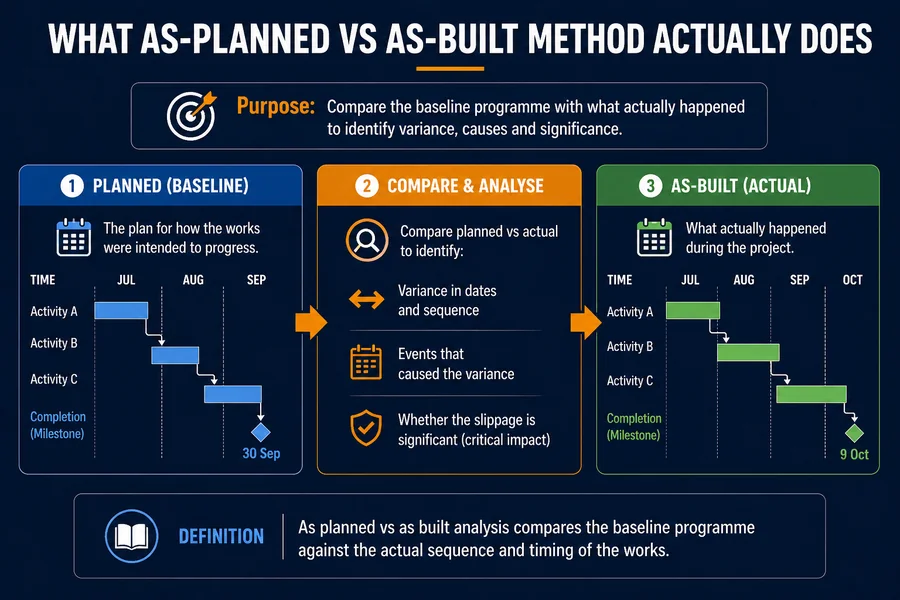
As-planned vs as-built analysis compares the original planned programme with what actually happened on the project. The purpose is to identify where actual delivery diverged from the baseline and what that says about delay, disruption, and responsibility.
This method is useful when the parties need a broad retrospective view of project performance. It helps show whether the works followed the intended sequence, where slippage occurred, and whether major changes or events altered the delivery path.
To do it properly, the analyst usually needs:
- the baseline programme
- site progress records
- progress photos or time-lapse records
- instructions, directions, and correspondence
- variation and change records
- contemporaneous delivery evidence
Its main strength is simplicity. It is often easier to explain to project teams, commercial managers, and tribunals than more technical modelling approaches. Its main weakness is that it can become too high-level if it is used to prove detailed causation without enough supporting analysis.
For detailed information on As-planned vs as-built analysis, read the following article: As-Planned vs As-Built Analysis in Construction: How the Method Works and When to Use It
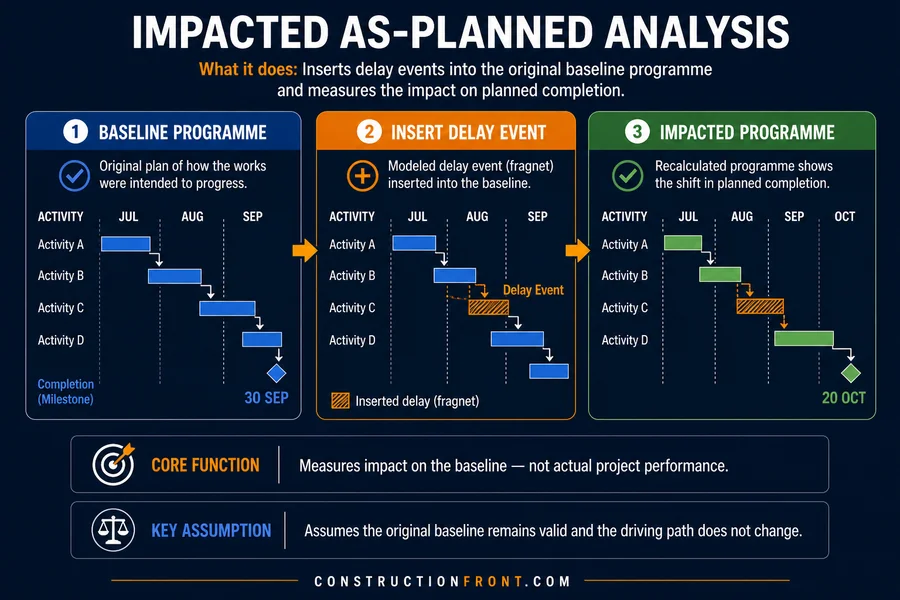
Delay Analysis Method #2: Impacted As Planned
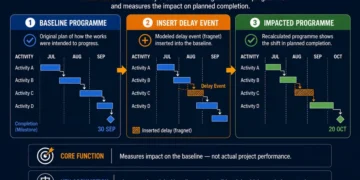
Impacted as planned analysis inserts delay events into the original baseline programme and measures how much the planned completion date moves. It is a modeled, additive method rather than an analysis of what actually happened on site.
This method is usually most useful where:
- the event arose early
- actual progress had not yet materially diverged from plan
- the baseline remained a credible model
- the team needs a quick provisional view of time effect
It is less reliable once the project has moved away from the original planned path. If progress changed, logic shifted, mitigation occurred, or concurrent delay emerged, the method can overstate or understate entitlement.
If you want a deeper breakdown, see our full guide to impacted as planned analysis – Impacted As Planned Analysis: What It Is, How It Works, and When It Fails in Construction Claims.
Delay Analysis Method #3: Window Analysis
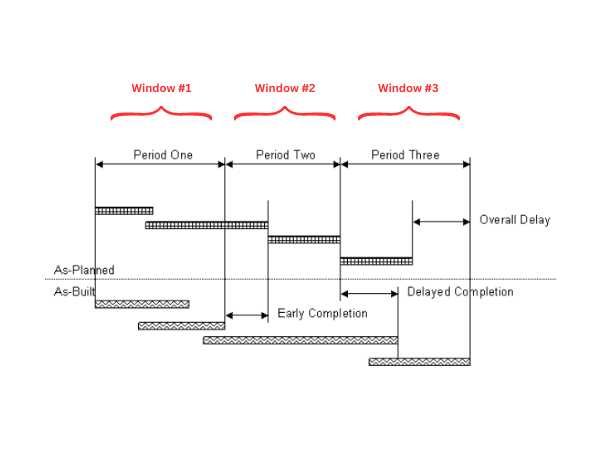
The window analysis method breaks the project into defined time periods and examines what was driving delay in each window. It is particularly useful where delay responsibility changed over time or where multiple events overlapped.
This method is commonly used in more mature disputes because it is better suited to:
- changing critical path logic
- overlapping employer-risk and contractor-risk delays
- sequential programme updates
- concurrency analysis
- retrospective expert review
Its strength is that it is more grounded in actual progress than baseline-only methods. Its weakness is that it depends on a stronger project record and takes more time and effort to perform properly.
For detailed information on window analysis, visit the following: What is the Window Analysis Method? (And When to Use It)
Delay Analysis Method #4: Time Impact Analysis
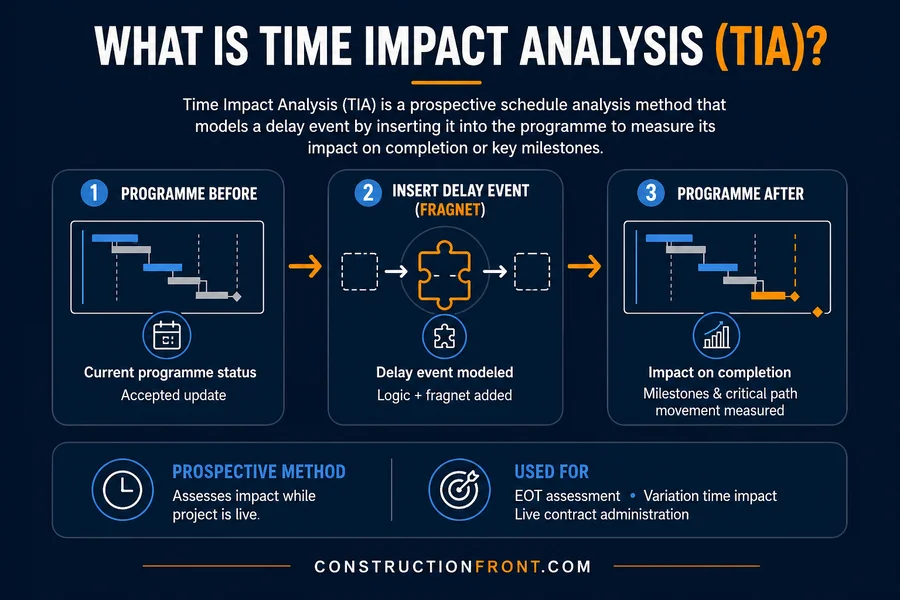
Time impact analysis tests the effect of a delay event by inserting it into a contemporaneous or updated accepted programme. In practice, it is often one of the more defensible methods where the project maintained reliable updates and the issue is whether a particular event changed completion.
This method is especially useful where:
- the project is still live or recently completed
- accepted update programmes exist
- the event can be tied to a defined point in time
- the parties need a stronger EOT position than a purely baseline-based method can provide
Its strength is that it reflects the project status closer to the time the event arose. Its weakness is that it depends heavily on programme quality. If the updates are poor, rejected, or do not reflect reality, the analysis weakens quickly.
This guide Time Impact Analysis (TIA) in Construction: What It Is, How It Works, and When to Use It details the TIA approach thoroughly.
Which Delay Analysis Method Is Best?
There is no universal “best” delay analysis method. The better question is which method best fits the records, timing, and dispute issue.
A simple rule of thumb is:
- use time impact analysis where you have strong contemporaneous programme updates and need to assess a defined event
- use window analysis where the project history is complex and criticality changed over time
- use impacted as planned only where the baseline still reflects the job and the event arose early
- use as-planned vs as-built analysis where you need a broad retrospective comparison between plan and actual performance
That choice should always sit alongside the broader claims and contract administration strategy, not outside it.
Common Mistakes When Choosing a Delay Analysis Method
The most common mistakes are not technical. They are commercial and administrative.
- Choosing the method before testing whether the records can actually support it.
- Using impacted as planned on a project where logic and progress had already changed materially.
- Treating a broad as-planned vs as-built comparison as if it proves detailed causation by itself.
- Ignoring concurrency and assuming one delay event can be assessed in isolation.
- Running a time impact analysis on weak or unrealistic update programmes.
- Treating method choice as a programming issue instead of an entitlement and risk-allocation issue.
These mistakes often weaken both claim presentation and claim defensibility.
Contractor’s perspective on Delay Analysis
For contractors, the wrong delay analysis method can narrow recovery, weaken credibility, and make it harder to support an extension of time claim. A method that ignores resequencing, mitigation, or actual progress may look attractive early, but it can become a liability once the employer’s review becomes more detailed.
Contractors should usually focus first on record quality, update discipline, and preserving a proper notice of delay position. Method choice should follow the records, not replace them.
Owners’ perspective on Delay Analysis
For owners and clients, the method matters just as much. A weak method can over-credit employer-risk events, distort concurrency analysis, and lead to avoidable EOT awards or poor rejection decisions.
Client-side teams should test whether the contractor’s chosen method matches the state of the project record, the timing of the event, and the actual path to completion. If it does not, the method itself may be one of the strongest points of challenge.
FAQ
What are the main delay analysis methods in construction?
The main methods commonly used are as-planned vs as-built analysis, impacted as planned, window analysis, and time impact analysis.
What is the best delay analysis method for concurrent delay?
Often the window analysis method is better suited where overlapping delay and changing criticality are central issues. That said, the best method still depends on the available records and the actual dispute question.
When is impacted as planned analysis useful?
Usually only where the event arose early and the baseline still reflected the project realistically. Once progress and logic have materially changed, it becomes much less reliable.
Is time impact analysis better than as-planned vs as-built?
Not automatically. Time impact analysis is often stronger for assessing a defined event against a contemporaneous programme, while as-planned vs as-built analysis is often more useful for broad retrospective comparison. They answer different questions.
Why does method choice matter in claims?
Because method choice can affect causation, entitlement, concurrency treatment, EOT outcome, and the overall credibility of the claim or defence.
Conclusion
Delay analysis methods are not just technical schedule tools. They are part of how construction teams test causation, allocate responsibility, and defend or resist time entitlement.
The right method depends on the state of the records, the maturity of the dispute, and what question the analysis needs to answer. If the project is live and well-documented, time impact analysis may be the better route.
If the dispute is mature and the critical path moved over time, the window analysis method may be more defensible. If the baseline no longer reflects the job, impacted as planned will often be too weak on its own.

Sources
- Construction Front, As-Planned vs As-Built Analysis in Construction: How the Method Works and When to Use It
- Construction Front, Time Impact Analysis (TIA) in Construction: What It Is, How It Works, and When to Use It
- Construction Front, What is the Window Analysis Method? (And When to Use It)
- Construction Front, Construction Claims and Contract Administration
- Construction Front, What Is an Extension of Time Claim?
- Construction Front, Notice of Delay
- Construction Front, Concurrent Delay
- Construction Front, Variation Order Template / Variation Management Toolkit
Disclaimer: The articles on this website are for informational and educational purposes only and do not constitute legal or technical advice. While we strive to provide accurate and up-to-date information on construction law, regulations may vary by jurisdiction, and legal interpretations can change over time.