


In the world of construction projects, timely completion is of utmost importance. However, unforeseen circumstances often arise, leading to delays that can significantly impact project schedules and budgets.
Delays can occur as consequence of adverse weather conditions, design changes, unknown site conditions (i.e. soil contamination, geological conditions, etc.), material, equipment and/or labor shortage, and many other factors.
An Extension of Time (EoT) claim is a formal request initiated by one party, typically the contractor or builder, to the other party (client/ principal/employer), which aims to secure an extension for the specific dates outlined in the contract, including project milestones’ dates, substantial completion dates, completion dates, etc.
The grounds of EOT claims are usually underpinned by an excusable delay, which is events or circumstances beyond the control of the party responsible for the delay. For example, a contractor may attribute its delay to a client that did not provide site access as agreed under the construction agreement.
This blog post aims to shed light on the concept of EoT claims, their legal and contractual aspects, and the importance of accurately dealing with delays in engineering projects.
What is a Extension of Time (EOT) claim under a construciton contract?
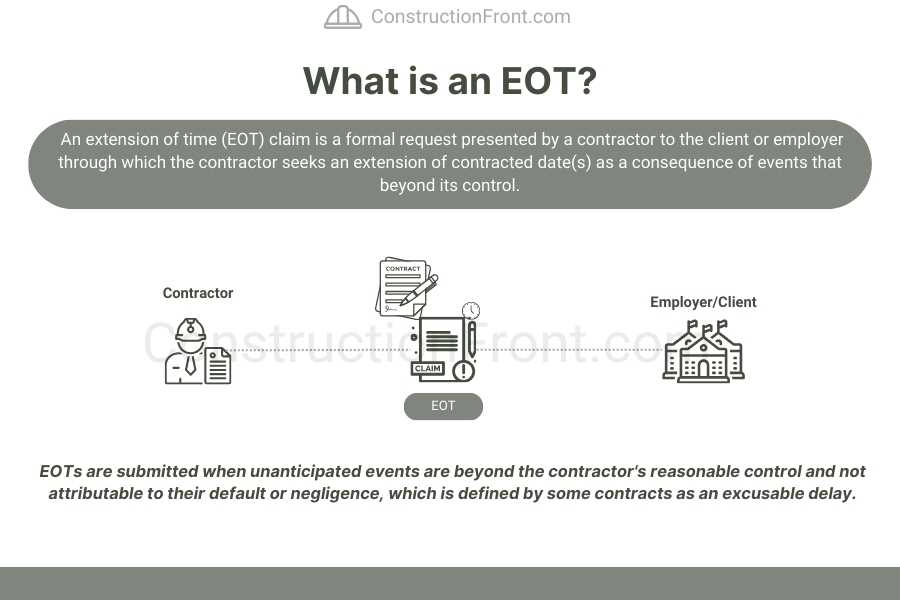
An extension of time (EOT) claim is a formal request presented by a contractor to the client or employer through which the contractor seeks an extension of contracted date(s) as a consequence of events beyond the contractor’s controls.
It is usually submitted when unanticipated circumstances or events are beyond the contractor’s reasonable control and not attributable to their default or negligence, in what is defined by some contracts as an excusable delay – in other words, a delay that the contractor can be excused for.
To substantiate an extension of time claim, the claimant must furnish comprehensive documentation and evidentiary support, effectively establishing a causal nexus between the events or circumstances invoked and the resulting project delay.
To support the claim, the Contractor (Claimant) must provide extensive and detailed background, which includes photographs, formal communications with the Client (i.e. Contract Notices), site reports, and other relevant documents, which should rely on the correct contract mechanisms.
Extension of Time Claim - Example
For example, imagine a Developer (Principal) contracts a Builder (Contractor) to deliver a tiny house under a construction-only contract. Both parties agree that the project must be delivered within eight months.
During the commercial negotiations, the developer retains the weather-related risks and is also in charge of providing the joinery elements to ensure material quality in accordance with its requirements.
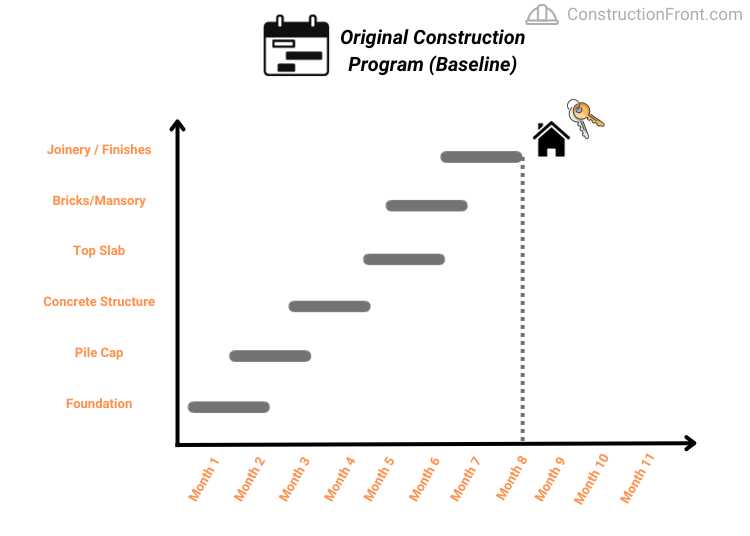
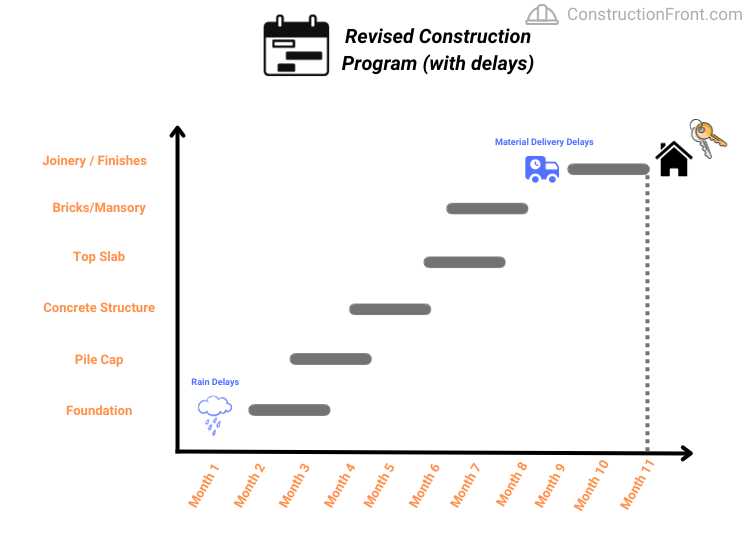
The first setback came in the form of a relentless rainy season that hit just before the foundation works were set to begin, causing an unavoidable delay of 1 month.
The builder resumed the work as soon as the rainy season was finished and progressed with its work following agreed sequencing and within the pre-agreed timelines for each task (albeit it has already been delayed by one month in the foundation’s works).
Given the developer’s problems in procuring the joinery elements, these materials were delivered on-site two months after the agreed dates under the contract, pushing the completion date further, as detailed in program below.
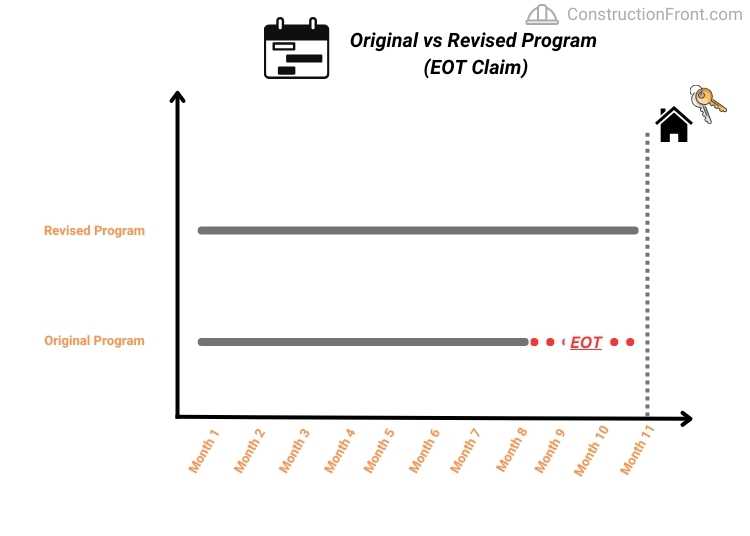
Because under the contract, the Developer retained weather-related risks and was responsible for delivering the joinery material, the builder is entitled to claim an extension of time (EOT – highlighted in red below) for project completion of 3 months and should, therefore, follow the contractual procedures to do so.
How to claim an EoT?
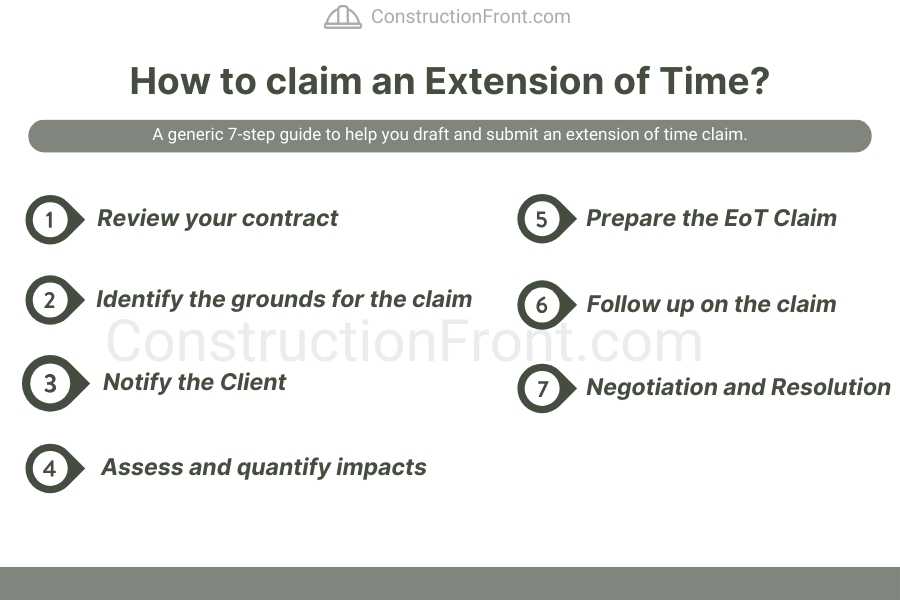
We have prepared a generic 7-steps guide to help you how to draft and submit an extension of time claim. Each contract has specific provisions, and you should adapt this framework accordingly.
The 7 steps are:
- Step-1 – Review your contract
- Step-2 – Identify the grounds for the claim
- Step-3 – Notify the owner
- Step-4 – Assess and quantify impacts
- Step-5 – Prepare the EoT Claim
- Step-6 – Submit follow-up on the claims
- Step-7 – Negotiation and Resolution
Step 1 - Review your Contract
Begin by carefully examining the construction contract, specifically the clauses related to claims for Extension of Time (EoT). For instance, look for provisions that clearly define the events or circumstances that may qualify for an extension, such as extreme weather conditions, unforeseen site conditions, or delays caused by third-party suppliers.
Additionally, take note of the notification requirements, such as submitting a written request within a specified timeframe or notifying the client/owner immediately upon identifying a delay.
Lastly, familiarize yourself with the documentation needed to support the claim, such as detailed records of the events leading to the delay, photographs, weather reports, or any other relevant evidence as outlined in the contract.
Step 2 - Identify the grounds for the claim
Proceed by determining the legitimate justifications for requesting an extension of time (in accordance with the contract). These may encompass various circumstances, such as modifications in project scope initiated by the owner, or disruptions arising from third-party actions, such as a client supplier.
Compile all pertinent details and supporting evidence to substantiate your claim, including comprehensive records, reports, and documented correspondence.
Step 3 - Notify the Owner
Ensure timely and compliant notification to the appropriate stakeholders as per the contractual notification timelines.
These days, it is very common in construction contracts include early warning mechanisms to help risk management. Through these dispositive, also known as Notices of Delays, the contractor is required to pre-warn the owner with regards to potential delays before submitting the claim.
Issue a written notice that explicitly describes the event or circumstance, its repercussions on the project timeline, and the expected necessity for an extension. Bolster your claim with comprehensive documentation, including daily reports, photographs, weather records, and any other pertinent records that validate the delay or disruption.
Suggested Reading: What is an Early Warning Notice? (And How To Effectively Use them)
Step 4 - Assess and quantify impacts
In evaluating the impact of an event or circumstance on the project schedule, critical path, resources, and costs, it is important to engage experts if needed to assist with the analysis. Employing established delay analysis techniques such as the critical path method (CPM) or retrospective analysis can help determine the causal link between the event and the resulting delay.
To effectively address the delay, it is crucial to quantify the extension of time required for compensation. This involves utilizing suitable scheduling tools and methodologies to accurately determine the additional duration needed.
Factors such as the project’s complexity, resource availability, and any concurrent delays or compensable time extensions should be carefully considered during this assessment process.
Thorough evaluation and analysis are key factors in preparing a well-supported EoT claim, enabling project stakeholders to address delays and disruptions in a comprehensive and informed manner.
Tip: Ensure time-related costs are easily identified from other costs to initiate discuss with the owner. For example, if your project will be delayed because of a Variation Order instructed by the Owner (i.e. change in design specification), make sure that you capture the costs of this variation order in one “pot” and extension costs in another “pot” (i.e. equipment staying on construction site longer than originally required).
Suggested Reading: What are the existing Delay Analysis Methods? (And When To Use Each)
Step 5 - Prepare the EoT Claim
It is essential to compile a comprehensive and well-structured claim submission. This should include a detailed narrative that clearly outlines the event, its impact on the project, the justifications for the extension, and the quantified time required for compensation.
It is crucial to attach all supporting documentation, such as the initial notice, relevant records, expert reports, and any additional evidence that bolsters your claim. By presenting a thorough and organized claim, you enhance the chances of a favorable assessment and resolution of your extension of time request.
Step 6 - Submit follow-up on the claims
After preparing the EoT claim, it is important to submit it to the designated party or parties as specified in the contract. Maintain a record of the submission date and diligently follow up to ensure that the claim has been received and acknowledged.
Some contracts detail mechanisms to address occasions where claims are continuous. For instance, in some cases, the contractor can submit its EoT claim without fully understanding the total impacts (ongoing event). Usually, the contractor must notify the client of a status update within specific timeframes stipulated under the agreement executed between the parties.
It is crucial to maintain open lines of communication throughout the process, promptly addressing any queries or requests for additional information that may arise. By proactively managing communication and staying engaged, you can facilitate a smoother evaluation and review process for your EoT claim.
Step 7 - Negotiation and Resolution
Engaging in constructive discussions and negotiations with the project owner, contractor, or other relevant stakeholders is essential to reach a resolution regarding the extension of time (EoT) claim.
Strive for a fair and reasonable outcome that considers the project’s overall objectives and the impact of the delay on all parties involved. If necessary, consider involving legal professionals with expertise in construction contracts to provide guidance and support, particularly in cases where the claim becomes contentious or legal expertise is required.
By diligently following this step-by-step process, you can effectively pursue an extension of time for your construction project.
It is important to consult legal experts or professionals well-versed in construction contracts to ensure compliance with specific legal requirements and to maximize the chances of a successful outcome.

Author’s Note:
One of the critical issues under the negotiation and assessment of the delays is selecting the appropriate delay analysis method and reviewing crucial contractual aspects, such as the “ownership” of the program float.
As such, the reading of the following articles is suggested:
What are the Common Reasons for Submitting an Extension of Time Claim?
A myriad of factors can disrupt construction, leading to unexpected delays that may necessitate lead or not to EoTs. Understanding the common reasons behind such claims can provide insights into the challenges faced in the industry and help you to understand better and substantiate your claim (if you are the Contractor) or articulate your response, in case you are working on behalf of the client.
The common factors leading to construction delay and some examples are detailed in the table below.
| Common Causes for Extension of Time Claims | Explanation | Example |
|---|---|---|
| Unforeseen adverse weather conditions | Severe weather conditions that prevent or delay construction work. | Heavy rainstorms halted construction for a certain period of time (floods, inclement weather), causing project delays. |
| Design changes or modifications | Changes to the original project design requiring extra time. | Client requests alterations to the building layout or change specifications, leading to project delays (i.e. procurement of new supplies, re-design, etc.) |
| Unanticipated site conditions | Unexpected challenges encountered on-site impacting progress. | Unforeseen underground utility lines required extensive re-routing, causing delay. Unexpected contamination. |
| Delays in material delivery | Late or insufficient delivery of construction materials. | Delayed arrival of steel beams postponed construction of the structural framework. |
| Labor shortages or productivity issues | Insufficient workforce or reduced productivity affecting progress. | Shortage of skilled workers resulted in slower construction pace and project delay. |
| Permitting and regulatory delays | Delays in obtaining necessary permits or meeting regulatory requirements. | Lengthy approval process for environmental permits caused project timeline delays. |
We note this table is indicative only, and several other factors can cause project delays and trigger entitlement to EoT claims, depending on the project’s contract.
It is of utmost importance to review and understand your agreement and ensure that all conditions precedent are met and the robustness of your submission and/or responses.
FAQ - Extension of Time (EOT) Claims
What is the difference between the excusable delay and non-excusable delay?
The key difference between excusable and non-excusable delays in construction lies in the responsibility for the delay:
- Excusable delays are unforeseen events beyond the control of the party, such as extreme weather or changes in law, entitling them to time extensions and, possibly, additional compensation.
- Non-excusable delays, however, result from factors within the party’s control, like poor planning or breaches of contract, and may lead to liability, penalties, or liquidated damages.
Need help?
Do not hesitate to contact us (click here) for specialised advice in the construction industry.
Conclusion
Delays can significantly affect schedules and budgets. An Extension of Time (EoT) claim is a formal request made by contractors seeking an extension of the project’s completion date or milestones.
To successfully claim an EoT, contractors must review the contract, identify grounds for the claim, notify stakeholders, assess and quantify impacts, prepare a comprehensive claim, submit it, and engage in negotiation and resolution.
Consulting legal and construction experts is crucial and might help you on ensuring best value for money outcomes for your project.
Sources
- Structuring a delay and disruption claim: An application of cause-mapping and system dynamics – ScienceDirect
- AN INVESTIGATION INTO THE USE OF CONSTRUCTION DELAY AND DISRUPTION ANALYSIS METHODOLOGIES
- Avoiding and Mitigating Delay and Disruption Claims Conflict: Role of Precontract Negotiation | Journal of Legal Affairs and Dispute Resolution in Engineering and Construction
- Liquidated Damages and Extensions of Time: In Construction Contracts – Brian Eggleston
- Assessing Extension of Time delays on major projects – ScienceDirect
- wbc2010-proceedings-libre.pdf (d1wqtxts1xzle7.cloudfront.net)