

On many construction projects, one of the hardest commercial decisions is when to lock in the price. If the price is fixed too early, the contractor may include large contingencies for unresolved design, unclear quantities, and uncertain risk. If the price is fixed too late, the owner may struggle to manage budget certainty, approvals, and procurement planning.
A Guaranteed Maximum Price (GMP) is a pricing mechanism that caps what the owner will pay for the agreed scope, subject to the contract’s adjustment rules. A lump sum is usually a fixed-price contract agreed at award for delivering the defined works.
In practice, lump sum suits projects with a more mature scope, or situations where the client wants to transfer more pricing risk to the contractor early. GMP is generally better used where the client is more mature, is willing to work collaboratively with the contractor, and wants to refine scope before later committing to a price. That usually creates more pricing transparency and, in some cases, better risk allocation.
This guide explains the difference between GMP and lump sum, how each model works, where each one fits best, and how the choice affects risk allocation, procurement, change control, and contract administration.
GMP vs lump sum: the basic difference
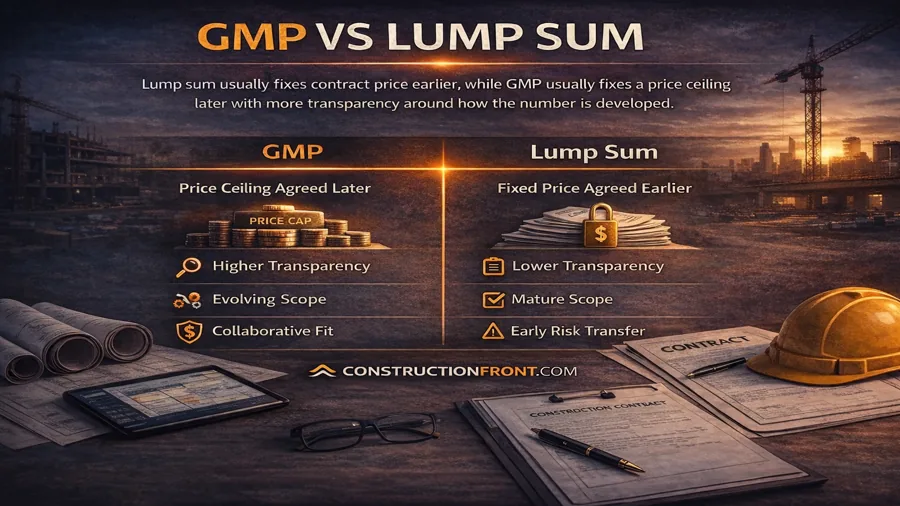
The simplest distinction is this: a lump sum fixes the contract price earlier, while GMP usually fixes a price ceiling later and often with more transparency around how that number is built.
Under a lump sum model, the contractor tenders a fixed price for carrying out the defined scope. If it underestimates the work, it usually bears that risk. If it delivers more efficiently than expected, it may keep the upside.
Under a GMP mechanism, the contractor often develops the price progressively and then agrees a cap above which it will typically carry the overrun, unless the contract allows an adjustment. Many GMP arrangements also include a gain-share mechanism, allowing savings below the GMP to be shared between owner and contractor.
That means the commercial question is not only which model gives more certainty. Both do, but in different ways. The better question is: at what stage is certainty being locked in, and how much design and scope maturity exists at that point?
How lump sum works in practice
A lump sum contract generally assumes that the project is sufficiently defined for the contractor to offer a firm price at tender stage. That is why lump sum is strongly associated with clearer design completeness, stronger tender documentation, and earlier risk transfer.
This is also why lump sum is common under Design and Construct (D&C) and some EPC contract structures. The owner wants a clear number at award, and the contractor is expected to include direct cost, overhead, profit, contingency, and delivery risk within that price. That can work very well where the scope is stable.
The problem starts when the project is not as mature as the procurement strategy assumes. In those cases, the lump sum may look clean at award, but the contractor may have priced in heavy contingency, taken aggressive assumptions, or left itself with limited room to absorb design development later. For that reason, a lump sum approach is not automatically the “safer” option. It is often the cleaner option only when the project is genuinely ready for it.
How GMP works in practice
A GMP arrangement usually sits within a broader collaborative delivery model rather than existing in isolation. It is especially common in Construction Manager at Risk (CMaR), ECI contracts, and progressive design-build.
In practical terms, the GMP establishes a price ceiling above which the contractor will usually carry the overrun, unless the contract allows the cap to be adjusted. That means the contractor still takes real pricing risk, but the commercial mechanism is often developed in a more progressive and transparent way than under a conventional lump sum. In many cases, the GMP is built through open-book pricing, progressive estimating, package-level review, and ongoing discussion of scope, contingency, and risk before the final cap is locked in.
Many GMP arrangements also include a gain-share mechanism. If the final cost comes in below the GMP, the resulting savings may be shared between owner and contractor under a pre-agreed formula. That can encourage more collaborative cost management and reduce the tendency for each side to take an overly defensive position too early. One practical issue that always needs to be clarified is what is actually included within the GMP. A simplified cost structure often looks like this:
| Element | Typical treatment under a GMP |
|---|---|
| Direct construction cost | Included within the GMP |
| Contractor overhead and profit | Included within the GMP |
| Contractor contingency | Usually included within the GMP |
| Approved client changes | Often able to adjust the GMP |
| Shared savings | Sometimes split between owner and contractor |
| Cost overruns above the GMP | Usually borne by the contractor unless the GMP is adjusted |
However, each project may deal with the GMP slightly differently. Some risk items are often negotiated separately because they are difficult to predict and price properly from the start. Typical examples include latent conditions, unknown utilities, contamination, or archaeological findings. These are exactly the kinds of issues that can undermine a GMP if the parties try to force them into the cap without a realistic allocation of risk.
GMP vs lump sum pricing at a glance
| Feature | GMP | Lump Sum |
|---|---|---|
| Pricing basis | Ceiling price, often developed progressively | Fixed-price contract agreed at award |
| Cost transparency | Usually higher | Usually lower |
| Design maturity needed | Moderate | Usually higher |
| Typical fit | Collaborative delivery, evolving scope | Stable scope, clearer design |
| Treatment of underruns | May involve gain-share or shared savings | Contractor often keeps the benefit |
| Treatment of overruns | Contractor usually bears above GMP, subject to adjustment rules | Contractor bears overruns within original scope |
| Common procurement route | Negotiated, best-value, or early involvement | Competitive tender with firmer documentation |
Why owners and contractors choose one over the other
Owners usually choose lump sum where they want earlier cost certainty and believe the project is sufficiently mature to support it. That is often the case where the design is advanced, the scope is relatively stable/known, and the client wants to transfer more risk to the contractor at contract award.
By contrast, owners often prefer GMP where they still want cost certainty, but do not want to force a final number before the project is ready. This is especially relevant where the project is complex, the design is still evolving, or early contractor involvement is likely to improve constructability, packaging, sequencing, and pricing realism.
From the contractor’s perspective, lump sum may be attractive where the team understands the scope well and believes it can execute efficiently below the tendered price. GMP may be more attractive where the scope is still moving and the contractor wants to avoid loading large contingencies into an early fixed-price offer. In that sense, GMP can create a more workable commercial environment where both parties accept that the project needs further development before the final number is locked.
Risk allocation: where the real commercial difference sits
The real difference between GMP and lump sum is not only the price label. It is the point at which project risk is converted into contractual price.
Under lump sum, more pricing risk is usually transferred earlier. That works well where the contractor can assess the scope and risk with confidence. But where the project is still immature, the contractor may either include substantial contingency or submit an aggressive price and then later seek recovery through variations and other time-related claims.
Under GMP, the parties often have more time to define scope, test assumptions, and discuss risk before the cap is finalised. That can lead to a more realistic commercial outcome, but it does not mean the project becomes less risky. It simply means the risk is being crystallised later, often on a better-informed basis.
This is also why both mechanisms still depend heavily on robust contract administration, even though, in theory, GMP should lead to less adversarial behaviour. Ultimately, a pricing model can shape risk, but it does not remove the need for disciplined notices, change control, use of proper risk management tools such as early warning notices, and strong records.
Scope maturity and design completeness
If there is one deciding factor in the GMP vs lump sum question, it is scope maturity. A lump sum model generally works best where the design is sufficiently complete and the owner can define the work clearly enough for the contractor to price it with confidence. Hence why design completeness, tender documentation, and scope clarity matter so much in fixed-price procurement.
A GMP model is often more suitable where the project still needs meaningful design development, packaging decisions, constructability review, or pricing refinement before the commercial cap can be fixed.
This is one the reasons underpinning Front-End Engineering Design (FEED) studies industrial projects, for example. Owners and contractors can work together to better refine the project understanding and agree on scope and price before the owner issues a notice to proceed for construction and engages in a full EPC contract.
In short, the stronger the scope definition, the easier it is to support lump sum. The less mature the scope, the stronger the case for GMP or another collaborative pricing mechanism.
This is also why GMP is increasingly relevant in progressive design-build. The design-builder is brought in early, the project is further developed, and the GMP is often agreed only once the owner and contractor are more comfortable with the actual scope and risk profile.
A simple practical example
Imagine an owner is procuring a technically complex building or transport package.
If the owner tenders the project as lump sum before the design is sufficiently mature, bidders may include large contingencies or rely on aggressive assumptions just to remain competitive. If the design later develops materially, the parties may then argue over whether the new detail was already included in the original tendered price or should be treated as a change.
If the same project uses GMP under CMaR or progressive design-build, the contractor may help refine the scope, sequencing, and package pricing before the cap is agreed. That can lead to a more realistic commercial outcome and better transparency, but only if the owner remains engaged and the documentation is strong.
That example captures the core point: GMP and lump sum are two different ways of dealing with uncertainty. One prices more of it earlier. The other tries to understand more of it before the cap is fixed.
Which model suits which project?
As a practical rule, GMP is often better suited to:
- complex projects
- projects where scope is still evolving
- projects where timelines can accommodate the GMP development process
- collaborative procurement routes
- clients or owners with strong experience in early contractor involvement
Lump sum is often better suited to:
- clients wishing to transfer more construction risk to the contractor earlier in the process
- projects where the scope of works is sufficiently clear to proceed to procurement
- projects where the design is mature enough to support robust pricing
- situations where tender documentation is clear and risk allocation is well defined
- clients seeking a simpler fixed-price procurement route
- clients wanting faster procurement
These are not rigid rules, but they are a useful commercial starting point.
Final thoughts
GMP vs lump sum is not just a pricing comparison. It is a decision about when price certainty is locked in, how much design maturity exists at that point, and which party carries the commercial risk if the project changes.
If the scope is mature, the design is stable, and the client wants a firm price early, lump sum may be the cleaner option. If the project is more complex, needs earlier contractor input, or would be artificially priced if fixed too soon, GMP may be the better commercial mechanism.
The key point is that neither model cures poor scope definition or weak project controls. It only determines how uncertainty is priced, transferred, and argued about later. That is why the better choice is usually the one that best matches the real maturity, risk profile, and procurement strategy of the project.
FAQ
What is the difference between GMP and lump sum?
A lump sum is usually a fixed price agreed at award for the defined works. A GMP is a ceiling capped price that is often developed more progressively and with greater pricing transparency.
Is GMP better than lump sum?
Not necessarily. GMP is often better for evolving scope and collaborative delivery. Lump sum is often better where the design is mature and the owner wants earlier fixed-price commitment.
Is lump sum the same as a fixed-price contract?
In most construction contexts, yes. Lump sum is generally treated as a fixed-price contract for the defined scope of work.
Does GMP mean the contractor takes less risk?
Not automatically. The contractor still carries significant risk, but GMP may allow that risk to be priced later and on a more informed basis.
Which model leads to more change orders?
Neither automatically does. But lump sum can create stronger disputes about whether a change was already included in the original price, while GMP can create disputes about whether the issue sits inside or outside the GMP basis.
When should GMP be used instead of lump sum?
GMP is often more suitable where the design and scope of works is still developing, the project is complex, or the owner understands early contractor involvement is valuable to de-risk and improve project outcomes.
Need Help?
Do not hesitate to contact us (click here) for specialised advice in the construction industry.
Sources
- Rashid, Md Redowan, Lump Sum Contracts in Construction: Benefits, Challenges, and Risk Allocation Strategies
- Anvuur, A. M. and Kumaraswamy, M. M., Promises, Pitfalls and Shortfalls of the Guaranteed Maximum Price Approach: A Comparative Case Study
- Palihakkara, A. D. and Perera, B. A. K. S., Identification of Significant Risk Factors of Guaranteed Maximum Price (GMP) Contracts
- Construction Front, Guaranteed Maximum Price
- Construction Front, Progressive Design-Build
- Construction Front, Construction Manager at Risk (CMaR)
- Construction Front, What is an ECI Contract?
- Construction Front, Design and Construct (D&C) Contracts
- Construction Front, Front-End Engineering Design (FEED)
- Construction Front, Construction Claims and Contract Administration Explained
- Construction Front, What is a Variation Order?
- Construction Front, What is a Variation Request?
- Construction Front, What is a Time Bar Clause?
- Construction Front, Are Time Bars Enforceable in Construction Contracts?
- Construction Front, Notice of Delay
- Construction Front, What is an Extension of Time Claim (EOT)?
- Construction Front, What is a Latent Condition in Construction?
- Construction Front, What Is Concurrent Delay in Construction?
Disclaimer: The articles on this blog are for informational and educational purposes only and do not constitute legal or technical advice. While we strive to provide accurate and up-to-date information on construction law, regulations may vary by jurisdiction, and legal interpretations can change over time.