


• Home
  • News
  • Engineering
  • Knowledge Hub
  • Resources
No Result
View All Result
Newsletter
Construction Front | Industry Knowledge Hub, News Portal
  • Engineering
  • News
  • Knowledge Hub
  • Resources
  • Contact Us
  • About us
Construction Front | Industry Knowledge Hub, News Portal
  • Home
  • News
  • Engineering
  • Knowledge Hub
  • Resources
No Result
View All Result
Newsletter
Construction Front | Industry Knowledge Hub, News Portal
No Result
View All Result
Home Knowledge Hub Claims & Contract Administration
What is an Early Warning Notice? (And How To Effectively Use them)

What is an Early Warning Notice? (And How To Effectively Use them)

Denys S. by Denys S.
April,2026
in Claims & Contract Administration, Knowledge Hub
0 0
0
413
SHARES
3.8k
VIEWS
Share on EmailShare on TwitterShare on LinkedinShare on Facebook

Effective risk management is a key aspect of major construction projects’ success. Through the years, construction contracts have incorporated early warning notifications, an important contractual mechanism that helps to identify projects’ potential issues prematurely. 

So, in a nutshell, what is an Early Warning Notice? These are contractual notifications issued by any party to proactively identify, mitigate and address potential risks or issues in a construction project, such as cost increases, program delays and unexpected findings (i.e. latent conditions).

In this article, we will explore the concept of early warning notices further, their importance in construction projects, how to effectively write and respond to them, and address some common questions surrounding their use.

What is an Early Warning Notice?

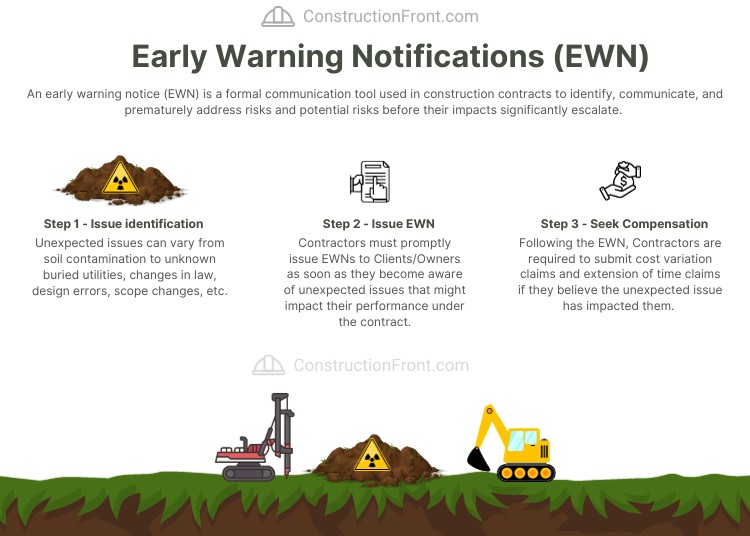
An early warning notice (EWN) is a formal communication tool used in construction contracts to identify, communicate, and prematurely address risks and potential risks before their impacts significantly escalate. 

Lawyers and experienced construction managers incorporate these notifications into contracts to facilitate proactive risk management (by both the Principal/Owner and the Contractor) as soon as any party become aware of potential issues.

For example:

  • An instruction given by the Owner may lead the Contractor to incur additional costs and/or cause program delays, and the Contractor may issue an EWN to warn the Owner of the potential costs and time impacts associated with its instruction. 
  • While undertaking piling works, the Contractor might become aware of unexpected soil contamination issues and may need to raise an Early Warning Notice to the Owner to protect its rights with regard to variation claims and extension of time claims.

Early Warning Notice - Example

To help understanding, we will expand on the second example given above.

Imagine that while undertaking piling works, a Contractor might become aware of unexpected soil contamination issues, such as the presence of hazardous materials or pollutants, which were not initially anticipated during the project planning and tendering phases. 

Early Warning Notifications (EWN)
Example of the Use of Early Warning Notification in a Contstruction Contract.

In such circumstances, the Contractor may need to raise an Early Warning Notice to the Owner promptly. This action serves a dual purpose:

  • Firstly, it safeguards the Contractor’s general rights.
  • Secondly, these notifications are typically a condition precedent to claims entitlement. Therefore, the Contractor must submit the notice as soon as it becomes aware of the issue to preserve its rights regarding potential cost and time variation claims. 

Overall, when incorporated into agreements, these notifications must be sent within a specific timeframe detailed in the contract after the issue or finding occurs (i.e. five business days), and one party (typically the Contractor) must promptly notify the other to reserve its rights and compensation entitlement. 

Early Warning Notices - NEC3, NEC4 and FIDIC Contracts

In the NEC Contract suite, early warnings are governed by Clause 16.1 in NEC3 and 15.1 in NEC4. The parties are to issue a notification under a specified timeframe to raise any risks related to the project’s time, cost, and quality.

 FIDIC contracts also have similar provisions, and clauses will vary according to the suite used in your project.

Author’s Note: Whilst Early Warning clauses, terminology, and timeframes might vary according to the contract and/or jurisdiction you are working on, the rationale of this dispositive is the same – risk’s early identification and assessment.

Why are Early Warning Notices important in Construction Projects?

Among many positive features, these notifications support contract and project management activities for both the Principal (Owner) and Contractor by:

      • Promoting transparency and open communication;

      • Sharing immediate information about potential project risks; 

      • Enabling both parties to eliminate, mitigate or discuss the best strategy to deal with the identified issue;

      • Reducing the likelihood of cost blow-outs, quality issues, and program delays;

      • Facilitating collaboration and collective problem-solving; and

      • Building trust and fostering a cooperative working environment, facilitating smoother delivery.

    Further, the correct implementation and use of a proper early warning system significantly decrease the probability of future claim disputes. 

    How Do you Write an Early Warning Notice?

    Overall, you should follow the following steps:

    • Step 1 – Identify the relevant contract clause
    • Step 2 – Clearly identify the event or circumstance
    • Step 3 – Describe the potential risk or issue in detail
    • Step 4 – State the reasons for considering it a risk
    • Step 5 – Include supporting documentation
    • Step 6 – Suggest potential measures for risk mitigation
    • Step 7 – Specify the desired outcome and timelines
    • Step 8 – Draft and submit the Contract Notification

    The table below consolidate the steps and further tips to effectively write your EWN. 

    Step

    Description

    Notes and Tips

    1

    Identify the relevant contract clause

    Make sure that you use the correct mechanism under the contract and comply with the required timeframes for notifications to protect your interests

    2

    Clearly identify the event or circumstance

    Provide a concise description of the specific event or circumstance that needs to be addressed.

    3

    Describe the potential risk or issue in detail

    Provide a detailed explanation of the nature, scope, and potential impact of the risk on the project’s cost, schedule, or quality.

    4

    State the reasons for considering it a risk

    Highlight underlying causes or factors contributing to the identified risk

    5

    Include supporting documentation

    Attach all relevant supporting documents, such as photographs, reports, directions, or event test results, to provide additional clarity and evidence.

    6

    Suggest potential measures for risk mitigation

    Offer practical recommendations and actionable steps to manage or mitigate the identified risk effectively.

    7

    Specify the desired outcome and timelines

    Clearly state the objectives and timelines to be met by both parties to ensure risks are addressed properly

    8

    Draft and submit the Contract Notification an

    Compile the information from steps 2 to 7 and send the notice.

    We note this is a generic guide only, and you should adapt this step-by-step template to comply with your contract requirements. If in doubt, please do not hesitate to contact us (click here) and we can offer specialised advice. 

    how to write an early warning notice

    How to Respond to an Early Warning Notice?

    We recommend implementing the following steps:

    • Step 1 – Review your contract and identify what actions are required.
    • Step 2 – Review the notification content.
    • Step 3 – Assess validity, rationale/root-causes, and contract entitlement.
    • Step 4 – Identify potential measures to be implemented.
    • Step 5 – Engage with the other party and discuss solution.
    • Step 6 – If required by the Contract, submit a response

    The table below summarises some practical recommendations for each step.

    Step

    Description

    Notes and Tips

    1

    Review your contract and identify what actions are required

    – Pay attention to timelines to avoid time-bar issues.  

    2

    Review the notification content

    – Carefully read and understand the content of the notification, and request further clarification (if needed)

    3

    Assess validity, rationale/root-causes, and contract entitlement

    – Thoroughly assess the merits of the EWN (i.e. who caused/initiate the issue? What the contract states in relation to the issue?)


    4

    Identify potential measures to be implemented

    – Brainstorm and consider various options for addressing the identified issue.

    5

    Engage with the other party and discuss solution

    – Initiate open and constructive communication with the issuing party.

    6

    If required by the Contract, submit a response

    – Follow the contract requirements regarding the submission of a response.

    We note this is a generic guide only, and you should adapt this step-by-step template to comply with your contract requirements. If in doubt, please do not hesitate to contact us (click here) and we can offer specialised advice. 

    FAQ

    What is the difference between an Early Warning Notice and a Compensation Event?

    An Early Warning Notice identifies potential risks in construction projects, allowing stakeholders to take proactive measures to deal with the issue prematurely and avoid its escalation. 

    On the other hand, a Compensation Event refers to an event that entitles any party to claim additional time or money under the contract (i.e. a direction sent by the owner might increase the Contractor’s costs, which it might be entitled to recover).

    Generally, an EWN is a mandatory condition precedent to a Compensation Event. 

    Suggested Articles: 

    • For cost compensation: What is a Variation Claim/Request? (And How to Submit one!)
    • For time compensation: What is an Extension of Time Claim? 

    Who is responsible for issuing early warning notices in construction contracts?

    Typically, these notifications are often used by Contractors. However, Owners can also implement this mechanism in case potential issues are identified. 

    Normally, notices are given by Contractor and Owner’s representative, respectively.

    Conclusion

    Early warning notices are vital in construction projects for proactive risk management and open communication.

    The early identification and addressing of potential risks will help you substantially reduce cost overruns, delays, and quality issues in your job.

    Further, correctly implementing this mechanism in your contract management activities will foster communication and trust between parties and reduce costly disputes.

    Need Help?

    Do not hesitate to contact us (click here) for specialised advice in construction contracts. 

    Tags: Claims & Contract Administration
    Previous Post

    Jacobs enters into an EPA Agreement with Fortescue Group (FFI) to support group’s zero-carbon initiative

    Next Post

    Two Consortia shortlisted to Deliver Melton Hospital PPP in Australia

    Denys S.

    Denys S.

    Denys Schwartz is a civil engineer and certified professional (PMP, CP3P, CAIA) with more than 15 years of experience in the construction industry, specialising in construction contracts, procurement, claims, delay analysis, and contract management for major infrastructure and energy projects. He holds a postgraduate degree in Corporate Finance and has worked on multibillion-dollar projects across Australia, Brazil, and other international markets — including the Sydney Metro and major renewable energy programs — supporting projects from development, transactions, and procurement through to delivery, claims, and dispute resolution

    Related Posts

    pre_construction_services_contract_infographic_900x600pre_construction_services_contract_infographic_900x600
    Knowledge Hub

    How a Pre-Construction Services Contract (PCSA) Works (And When to Use It)?

    by Denys S.
    April,2026
    Construction infographic showing how two-stage tendering works, with Stage 1 contractor selection, PCSA execution, Stage 2 preconstruction development, and the final construction contract.
    Knowledge Hub

    How Two Stage Tendering Works? (And When to Use it)

    by Denys S.
    April,2026
    Construction infographic comparing GMP and lump sum contracts, showing GMP as a later price ceiling with higher transparency and evolving scope, versus lump sum as an earlier fixed price with mature scope and early risk transfer
    Knowledge Hub

    GMP vs Lump Sum in Construction: What’s the Difference?

    by Denys S.
    April,2026
    Editorial infographic explaining what a Guaranteed Maximum Price means in construction, showing a GMP cost cap above direct costs, contractor fee, contingency, and owner cost certainty.
    Knowledge Hub

    What Is a Guaranteed Maximum Price (GMP) in Construction? (And How It Works?)

    by Denys S.
    April,2026
    nfographic showing the two-phase structure of progressive design-build, with early collaborative development in Phase 1 and construction execution in Phase 2
    Knowledge Hub

    What Is Progressive Design-Build? How It Works and When to Use It

    by Denys S.
    April,2026
    Next Post
    Melton PPP shortlist released

    Two Consortia shortlisted to Deliver Melton Hospital PPP in Australia

    What are keyway joints in concrete

    What is a Keyway Joint in Concrete? (and When to use Them)

    transmission line in Brazil

    Engie wins Transmission Line Concessions in Brazil

    Leave a Reply Cancel reply

    Your email address will not be published. Required fields are marked *

    I agree to the Terms & Conditions and Privacy Policy.

    Stay Connected

    Join our newsletter!

    Newsletter

    Newsletter

    Stay at the front of the construction industry with the latest news, market trends, and project insights — delivered by ConstructionFront.com

    Name
    Enter your email address
    LinkedIn Twitter Youtube Instagram Facebook Flirk

    All about the construction world: the latest industry news and trends, practical knowledge, and unique tips to help you on your projects.

    Site Map

    • Home
    • News
    • Engineering
    • Knowledge Hub
    • Resources
    • Contact Us
    • About us

    Recent Posts

    Red Oak Campus - Data Centre Map

    DataBank secures $2 billion financing for Red Oak data centres in Dallas

    April,2026
    pre_construction_services_contract_infographic_900x600pre_construction_services_contract_infographic_900x600

    How a Pre-Construction Services Contract (PCSA) Works (And When to Use It)?

    April,2026

    Copyright © 2023 ConstructionFront.Com | Affiliate Disclosure | Privacy Policy | Terms & Conditions

    Welcome Back!

    Login to your account below

    Forgotten Password?

    Retrieve your password

    Please enter your username or email address to reset your password.

    Log In
    No Result
    View All Result
    • Home
    • News
    • Engineering
    • Knowledge Hub
    • Resources

    Copyright © 2023 ConstructionFront.Com | Affiliate Disclosure | Privacy Policy | Terms & Conditions

    This website uses cookies. By continuing to use this website you are giving consent to cookies being used. Visit our Privacy and Cookie Policy.

    ConstructionFront.com - Newsletter!

    Stay at the front of the construction industry with the latest news, market trends, and project insights — delivered by ConstructionFront.com

    Name
    Enter your email address

    Thanks, I’m not interested

    Privacy Policy - Terms and Conditions