

On an NEC4 project, compensation event entitlement is often lost or weakened long before the final quotation is argued about. The real damage usually happens earlier: a notice goes in late, the contractor relies on informal instructions, the programme effect is not assessed properly, or the records are too thin to support time and cost recovery when the Project Manager asks for detail.
That structure is one of NEC4’s strengths, but it is also where contractors get exposed. NEC4 compensation events are highly procedural. If the notice is mishandled, if the event is not linked clearly to the contract, or if the quotation and programme support are weak, the contractor can lose recovery, weaken time entitlement, or end up in a pricing dispute that should have been avoided.
This guide explains what NEC4 compensation events are, how the NEC4 compensation event process works, how Clause 61 notification interacts with early warning, what the main commercial risks look like in practice, and what contractors should do to protect entitlement.
What NEC4 Compensation Events Are?
Under NEC4 ECC, compensation events are the events listed in Clause 60.1, together with any additional compensation events stated in the contract data. NEC’s own guidance makes the commercial point clearly: compensation events are the principal contractual mechanism for adjusting the Prices, the Completion Date, and where relevant Key Dates, for qualifying events under the contract. If the event does not fall within the contract, calling it a compensation event does not make it one.
That is one reason NEC4 feels different from contracts built around a traditional construction change directive or later-stage claims positioning. The contract expects the parties to identify the event, notify it properly, assess the impact, and deal with it while the job is still moving.
NEC guidance for new users says that 21 compensation events are listed in clause 60.1 of NEC4 ECC. The table below gives a practical summary of what those events typically cover.
| CE | What it typically covers | Common example |
|---|---|---|
| 60.1(1) | Project Manager instruction changing Scope or a Key Date, subject to contract exceptions. | Issued drawing revision changes drainage layout or finish specification. |
| 60.1(2) | Failure to give access to the Site by the contractual access date. | Contractor cannot mobilise because possession is not available on time. |
| 60.1(3) | Failure by the Client to provide something it was supposed to provide by the date shown on the Accepted Programme. | Client-furnished equipment arrives late and pushes installation activities. |
| 60.1(4) | Instruction to stop or not start work. | Project Manager suspends a work area pending design clarification. |
| 60.1(5) | Client or Others do not work to the times, conditions or site arrangements the contract assumed. | Utility diversions or third-party works overrun and block the contractor’s sequence. |
| 60.1(6) | Project Manager or Supervisor fails to reply within the time the contract requires. | Submission sits unanswered and procurement or installation is delayed. |
| 60.1(7) | Discovery of an object of value or historical or other interest at the Site. | Archaeological find stops excavation pending instruction. |
| 60.1(8) | A previously communicated decision is changed. | Accepted approach is later reversed, causing rework or resequencing. |
| 60.1(9) | Acceptance is withheld for a reason the contract does not permit. | Programme or design submission is rejected on non-contractual grounds. |
| 60.1(10) | Search for a Defect is instructed and no Defect is found, subject to contractual exceptions. | Opened-up works prove compliant, creating abortive investigation cost. |
| 60.1(11) | Tests or inspections by the Supervisor, Client or Others cause unnecessary delay. | Inspection team delay leaves crews and plant standing by. |
| 60.1(12) | Physical conditions encountered are materially different from what an experienced contractor should reasonably have allowed for. | Unexpected buried obstruction or more adverse ground than site data suggested. |
| 60.1(13) | Weather event meets the contract’s statistical threshold and stated measurement criteria. | Rainfall or temperature threshold in the contract data is exceeded. |
| 60.1(14) | A Client liability stated in the contract occurs. | Client-risk event affects the works and drives time and cost consequences. |
| 60.1(15) | Client takes over part of the works earlier than planned, outside stated exceptions. | Operational use starts early and changes access or finishing sequence. |
| 60.1(16) | Client fails to provide materials, facilities or samples needed for tests and inspections. | Required sample or test facility is unavailable and progress is held up. |
| 60.1(17) | Project Manager corrects an assumption previously used to assess a compensation event. | Temporary assumed quantity or sequence later proves wrong and assessment must move. |
| 60.1(18) | Client breaches the contract and no more specific compensation event already covers it. | Residual breach route where the contractor suffers time or cost impact. |
| 60.1(19) | A prevention event occurs which neither party could prevent and which would have been unreasonable to allow for. | Rare disruptive external event stops completion and was not realistically foreseeable. |
| 60.1(20) | Abortive cost linked to a proposed instruction or quotation route that does not proceed under the contract. | Contractor spends time pricing a contemplated change that is then dropped. |
| 60.1(21) | Additional project-specific compensation events stated in Contract Data part one. | Bespoke risk event added at tender stage for that project only. |
Two practical points matter. First, not every event is contractor-notified. NEC guidance is clear that Project Managers and contractors may both notify compensation events depending on the event type. Second, the signed contract wording always governs. The table above is a commercial summary, not a substitute for the contract itself.
Why NEC4 Compensation Event Notification Matters
On NEC4 projects, entitlement protection starts with the notice. A contractor may have a strong underlying event, but if it is notified late or badly, the commercial position can weaken very quickly.
That is why NEC4 compensation event notification should be treated as a live contract administration control, not a back-office formality. A late notice can lead to loss of entitlement. A vague notice can create argument over whether the event was identified properly. A notice with no clear link to programme or cost effect makes later quotation stages harder to defend.
The time-bar point matters in particular. Where contractor notification is required, NEC4 Clause 61 notification is often the clause that causes the damage. NEC’s own user guidance says that if the Project Manager has not already notified the event, the contractor generally has eight weeks from the event occurring to notify it. On real projects, that is where value is often lost: not because the event was weak, but because the clock was ignored and claims might become time barred.
This is why disciplined notices matter just as much here as they do in wider construction claims and contract administration: clear notice, clear records, and early assessment of time and cost effect.
NEC4 Compensation Event Process
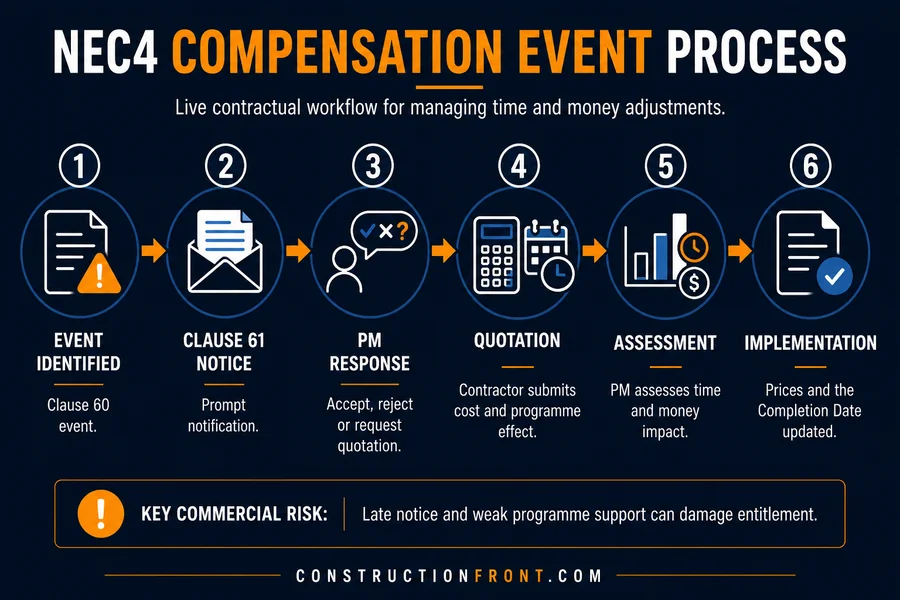
Before getting into practical pitfalls, it helps to set out how the NEC4 compensation event process usually works in practice:
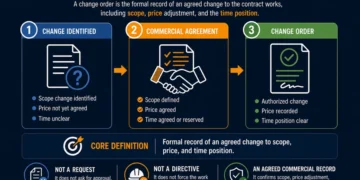
- First, the event is identified: either the contractor or the Project Manager recognises that a Clause 60 event may have occurred.
- Next, the event is notified: the party responsible under the contract issues the compensation event notice.
- The Project Manager then responds: either accepting the event, rejecting it on contractual grounds, or moving it into the quotation stage.
- The contractor then submits a quotation: setting out the forecast cost effect, time effect, assumptions, and programme implications.
- Finally, the event is assessed and implemented: so the contractual effect on time and money is formalised.
Who notifies and when
Under NEC4, some compensation events are notified by the Project Manager, while others require contractor notification. From a contractor’s perspective, the safest habit is not to assume the Project Manager will always protect the contractor’s position. If the event needs contractor notification, the notice needs to go in properly and on time.
That is why people focus so heavily on NEC4 Clause 61 notification. NEC’s 2024 introductory guidance says the contractor generally has eight weeks from the event occurring to notify it where contractor notification is required and the Project Manager has not already done so.
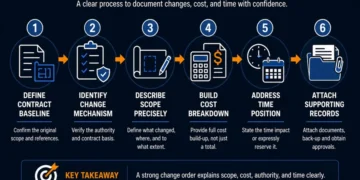
The notice itself should do three things clearly:
- identify the event
- state why it is being treated as a compensation event
- connect it to the relevant contractual basis
A contractor who waits until the pricing debate starts is often already on the back foot.
Project Manager response and quotation flow
NEC guidance also emphasises the next steps. Once a contractor notifies, the Project Manager typically has one week to respond unless a longer period is agreed. If the event proceeds, the contractor normally has three weeks to submit a quotation unless a different period is agreed.
This is where many contractors mistakenly treat the notice as the hard part and under-resource the rest. In practice, the quotation stage is where the commercial effect has to be proved. The quotation should explain:
- what the event changed
- why it falls within the compensation event mechanism
- how the cost build-up has been formed
- how the Accepted Programme is affected
- what assumptions have been used
- whether the event creates delay, disruption, or both
This is similar in discipline to structured pricing under a contractor variation request process, even though the NEC4 contractual route is different.
How Early Warning Affects NEC4 Compensation Events
NEC4 compensation events also sit alongside Clause 15 early warning. The two are not the same thing, but they interact in ways that matter commercially.
An early warning notice is there to flag a matter that could increase total cost, delay Completion, delay meeting a Key Date, or impair performance in use. A compensation event notice deals with the contractual event and its assessment. Good contract administration recognises that an issue may need both.
This is important because early warning and compensation event notification are separate processes with different functions. Failure to give an early warning will not usually extinguish the compensation event itself, but it can affect the commercial assessment, particularly where the Project Manager argues that earlier warning would have allowed mitigation of the resulting time or cost effect.
In practical terms, that can reduce recovery where the argument is that earlier warning would have allowed mitigation. Contractors should therefore avoid treating early warning as optional soft administration and compensation event notification as the only notice that matters. On NEC4 projects, the notices need to work together.
Common NEC4 Compensation Event Risks
Late notification
This is the most obvious risk and often the most damaging. A contractor may have a genuine event, but if the notice is late, the entitlement position can be severely weakened or lost entirely.
Weak programme support
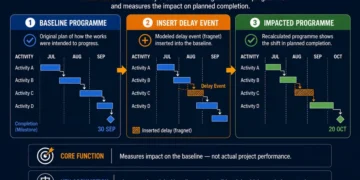
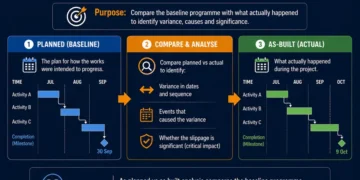
Compensation events are not just about cost. If the contractor wants relief in relation to the Completion Date or Key Dates, the event has to be linked properly to programme effect and, in practice, to the Accepted Programme. Under NEC4, that is not just a planning tool; it is the contractual programme baseline against which the effect of the event is usually examined. A weak, outdated, or unaccepted programme makes this much harder and can materially undermine later assessment.
Poor substantiation
A bare notice and a thin quotation rarely recover well. NEC4 administration needs records: instructions, correspondence, labour impact, plant impact, procurement effect, and programme evidence. Without that, pricing disputes become much harder to resolve.
Unclear scope definition
If the event is described vaguely, the quotation stage becomes unstable. The contractor and Project Manager may end up arguing about different events. That problem looks different from a traditional change order dispute (CE in NEC4 contracts), but the commercial weakness is the same.
Weak quotation logic
A compensation event quotation should not be a single number with no explanation. It should show the build-up, the forecast effect on Defined Cost, and the assumptions behind the pricing. If it does not, the event may still be recognised, but recovery value becomes harder to defend.
Failure to assess time impact properly
Some events clearly affect Completion. Others affect sequence, productivity or risk exposure without moving the critical path immediately. Contractors should assess both direct delay and wider disruption risk, and where relevant connect the issue with notice of delay and potential prolongation costs. Under NEC4, weak time analysis can also distort valuation, not just the programme argument.
Practical NEC4 Compensation Event Example
Assume the Project Manager issues revised design information for underground drainage after the contractor has already mobilised trenching works in the original alignment.
The contractor identifies that the redesign changes trench length, introduces deeper excavation in one zone, and requires resequencing with adjacent utilities. The contractor issues a Clause 61 compensation event notice promptly (under clause 61.3), linking the event to the revised information and the relevant contractual basis.
The Project Manager accepts that the matter is a compensation event and instructs a quotation (Cl 62.1). The contractor then prices:
- additional excavation and disposal
- revised pipework and fittings
- extra temporary support
- additional supervision
- revised plant usage
The contractor also explains that the change affects the Accepted Programme because the deeper trenching and utility resequencing move part of the works onto a near-critical path.
The quotation therefore addresses both cost and time, identifies the assumptions used, and ties the assessment back to current records. That is a much stronger position than waiting for the monthly valuation meeting and trying to deal with the issue informally as if it were a normal site adjustment.
NEC4 Compensation Event – Notification Template
NEC4 COMPENSATION EVENT NOTIFICATION
Project: ___
Contract: ___
Notice Ref: ___ Date: ___
To: [Project Manager] From: [Contractor]
Issued under: NEC4 ECC Clause 61.3
1. Description of Event
The Contractor notifies the Project Manager that the following event is a compensation event under NEC4 ECC Clause 60.1[__]: [describe the event clearly — instruction, access failure, design change, physical condition, or other Clause 60 event].
2. Contractual Basis
The Contractor considers this event falls within Clause 60.1[__] because [state why the event qualifies — link to the contract, the instruction, or the site condition].
3. Likely Effect on Prices
The Contractor anticipates a cost impact. A detailed quotation will be submitted in accordance with Clause 62. A preliminary estimate is [$ amount / TBC pending further assessment].
4. Likely Effect on Completion Date / Key Dates
[No delay anticipated / Delay likely — estimated [X] days / Effect on Completion Date under assessment — further programme analysis to follow].
5. Early Warning
[An Early Warning Notice was issued on [date] / This notice also serves as an Early Warning under Clause 15.1 where applicable].
6. Supporting Records
Attached: [instructions / drawings / site records / correspondence / photos / programme extracts].
7. Required Action
The Contractor requests the Project Manager to respond in accordance with Clause 61.4 within the contractual period.
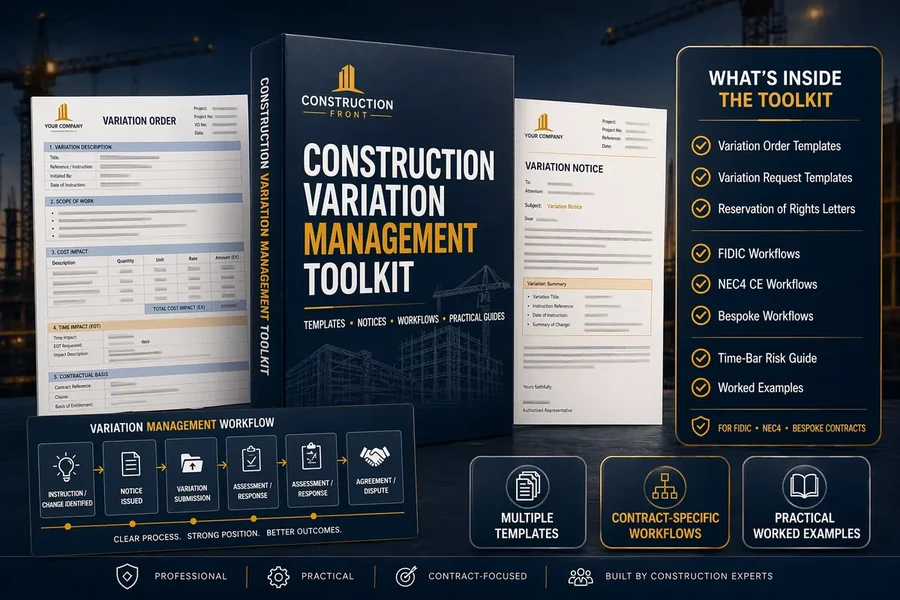
The full toolkit includes the complete NEC4 compensation event guidance, entitlement checklists and worked examples.
Practical Guidance to Protect NEC4 Contractor Entitlement
Contractors administering NEC4 compensation events usually improve outcomes by keeping the process disciplined and boring. Most entitlement failures do not come from exotic legal arguments. They come from ordinary administrative drift.
Practical habits that help include:
- identify potential compensation events early rather than waiting for commercial meetings
- issue notices in a way that clearly links the event to the contract
- keep contemporaneous records from the start
- maintain and update the Accepted Programme properly
- assess programme effect early, not after the quotation has already gone weak
- avoid relying on verbal instructions where the contract needs formal notice
- keep early warning, compensation event notification, quotation, and programme support aligned
- state assumptions clearly where the full effect is not yet fixed
That same discipline also supports stronger wider construction claims and contract administration if the project becomes more contentious later.
Practical Guidance for Project Managements and Employers
For Project Managers and employers, the commercial risk is not only overpaying a weak compensation event. It is also losing control of the process by failing to administer it properly.
That means Project Managers should:
- respond to notifications within NEC timelines
- state clearly whether the event is accepted or rejected and on what contractual basis
- keep instructions, assumptions and assessments aligned with the Accepted Programme
- avoid informal directions that create scope uncertainty
- review quotations for logic, assumptions, mitigation and programme effect rather than only the total figure
- keep early warning and compensation event administration moving together
The delay in responding can create avoidable procedural exposure. Under NEC4’s enforcement mechanisms, failure to respond within the contract timescales can push the process forward in a way that reduces the Project Manager’s control over assessment and can, in some cases, leave the contractor’s quotation standing with much less room to challenge it later.
In practice, poor Project Manager administration can be just as commercially damaging as poor contractor notice discipline.
FAQ
What is a compensation event under NEC4?
A compensation event is a defined NEC4 contractual event that can entitle the contractor to an adjustment to the Prices, the Completion Date and sometimes Key Dates.
How many compensation events are listed in NEC4 ECC clause 60.1?
NEC’s current user guidance says 21 compensation events are listed in clause 60.1 of NEC4 ECC, with further project-specific events also capable of being added through contract data.
What is NEC4 Clause 61 notification?
Clause 61 deals with notification of compensation events. In practical terms, it is the part of the NEC4 compensation event process that determines who notifies, when notification is required, and whether a late notice may damage entitlement.
How long does a contractor have to notify a compensation event under NEC4?
NEC’s published introductory guidance says the contractor generally has eight weeks from the event occurring to notify it where contractor notification is required and the Project Manager has not already done so.
Can failure to issue early warning affect compensation event recovery?
Yes. Early warning and compensation event notification are separate processes, but failure to give early warning can still affect how the compensation event is assessed.
Conclusion
NEC4 compensation events are not difficult because the concept is obscure. They are difficult because the process is unforgiving when notice, records, quotation logic, and programme support fall out of step. Contractors who treat them casually often create their own recovery problems.
The commercial lesson is straightforward: notify early, tie the event to the contract, keep the records clean, and deal with programme effect before the argument hardens. On more exposed projects, structured templates, disciplined notices, and stronger administration processes are usually what keep entitlement from slipping into avoidable dispute.

Sources
- NEC Contracts, Compensation events – an introduction for new NEC users
- NEC Contracts, Clause 60 – compensation events
- NEC Contracts, ECC Risk allocation and compensation events
- NEC Contracts, NEC101 – Compensation Events Webinar Slides (PDF)
- NEC Contracts, NEC101: Compensation Events, an introduction Q&A (PDF)
- NEC Contracts, Resources preparing quotations
- NEC Contracts, Do what NEC4 ECC says or face the ‘enforcement clauses’
- NEC Contracts, Resource-thickening assessments in compensation event quotations
- Construction Front, What Is an Early Warning Notice?
- Construction Front, Change Order
- Construction Front, Construction Change Directive
- Construction Front, Variation Request
- Construction Front, Contractor Variation Request Process
- Construction Front, Time Impact Analysis
- Construction Front, Prolongation Costs
- Construction Front, Notice of Delay
- Construction Front, Construction Claims and Contract Administration
Disclaimer: The articles on this website are for informational and educational purposes only and do not constitute legal or technical advice. While we strive to provide accurate and up-to-date information on construction law, regulations may vary by jurisdiction, and legal interpretations can change over time.