

The contractor variation request process is where entitlement is usually protected or lost.
When the contractor identifies a change early, gives contract-compliant notice, explains the commercial effect, and pushes for written direction, the issue can usually be managed through ordinary contract administration. When that discipline is missing, the same event often reappears later as an unpaid variation, a rejected time claim, or a final-account dispute.
Whether your team calls it a variation request procedure, contractor change request process, or variation notice workflow, the commercial objective is the same: record the change, preserve rights to time and money, and force a clear administrative response before the position drifts.
Quick answer – Contract Variation Request Process
A contractor variation request is a contractor-initiated submission stating that the works, design, quantities, sequence, access, conditions, or method of execution have moved away from the contract baseline and may justify an adjustment to the contract sum, the completion date, or both.
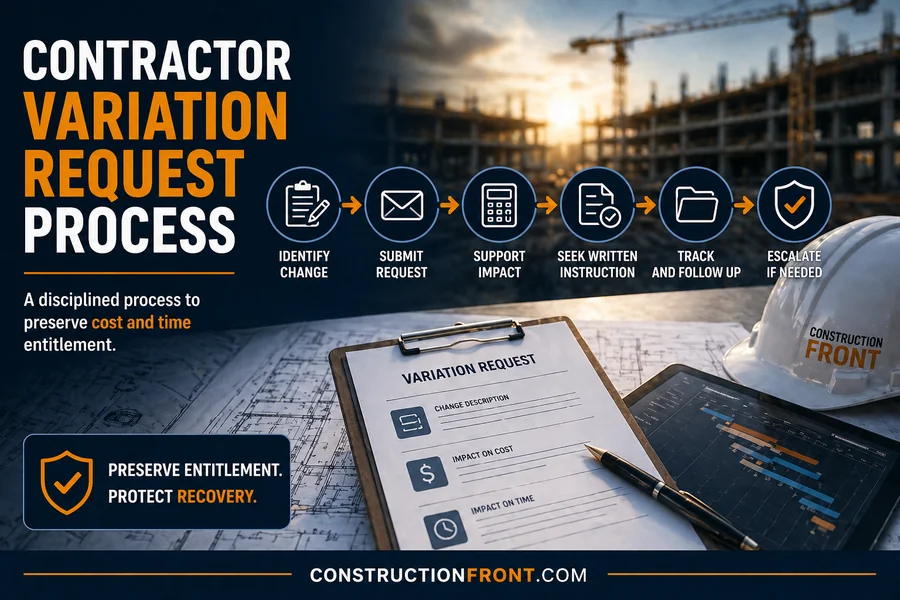
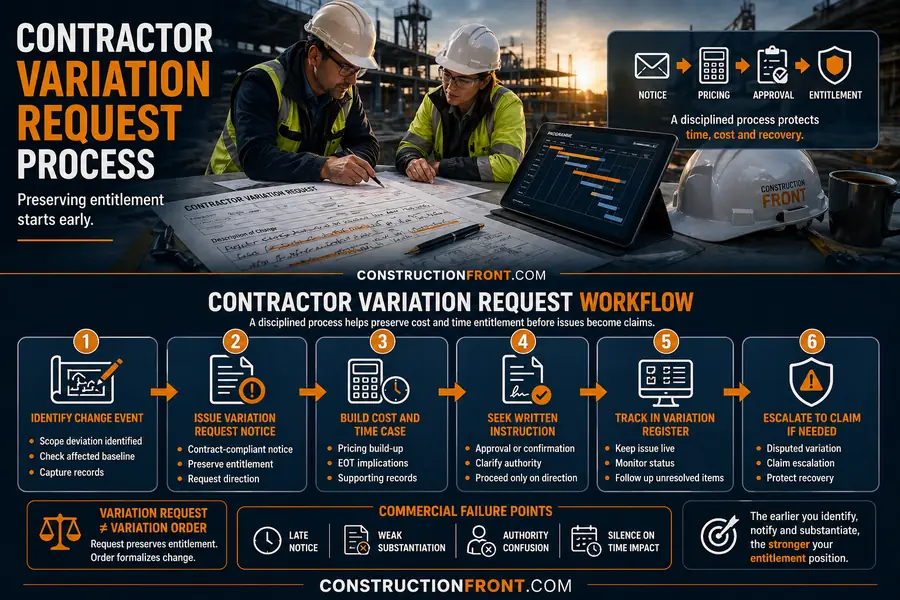
A workable contractor variation request process usually does six things well:
- identifies the change event clearly
- checks notice, authority, and valuation requirements
- issues a clear variation request notice
- supports cost and time consequences with records
- requests written instruction, approval, or confirmation
- keeps the issue live in the variation register until closeout
Many contractors lose valid entitlement long before final account. The failure usually starts earlier: the change is not identified properly, notice is late, pricing is thin, authority is unclear, or the team proceeds on verbal direction and tries to repair the paperwork later.
What is a contractor variation request?
A variation request is a formal contractor-initiated submission stating that a change, additional requirement, omission, substitution, altered condition, access issue, or sequencing change has moved the works away from the original contractual baseline.
In practice, a contractor variation request usually does one or more of the following:
- identifies a change in scope, design, quantities, access, sequence, temporary works, or methodology
- gives notice that the contractor considers the event a variation or potential variation
- explains likely cost and time consequences
- requests instruction, confirmation, valuation, or direction on how to proceed
- reserves rights where valuation, time consequences, or formal instruction remain unresolved
A contractor variation request is not approval. It is the contractor’s documented case that a compensable or contract-relevant change has arisen and must be dealt with under the contract’s variation and notice machinery. Typical triggers include:
- revised drawings or specifications
- discrepancies between issued documents and actual site conditions
- instructed acceleration, resequencing, or changed access arrangements
- added, omitted, or substituted work
- changed temporary works requirements
- out-of-sequence working imposed by others
- authority directions that alter testing, quality requirements, installation sequence, or methodology
The practical test is simple. If the contractor cannot show when the change was identified, when notice was given, what changed, what records support it, and how cost and time were affected, entitlement becomes much harder to prove and negotiate.
Variation request vs variation order
Contractors and owners often blur these terms. That creates avoidable disputes, especially when teams treat a discussion, sketch, meeting note, or email as if it were a formal instruction.
A contractor variation request is the contractor’s submission. A variation order is usually the formal instruction, approval, or contract change instrument issued by the party with authority under the contract.
| Item | Contractor Variation Request | Variation Order |
|---|---|---|
| Who initiates it? | Usually the contractor | Usually the owner, employer, engineer, superintendent, or contract administrator acting under contract authority |
| What is it for? | To notify, explain, price, and seek recognition of a change | To direct, confirm, approve, or formalize the changed work |
| Does it create approval by itself? | No | Usually yes, subject to contract wording and authority |
| Main purpose | Preserve entitlement and start the contractual process | Formalize the change for execution, valuation, and administration |
| Key risk if mishandled | Late notice, weak substantiation, authority confusion, loss of time rights | Unclear scope, valuation disputes, uncertified work, execution ambiguity |
That distinction matters commercially. The contractor’s request starts the entitlement process, but it does not necessarily authorize execution. A contractor may identify a valid variation event, submit a strong request, and still need a formal instruction before proceeding.
Equally, the contractor may receive an urgent field direction from someone without authority. That is a high-risk position: the work may be done, but entitlement may still be challenged.
Why the process matters commercially
Variation events are one of the fastest routes to cost growth, delay exposure, productivity loss, and payment disputes. The contractor variation request process is where the project team starts protecting recovery instead of arguing about it months later.
The external research listed in the sources points in the same direction as project practice: change orders and variation orders are strongly associated with cost overruns, delay, management weakness, and closeout friction when change is identified late or administered poorly.
Commercially, the process protects:
- recovery of direct costs
- recovery of preliminaries, supervision, attendance, and site overhead impact
- extension of time position where progress is affected
- protection from downstream exposure such as liquidated damages in construction contracts
- leverage in interim payment, certification, and final-account negotiations
If the event affects progress, the variation file should not sit on its own. In practice, it often needs to connect with construction claims and contract administration, a notice of delay, and a potential extension of time claim. That link should be made early, while records are current and before the commercial position hardens.
Step-by-step contractor variation request process
The contractor variation request process works best when it follows a disciplined sequence. The objective is to separate change identification, notice, entitlement framing, pricing, time assessment, instruction, tracking, and escalation.
Step 1: Identify the change event clearly
Start with the event, not the conclusion.
Record:
- what changed
- when it changed
- who initiated or caused it
- what contract documents are affected
- whether the work is additional, omitted, substituted, resequenced, or disrupted
- whether time, access, productivity, or milestone achievement is likely affected
Use objective project records at this stage:
- drawings and revisions
- RFIs and responses
- site instructions
- meeting minutes
- emails
- inspection requests
- daily reports
- photographs
- programme updates
- site diaries
- marked-up plans and sketches
Do not wait for the full cost impact before identifying the event. Early identification is what allows timely notice and a cleaner entitlement record.
Step 2: Check the contract procedure immediately
The contract controls the route to entitlement. Check:
- who has authority to instruct change
- what the notice period is
- whether notice must be given before the changed work is carried out
- whether the contractor must stop, proceed, mitigate, or await instruction
- how valuation is to be prepared
- whether contract rates, new rates, quotations, dayworks, or reasonable valuation principles apply
- whether time impact must be notified separately
- whether there are strict time bars, condition precedents, or documentation requirements
This is where the process becomes entitlement protection rather than general correspondence. If the contract requires notice within a defined period, missing that deadline can materially damage recovery even where the underlying change is real.
Where progress is affected, align the variation pathway with delay administration from the start. If sequence or access is changing, connect the issue to programme logic and records that may later support delay analysis methods or deal with concurrent delay.
Step 3: Issue a variation request notice
The first formal submission should usually be a variation request notice, even if full pricing is not ready. That notice should state:
- the event and date
- why the contractor considers it a variation or potential variation
- the affected work areas, packages, or contract items
- whether additional cost is expected
- whether time impact is possible or likely
- whether further particulars will follow
- whether the contractor requires instruction, clarification, or confirmation to proceed
Keep the notice direct. Do not bury the point in general correspondence. A weak notice says: “Please advise regarding revised drawing.”
A useful notice says: “The revised drawing issued on 22 April 2026 changes reinforcement layout and lap lengths in Area B. The contractor considers this a variation event and reserves entitlement to adjustment of contract sum and time pending detailed assessment.”
That wording works because it identifies the trigger, states the contractual position, and preserves the commercial consequence in the same communication.
Step 4: Build the scope and entitlement basis
After notice, convert the issue into a structured entitlement case. Set out:
- original scope basis
- changed scope basis
- contractual mechanism relied on
- causation between the event and the added work or impact
- affected quantities, labour, plant, materials, subcontract scope, and preliminaries
- whether there is inefficiency, resequencing, access loss, disruption, or abortive work
- whether the contractor was instructed to proceed before valuation was agreed
This is where weak requests usually fail. They assert change without proving the path from event to entitlement. A stronger approach is to show the chain:
- original contract requirement
- changed requirement or condition
- effect on execution
- cost effect
- time effect
- contractual basis for adjustment
That sequence allows the reviewer to certify, negotiate, or dispute specific components instead of rejecting the whole submission as vague.
Step 5: Price the variation properly
Do not submit a one-line price if the event has real commercial weight. A proper pricing package may include:
- quantity take-off
- build-up of labour, plant, and materials
- subcontract quotations
- revised temporary works, access, logistics, or protection cost
- preliminaries impact
- supervision and attendance
- overhead and margin where the contract allows
- supporting contract rates, derived rates, or new rate analysis
- assumptions, clarifications, and exclusions
Where the impact is evolving, submit the best current valuation and make the status clear:
- budget estimate
- preliminary quotation
- measured valuation
- daywork-backed valuation
- assessed loss pending final measure
If time is also affected, say so expressly. Cost-only submissions on time-sensitive changes often create avoidable recovery gaps later, particularly where the certifier treats silence on time as acceptance that completion is unaffected.
Step 6: Assess the time impact early
Not every variation affects completion, but many do affect progress, sequence, productivity, or resource loading. Assess whether the change causes:
- additional duration
- delayed access
- critical path movement
- out-of-sequence work
- stacking of trades
- reduced productivity
- extended site overhead
- acceleration pressure
- milestone slippage
If the variation may affect completion, the contractor should not wait until project end to say so. Link the request to the programme and preserve the right to separate or later-developed delay submissions. Articles on delays, disruptions, and liquidated damages and prolongation costs are useful framing references where the change moves beyond straightforward measure-and-value administration.
A practical discipline is to distinguish between:
- immediate time impact known now
- likely time impact requiring further programme analysis
- downstream disruption or prolongation that may only be quantifiable later
That keeps the notice timely without pretending the analysis is complete when it is not.
Step 7: Request instruction, confirmation, or approval
The process must end in an administrative act, not just a contractor email trail. Ask for one of the following, depending on contract structure:
- formal variation instruction
- written confirmation to proceed
- approval of quotation
- valuation assessment
- clarification of scope and authority
- confirmation that work is to be treated as disputed pending determination
Do not assume silence equals approval. If the contractor is directed to proceed before valuation is agreed, record that position clearly and preserve the unresolved commercial issues, including rate basis, time consequences, and any reservation of rights.
Step 8: Track status until it is closed out
Every variation request needs a live status in a variation register. Use a register that records:
- request number
- event date
- notice date
- date of detailed submission
- scope summary
- cost submitted
- time effect flagged
- instruction status
- valuation status
- approved amount
- disputed amount
- responsible action owner
- next review date
This is basic contract administration, but it is also one of the easiest points for entitlement leakage. Untracked requests turn into stale issues, then payment disputes, then final-account arguments over records that should have been resolved months earlier.
Step 9: Escalate to claim if the issue is not resolved
A variation request and a claim are not always the same thing.
If the other side refuses to recognize the change, does not issue instruction, disputes valuation, rejects time impact, or certifies only part of the submission without clear basis, the matter may need to move into a formal claim pathway.
Typical escalation points are:
- denied variation status
- no response within the contractual timeframe
- disagreement on measure or rates
- refusal of time consequences
- instruction to proceed without commercial resolution
- cumulative disruption or prolongation effects beyond the immediate variation value
At that point, the variation record becomes part of the claims record. If entitlement is preserved early, escalation is easier and cheaper. If early records are weak, later claim preparation becomes defensive, expensive, and harder to prove.
Contractor variation request workflow / checklist
Use this workflow on live projects to keep notice, pricing, time impact, and instruction aligned.
Quick workflow
- Identify the event.
- Check contract notice, authority, and valuation requirements.
- Issue the variation request notice.
- Secure records of original scope and changed scope.
- Build pricing and time impact assessment.
- Request written instruction, approval, or confirmation.
- Update the variation register.
- Escalate unresolved items through claim procedures if needed.
Practical checklist
- Has the changed requirement been described precisely?
- Have you identified the drawing, instruction, RFI response, site condition, or direction that triggered the change? (worth reading – When Does an RFI Become a Variation? A Practical Construction Contract Guide)
- Have you checked who has authority to instruct the change?
- Have you issued notice within the contractual period?
- Have you reserved rights on cost and time where the impact is still developing?
- Have you linked the issue to relevant drawings, emails, RFIs, site records, and programme records?
- Have you measured the direct cost effect?
- Have you considered labour inefficiency, resequencing, supervision, attendance, and preliminaries?
- Have you assessed whether completion, sectional completion, or interim milestones are affected?
- Have you requested written instruction or formal confirmation to proceed?
- Is the request logged in the variation register with a next action and response date?
- If unresolved, have you identified when the matter must escalate to a claim?
Practical Contractor Variation Request Template
Use this as a working draft on live projects and adapt it to your contract form. The worked example follows below.
Variation Request No.: VR-___
Project: ___
Contract No.: ___
Date: ___
To: ___ From: ___
Subject: Contractor Variation Request — [short description]
1. Change Event
Describe the event that gives rise to the request, including the date, instruction, drawing revision, site condition, or other trigger.
2. Original Contract Position
State the relevant original scope, drawing, specification, sequence, access arrangement, or other contractual baseline.
3. Changed Requirement / Condition
State what has changed and why the contractor considers it a variation or potential variation.
4. Contractual Basis
Identify the relevant contract clause, variation mechanism, notice requirement, or other contractual entitlement basis.
5. Cost Impact
State the estimated or assessed cost effect. Attach supporting build-up, quotations, measures, dayworks, or rate analysis. State whether the amount is preliminary or final.
6. Time Impact
State whether time is affected, potentially affected, or not yet fully assessed. Identify the likely mechanism.
7. Required Action
Request formal instruction, confirmation to proceed, valuation approval, or other decision required under the contract.
8. Reservation of Rights
The contractor reserves rights to adjustment of contract sum and time pending final determination where applicable.
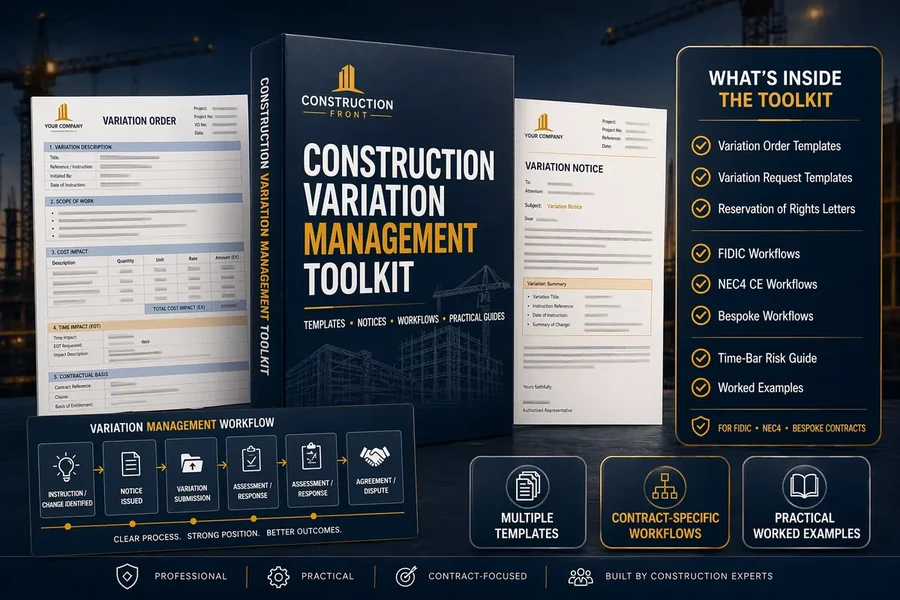
The full toolkit includes the complete editable template plus worked examples across multiple variation scenarios — FIDIC, NEC4 and bespoke contracts.
Worked Example
Variation Request No.: VR-017
Project: Logistics Warehouse Expansion
Date: 26 April 2026
Subject: Additional drainage pits and revised pipe alignment at northern hardstand
1. Change Event
Drawing C-214 Rev 5 issued on 24 April 2026 adds two drainage pits and revises the underground pipe route to avoid recently identified utility congestion.
2. Original Contract Position
The tender drawing set showed one pit and a shorter straight-line pipe route through the northern hardstand.
3. Changed Requirement / Condition
The revised design requires additional excavation, extra pit construction, additional pipe length, revised bedding quantities, and changed excavation sequencing around existing services.
4. Contractual Basis
The contractor considers this a variation because the revised issued-for-construction drawing changes the original contract scope. This notice is issued to preserve entitlement under the contract variation and notice provisions.
5. Cost Impact
Preliminary assessed cost impact: $38,450, made up of:
— excavation and disposal: $6,800
— extra pits and concrete works: $12,900
— additional pipework and fittings: $8,750
— service locating and hand excavation: $4,500
— revised traffic management and supervision: $3,200
— subcontract margin and attendance: $2,300
Detailed pricing build-up is attached. The amount is submitted as a preliminary valuation pending final measure of installed quantities.
6. Time Impact
The change is likely to affect the area handover milestone by 3 working days due to utility avoidance measures, constrained excavation around live services, and out-of-sequence working. A detailed programme impact submission will follow.
7. Required Action
Please confirm this change as a variation and issue written instruction or approval to proceed with the revised drainage layout.
8. Reservation of Rights
The contractor reserves entitlement to adjustment of contract sum and extension of time arising from this change, including any resulting prolongation, disruption, supervision, and site-overhead effects if they materialize.
The full toolkit includes this complete worked example plus additional scenarios covering owner-directed changes, RFI-triggered variations, latent conditions, and acceleration instructions.
Common mistakes that cause entitlement loss
1. Treating the request as paperwork instead of entitlement protection
If the team sees the variation request as a back-office form, notice will be late and records will be thin.
2. Proceeding on verbal direction without confirming authority
A direction from site staff is not always a valid contractual instruction. Record who said what, when, and under what authority. If urgent work proceeds, record that it proceeded under protest or pending formal confirmation where the contract allows.
3. Sending vague notices
“Please advise” is not a variation notice. State the event, the contractual significance, and the likely cost and time consequences.
4. Waiting for final pricing before giving notice
Notice and pricing are not the same step. Late notice often causes more damage than incomplete early pricing.
5. Failing to distinguish variation from separate claim elements
A change may begin as a variation and later generate delay, disruption, acceleration, or prolongation issues. Keep those pathways connected but distinct.
6. Ignoring time impact
Many teams submit only the cost side. Later they face rejected time arguments because the early record never flagged schedule consequences.
7. Poor backup
No marked-up drawings, no quantities, no photos, no programme extracts, no cost build-up, no clear link to the baseline scope. That turns a valid event into a weak file.
8. Letting requests go stale
Unanswered variation requests must be chased, registered, and escalated. Silence is not closure, certification, or approval.
9. Missing time bars and notice deadlines
Some contracts require variation notices, cost notices, or time-impact notices (e.g notice of delay) within strict time periods. If the contractor misses a contractual deadline, the other side may argue that entitlement is reduced or lost completely, even if the underlying change is real – in other words, being time barred. The safer approach is to identify the relevant notice period as soon as the event arises and issue a protective notice before pricing is complete.
For Contractors
For contractors, the variation request process should operate as a field-to-commercial workflow, not just a commercial manager task. Key operating points:
- train site engineers, supervisors, and project managers to identify variation events early
- use a standard notice form so the first record is not improvised every time
- separate “event identified” from “valuation complete” so notice is never delayed by pricing
- check authority carefully and confirm whether the direction came from someone empowered under the contract
- tie every request back to the original contractual baseline, not just the latest site conversation
- track time impact from the first sign of resequencing, access change, or productivity loss
- keep a live register and review it weekly with project and commercial teams
- if the event starts affecting completion, connect the file to delay notices, programme updates, and claims strategy immediately
A contractor that manages this well usually improves both recovery and negotiating position. A contractor that manages it badly usually ends up arguing from memory at final-account stage.
For Owners / Contract Administrators
For owners and contract administrators, a disciplined contractor variation request process is not a nuisance. It is a control mechanism that helps separate genuine change from poor scope definition, late pricing, or informal site drift.
Key operating points:
- require a clear description of the change event and the affected contract baseline
- confirm promptly whether the submission is accepted as a variation, a potential variation, or a disputed matter
- make authority lines clear so site direction does not become a source of ambiguity
- distinguish between scope clarification, correction of defective work, and actual scope change
- respond quickly where progress depends on instruction
- make the valuation pathway clear: contract rates, build-up, quotation, measured work, or dayworks
- where time impact is raised, require supporting programme logic and contemporaneous records
- keep the register current so unresolved items do not accumulate into avoidable dispute
Owners benefit from good variation administration for the same reason contractors do: unresolved change events distort cost reporting, payment certification, schedule forecasting, contingency use, and final-account settlement.
Commercial and Contractual Implications
A contractor variation request can affect much more than the immediate value of changed work. It can influence:
- interim payment entitlement
- margin recovery
- preliminaries and site overhead recovery
- extension of time entitlement
- exposure to liquidated damages
- final-account leverage
- dispute posture
- cash flow timing
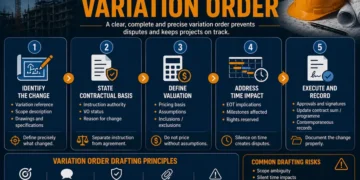
The process needs to distinguish five related stages:
Change identification
The project team identifies that the actual requirement has moved away from the contract baseline.Notice
The contractor formally preserves position and alerts the other side to cost and time consequences.Pricing / proposal
The contractor converts the event into a commercial submission with measurable support.Instruction / approval
The contract administrator or owner issues the administrative act needed to formalize, value, or direct the change.Claim escalation
If the matter remains unresolved, denied, or undervalued, it moves into the claims framework.
Confusing these stages creates entitlement problems. A contractor may have a valid change but still lose leverage because notice was poor, authority was unclear, or time consequences were never flagged. An owner may receive a genuine issue but mishandle it by delaying instruction until the operational effect has already compounded into disruption, acceleration pressure, or uncertified cost.
Project practice and the research cited in the source list point to the same conclusion: variations do not become expensive only because scope changes. They become expensive because change is identified late, decisions are slow, records are weak, valuation is delayed, and time consequences are handled after the work has already moved on.
The practical takeaway is straightforward: The contractor variation request process is not just how to submit a variation request. It is how the contractor preserves entitlement, how the contract administrator controls change, and how both sides stop a manageable event from turning into a claim.
FAQ
Is a contractor variation request the same as a variation order?
No. The request is the contractor’s submission. The order is typically the formal instruction or approval issued under the contract by the party with authority.
How do you submit a contractor variation request?
Identify the change event, check the contract notice and authority requirements, issue a clear variation request notice, support the cost and time consequences, and request written instruction or confirmation. Then keep the matter live in the variation register until it is resolved.
When should a contractor submit a variation request?
As soon as the contractor identifies a change event or potential change event and after checking the contract notice requirements. Do not wait for full pricing if notice is already due (avoid being time barred).
Can a contractor submit a variation request before the full cost is known?
Yes. In many cases that is the right approach. Submit notice first, then follow with detailed valuation and time impact.
Does every variation request also require a delay notice?
No. Only where the change affects progress, sequence, access, productivity, resources, milestones, or completion. But if time impact is possible, flag it early.
What should be attached to a contractor variation request?
Usually revised drawings, marked-up plans, quantity take-off, quotations, dayworks, photos, programme extracts, and relevant correspondence.
What if the owner or contract administrator does not respond?
Keep the request live in the register, follow up in writing, and escalate through the contract claims process if required. Do not assume silence is approval.
Can a contractor proceed without written instruction?
That depends on the contract and the circumstances. If work must proceed, record the direction, the authority position, the reason work proceeded, and the unresolved commercial issues immediately.
Why do contractors lose variation entitlement?
The usual causes are late notice, unclear authority, poor records, weak pricing, failure to flag time impact, and letting unresolved requests drift into final account.
Sources
- Ojo Ayodeji Sunday, Impact of Variation Orders on Public Construction Projects
- Loai Alkhattabi, Ahmed Alkhard, Ahmed Gouda, Effects of Change Orders on the Budget of the Public Sector Construction Projects in the Kingdom of Saudi Arabia
- CIB W55 / University of Southern Queensland repository, Security of Final Account Payments: The Case of New Zealand
- Construction Front, What Is a Variation Order?
- Construction Front, Variation Request
- Construction Front, What Is an Extension of Time Claim?
- Construction Front, Liquidated Damages in Construction Contracts
- Construction Front, Delays, Disruptions and Liquidated Damages
- Construction Front, Delay Analysis Methods
- Construction Front, Prolongation Costs
- Construction Front, Notice of Delay
- Construction Front, Construction Claims and Contract Administration
- Construction Front, Concurrent Delay
Disclaimer: The articles on this blog are for informational and educational purposes only and do not constitute legal or technical advice. While we strive to provide accurate and up-to-date information on construction law, regulations may vary by jurisdiction, and legal interpretations can change over time.