

On most construction projects, an RFI is intended to be a request for clarification. In principle, that sounds straightforward. If the contractor needs more information, it asks a question, and the designer, superintendent, or employer responds. In practice, however, the line between clarification and change is often far less clear.
That matters because an RFI may start as a simple request for information, but the response may go beyond clarification and alter the work, the sequence, the detail, the materials, or the design responsibility. When that happens, the issue may no longer be just an RFI. It may become relevant to variation, delay, cost entitlement, and disputes over who bears the risk under the contract.
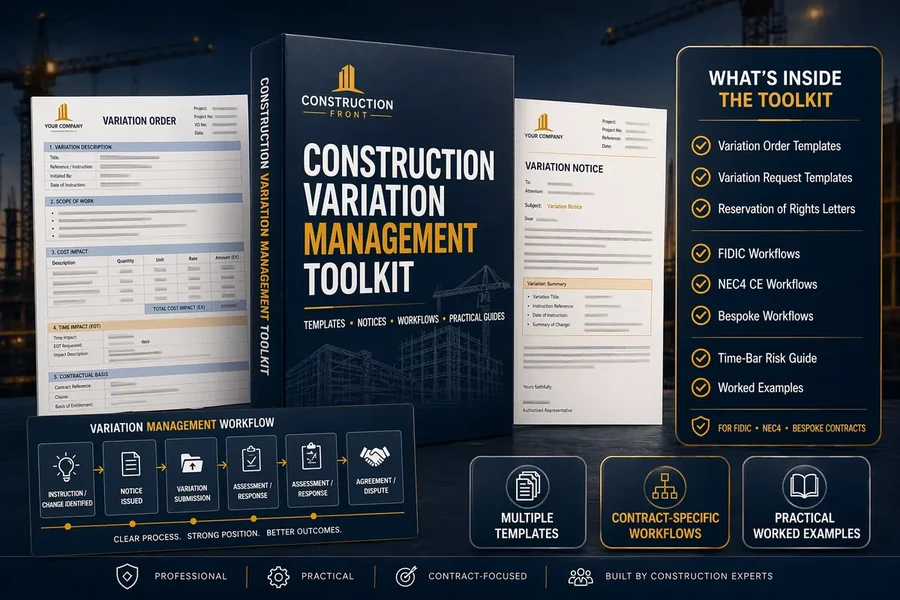
In simple terms, an RFI becomes a variation when the response changes the original contractual requirement, such as the scope of works, specification, sequence, design detail, or allocation of responsibility, rather than merely explaining what was already required. In this article, we explore how that happens in practice, why the distinction matters commercially, and how project teams can manage this issue more carefully.
What is the difference between an RFI and a variation?
An RFI, or Request for Information, is usually a formal written query raised when the contract documents, drawings, specifications, or site information do not provide enough clarity to proceed properly.
A variation, by contrast, usually involves a change to the original scope, design, quantity, quality, sequence, or method of carrying out the works. Where that change is formally instructed under the contract, it will often be issued as a variation order.
In theory, the distinction is simple:
- an RFI asks for clarification
- a variation changes the work
The difficulty is that many project communications do not stay neatly within one category. A response intended as clarification may in substance introduce new work, revised detail, or altered sequencing. That is where the commercial and contractual issues begin.
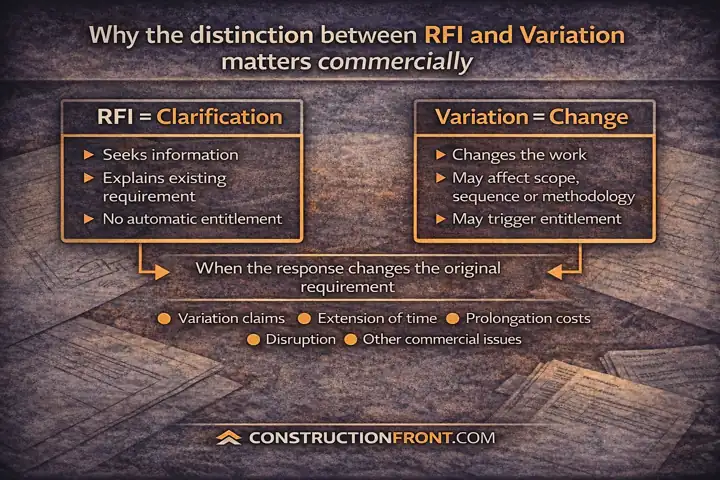
Why the distinction matters commercially
The difference between an RFI and a variation matters because the legal and commercial consequences are different. If the response to an RFI is merely a clarification of what was already required, the contractor may have no entitlement to additional time or money. If the response changes the requirement, however, the contractor may argue that:
- the original documents were incomplete or unclear
- the response introduced extra work
- the revised requirement changed the sequence or methodology
- the issue affected time, cost, productivity, or procurement
- a formal variation request should be recognised
That distinction can directly affect or lead to:
- entitlement to variation claims
- extension of time claims, and eventually prolongation costs
- Disruption of activities on site
- Other commercial issues
In practice, disputes often arise because the contractor reviews the original contract documents and concludes that the information provided in response to an RFI goes beyond clarification and gives rise to a claim for additional time, cost, or both. In other words, what looks like an ordinary technical exchange can later become a major commercial issue.
When does an RFI become a variation in practice?
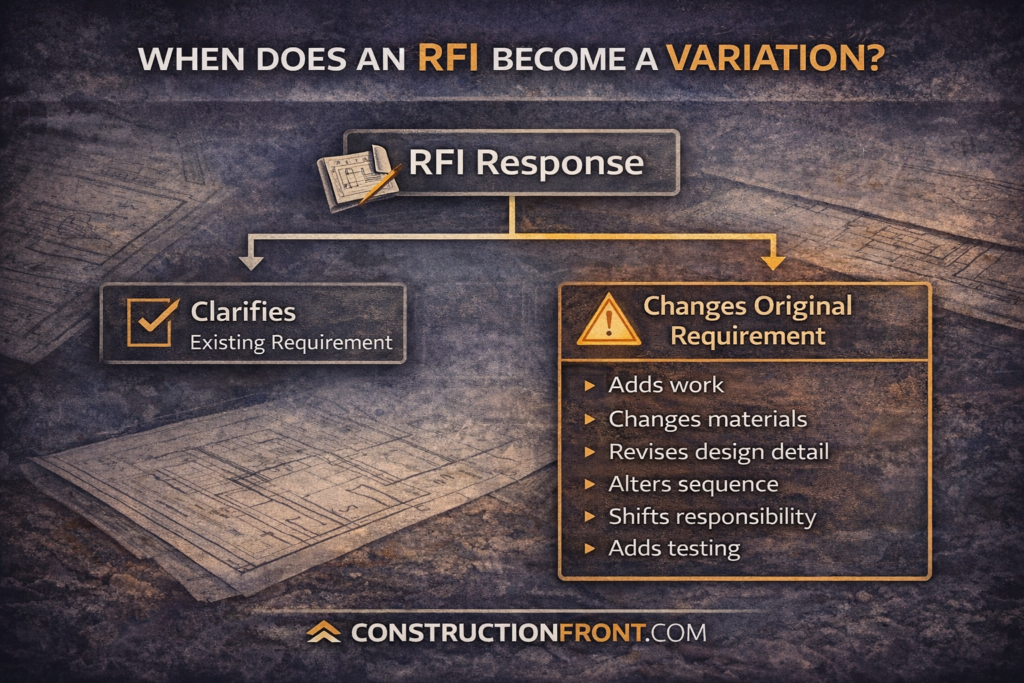
An RFI usually becomes a variation when the response does more than explain the existing requirement and instead changes what the contractor is required to do. This may happen where the response:
- adds work not reasonably inferable from the original documents
- changes dimensions, quantities, materials, or specification levels
- revises the design detail
- alters the sequence of work
- changes access or interface assumptions
- imposes additional testing or performance requirements
- shifts responsibility between parties
- requires different temporary works or construction methodology
The underlying question is not what the document is called, but what it actually does in contractual and practical terms.
An RFI is not usually the contractual mechanism for directing a change. However, if the response instructs the contractor to proceed on a revised basis, introduces a new requirement, or removes an assumption on which the contractor priced and planned the work, the substance of that response may support a variation argument even if the communication is labelled only as a clarification.
A response labelled “clarification” may still be a variation in substance if it changes the original contractual obligation.
Common situations where the line becomes blurred
This issue arises frequently in live projects because the design and delivery process is rarely perfectly clean. Typical grey areas include:
| Situation | Why it may become a variation |
|---|---|
| Missing design detail | The response introduces a new requirement rather than clarifying an existing one |
| Conflicting drawings | The selected solution increases scope, cost, or complexity |
| Material substitution | The response requires a different material or higher specification |
| Interface clash | The solution shifts work or responsibility to another party |
| Revised sequencing | The response forces a different construction sequence or temporary works approach |
| Additional testing | The answer introduces extra commissioning, inspection, or performance obligations |
| Site condition issue | The response requires work beyond what was reasonably foreseeable from the contract documents |
These situations matter because they affect more than document classification. They may change pricing assumptions, trigger notice obligations, alter programme logic, and shift risk between the parties.
That is why the distinction between an RFI and a variation should be analysed by reference to the contract, the original design information, and the actual effect of the response on time, cost, and responsibility. Where the issue arises from unexpected physical conditions, it may also overlap with latent conditions in construction.
A practical example: extra concrete joints
A good example is where the issued concrete drawings do not clearly show whether additional construction joints, movement joints, or saw-cut joints are required.
The contractor raises an RFI asking:
- whether extra joints are required
- where they should be located
- what detail applies
- whether reinforcement or pour sequence is affected
If the response simply confirms what was already implicit in the drawings and specification, the matter may remain a clarification.
But if the response introduces additional joints that were not reasonably apparent from the original design, changes reinforcement detailing, alters the pour sequence, or adds labour, material, or supervision requirements, the issue may go beyond clarification.
At that point, the contractor may reasonably argue that the additional joints were not apparent from the issued design, were not allowed for in its price or construction planning, and that the response has introduced a change for which a variation or associated time and cost entitlement should be assessed.
This is a practical reminder that the key issue is not whether the exchange started as an RFI. The real issue is whether the answer changed the work.
Why wording matters so much
Disputes often arise in this area because RFI responses are drafted in practical, site-facing language without enough attention being paid to their contractual effect. On a live project, teams commonly use phrases such as:
- “please proceed as follows”
- “use this revised detail”
- “install additional support”
- “change the sequence accordingly”
- “provide extra reinforcement in this zone”
On their face, these statements may look like ordinary operational guidance. In substance, however, they may do far more than clarify the existing requirement. If the response introduces additional work, revises the design, alters sequencing, or changes the basis on which the contractor priced or planned the works, it may have the effect of changing the contractor’s obligations under the contract.
For that reason, the wording of an RFI response should never be treated as a minor administrative detail. A genuine clarification explains what the contract already requires. If the response changes that requirement, it should be identified and administered as a change through the proper contractual mechanism.
What contractors should do?
From a contractor’s perspective, this issue needs to be addressed carefully and at an early stage, before the matter is absorbed into ordinary project correspondence. If the contractor considers that an RFI response has gone beyond clarification, it should usually:
- review the original contract documents carefully
- identify precisely what has changed
- assess whether the response affects time, cost, methodology, procurement, or sequencing
- avoid proceeding without reservation where entitlement may be affected
- issue the appropriate notice or, where required by the contract, an early warning or equivalent contractual notification
- preserve a clear contemporaneous record of the instruction, its impact, and the surrounding correspondence
At the same time, contractors should avoid treating every clarification as a variation. Credibility is important in contract administration, particularly where a claim may later depend on the quality of the record and the reasonableness of the contractor’s position. Where the response genuinely changes the contractor’s obligations, however, the issue should not be left to disappear into routine exchanges.
Depending on the facts, the matter may later become relevant to extension of time, prolongation costs, or broader delay and disruption claims. If notice timing becomes contentious, the analysis may also involve the time bar clause and the enforceability of such provisions, as discussed in Are Time Bars Enforceable in Construction Contracts?.
What owners, superintendents, and designers should do?
From the owner-side perspective, the main risk is that an informal response to an RFI may create the substance of a variation without being recognised and administered as such under the contract. A disciplined response process should therefore:
- check whether the answer genuinely clarifies the original requirement
- consider whether the response changes scope, sequence, design detail, or allocation of responsibility
- avoid issuing directions through casual or operational wording where a contractual change is intended
- use the correct contractual mechanism when the response goes beyond clarification
- maintain a clear and consistent contract administration trail
A careless response can create significant downstream issues. If the wording effectively directs additional or different work, the contractor may later argue that the response gave rise to a compensable variation or amounted in substance to a variation order, even if it was not labelled that way at the time.
Practical signs that an RFI response may be a variation
Certain features often indicate that an RFI response may no longer be operating as a simple clarification.
- The response introduces something that was not reasonably inferable from the contract documents.
- The response changes the quantity, detail, specification, sequence, or method of the work.
- The response affects procurement, fabrication, temporary works, access planning, or interface management.
- The response gives rise to a likely time or cost consequence.
- The response would be difficult to characterise as already included without stretching the original meaning of the documents.
Where several of these indicators are present, the issue should be examined carefully against the contract terms, the original design information, and the practical effect of the response on the contractor’s obligations.
Final Thoughts
An RFI becomes a variation when the response changes the original contractual requirement rather than simply clarifying it. The principle is straightforward, but its application on a live project is often much less clear — particularly where incomplete design information, sequencing constraints, or informal project communications are involved.
The difference between a clarification and a change can be the difference between no entitlement and a valid variation claim. Identifying it early, notifying it correctly, and preserving a clear contemporaneous record is where entitlement is protected or lost.
FAQs
Is every RFI response a variation?
No. An RFI response is not automatically a variation. If it merely clarifies what was already required under the contract, it will usually remain a clarification. The issue becomes more complex where the response changes the contractor’s obligations in substance, whether by adding work, revising detail, altering sequence, or shifting responsibility.
Can an RFI response entitle the contractor to extra time or money?
Potentially, yes. If the response changes the work, affects productivity, alters procurement, or disrupts the planned sequence, the contractor may argue that it has become entitled to additional time, additional payment, or both. Whether that entitlement succeeds will depend on the contract terms, the original documents, the notices given, and the quality of the contemporaneous record.
Does an RFI count as a contractual notice?
Usually not. An RFI is generally a request for information rather than a formal contractual notice. Even so, the response to an RFI may later become important evidence if it effectively directs a change or alters the basis on which the works are to be carried out.
What should a contractor do if an RFI response changes the work?
The contractor should review the original contract documents, identify precisely what has changed, assess the likely time and cost implications, and issue any notice required by the contract without delay. It should also preserve a clear contemporaneous record so that the issue does not disappear into routine project correspondence.
What is the key test for deciding whether an RFI has become a variation?
The key test is whether the response merely explains the existing contractual requirement or instead changes what the contractor is required to do. Labels matter far less than substance. If the response changes the contractor’s obligations in practical or contractual terms, the issue may need to be treated as a variation.
Need Help?
Do not hesitate to contact us (click here) for specialised advice in the construction industry.
Disclaimer: The articles on this blog are for informational and educational purposes only and do not constitute legal or technical advice. While we strive to provide accurate and up-to-date information on construction law, regulations may vary by jurisdiction, and legal interpretations can change over time.