

Projects rarely drift off programme because of one isolated event. More often, the problem starts with late information, restricted access, design changes, procurement delay, slow approvals, productivity loss, or failed recovery efforts.
When that happens, teams do not have the luxury of treating delay analysis as a theoretical exercise. They need to decide quickly whether the record is strong enough to support an extension of time position, defend exposure to liquidated damages, or justify moving into a more detailed forensic review before commercial positions harden.
As planned vs as built is one delay analysis method that compares the baseline programme against the actual sequence and timing of the works to identify where delivery departed from plan. It is not a comparison between two separate methods – Whole-project review and windowed review are simply different ways of applying the same planned-versus-actual method.
That distinction matters in practice because the wrong approach can weaken a live extension of time claim, overstate a defense to liquidated damages, or create a delay narrative that shows slippage without proving who carries the contractual risk. On many projects, this method is used first to decide whether the issue can be resolved through a clear factual comparison or whether the records point toward a more dynamic analysis. Typically, delay entitlement is not lost because the delay did not occur. It is lost because the records, notices, and supporting structure are too weak to prove it properly.
It also has limits. On a simpler project with a stable path to completion, it may be enough to frame the delay position. On a more complex claim involving resequencing, changing critical paths, mitigation, pacing, or concurrent delay, it may establish that slippage occurred without proving the full contractual effect of each event.
What the As-Planned vs As-Built Method Actually Does
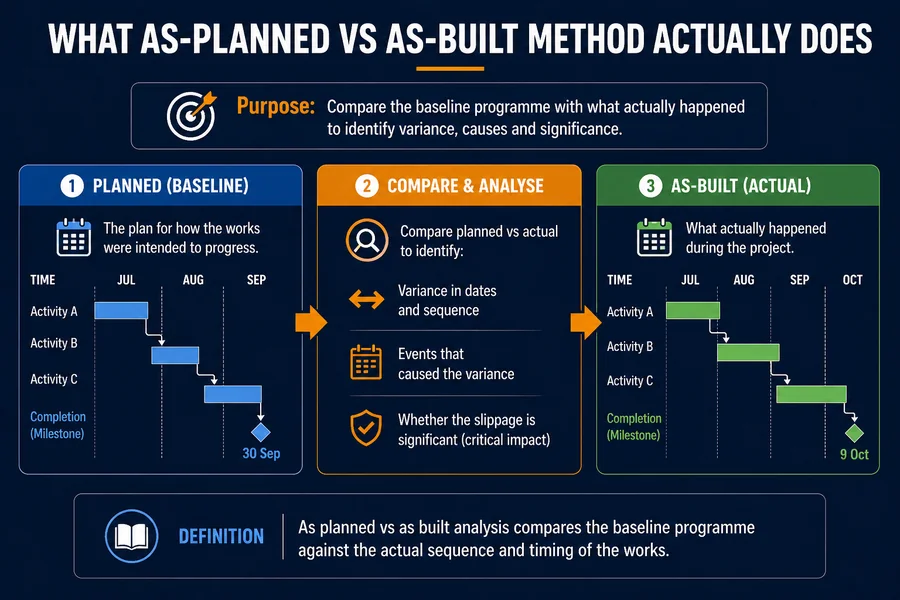
The as planned vs as built method starts with a planned programme, usually the accepted baseline, and compares it against what actually happened on the project. The actual record may come from programme updates, progress reports, site diaries, milestone logs, meeting minutes, payment records, procurement records, or a reconstructed as-built sequence supported by contemporaneous documents.
The core exercise is straightforward:
- Identify the key planned dates, logic, durations, and completion path in the baseline.
- Establish the actual start dates, finish dates, sequence changes, and real progress path from the project records.
- Measure the variance between planned and actual performance.
- Investigate the events that caused that variance.
- Assess whether the slippage is commercially and contractually significant.
Used properly, this is a delay analysis method, not just a progress summary. It connects planned dates, actual dates, and causation. But it does so through observation and variance review rather than through detailed prospective or retrospective modelling.
That sits comfortably with AACE International Recommended Practice 29R-03. AACE classifies forensic schedule analysis methods by factors such as timing, logic treatment, and implementation, and it notes that industry labels are often used loosely.
In practical terms, as planned vs as built is generally treated as an observational method that relies on comparing the planned position with the actual record and then testing the significance of the variance.
One Method, With Whole-Project and Windowed Variants
This point needs to stay clear because the method is often described inaccurately. As planned vs as built is one method family. It is not “as-planned analysis” on one side and “as-built analysis” on the other as though they were competing techniques. The analysis is the comparison between the plan and the actual build. That comparison can be carried out in two common ways:
Project-Wide Retrospective Review
This is the broadest application. The analyst compares the baseline against the final as-built outcome across the whole project. It is useful where the immediate question is whether the works finished materially later than planned, which major activities slipped, and whether the overall delay pattern is obvious.
The Society of Construction Law Delay and Disruption Protocol recognises retrospective as-planned versus as-built review as a method that may be appropriate in some circumstances. It is often the easiest version of the method to explain to a client, contractor, board, adjudicator, or insurer because the overall variance is visible.
Windowed Review Within the Same Method
The same method can also be applied by periods or windows rather than in one end-to-end review. The SCL Protocol recognises as-planned versus as-built windows analysis as a window-based application of this same planned-versus-actual family. The project duration is divided into windows using updates, milestones, or material events, and the analyst compares planned and actual progress within each period.
That usually produces a more reliable result where the project changed shape during delivery. It remains as planned vs as built. The difference is the level of granularity, not the method itself. If you want a fuller explanation of window-based review, see Window Analysis Method.
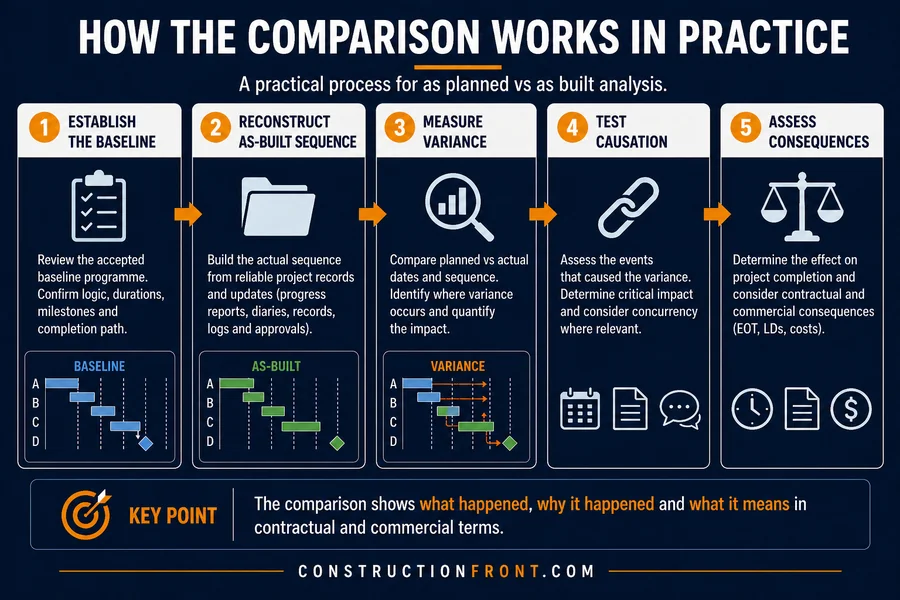
How the Comparison Works in Practice
A credible analysis usually turns more on record quality and programme reliability than on presentation format.
1. Validate the Baseline
The first question is whether the baseline was a genuine delivery plan or only a document produced for approval. If the baseline contained broken logic, unrealistic durations, omitted procurement activities, or heavy artificial constraints, the analysis starts from a weak foundation.
That is why the accepted programme, tender assumptions, method statements, procurement plans, and program float details all matter. If the baseline was never workable, planned-versus-actual slippage may show departure from the paper plan without saying much about actual responsibility for delay.
2. Reconstruct the As-Built Sequence
The analyst then establishes what actually happened. On many projects, the “as-built programme” is not a single clean schedule file. It often has to be assembled from programme updates, lookaheads, site records, payment applications, correspondence, inspection records, delivery records, and progress photographs.
AACE 29R-03 places real importance on validating both baseline and as-built source data. In practical terms, that matters because a loosely reconstructed as-built sequence quickly turns into argument rather than evidence.
3. Measure Variance
Once the planned and actual positions are established, the analyst measures slippage in start dates, finish dates, sectional completion, handover points, procurement milestones, and overall completion. This is where the method is often at its clearest. It can show, visually and factually, where the project moved away from the baseline.
That does not mean every late activity equates to critical project delay. AACE 29R-03 distinguishes between activity variance and project variance, and that distinction is commercially important. Some slippage consumes float. Some is recovered. Some sits on a non-critical path and never affects completion or sectional handover.
4. Test Causation Against the Records
After identifying variance, the analyst has to determine what caused it. That means linking periods of slippage to actual events such as late design release, late possession, restricted access, utility conflicts, latent conditions, variations, or contractor underperformance.
This is where weak claims and weak defences often fail. It is not enough to show that the project finished late. The analysis has to show which events affected which activities or paths, when that happened, and whether the effect reached contractual completion or another critical milestone.
5. Tie the Findings Back to Contractual Consequences
The final step is to connect the delay findings to contract entitlement and exposure. That may include:
- entitlement to an extension of time claim
- compliance with a notice of delay requirement, including time bars requirements
- exposure to liquidated damages
- recovery or defence of prolongation costs
Delay analysis is only commercially useful if it helps resolve who carries the time risk, whether notice obligations were met, and what financial consequences may follow.
Where the Method Is Most Useful
As planned vs as built is often useful when the project team, claims team, or decision-maker needs a clear factual narrative before moving into a more data-heavy methodology.
It works best where:
- the baseline programme is reasonably credible
- the actual sequence can be established from reliable records
- the delay story is relatively simple or concentrated in a few major events
- the critical path did not change repeatedly
- there is limited value in building a full model-based analysis at the current stage
- the aim is to identify broad delay pattern, slippage, and likely responsibility
Typical examples include:
- a building project where delayed approvals and drawing release pushed facade start and completion
- a subcontract claim where planned fabrication, delivery, and installation dates can be compared against actual performance
- an early-stage claim review where the team needs to decide whether to pursue a straightforward entitlement case or invest in a more advanced analysis
- a dispute screening exercise within broader delay analysis methods
It can also be useful where the parties need a disciplined factual platform before deciding whether time impact analysis or another more dynamic approach is justified.
Where the Method Becomes Weak
The method becomes much less reliable when the project did not follow one reasonably stable path to completion. The SCL Protocol cautions against over-reliance on retrospective methods where they cannot properly deal with critical path movement during the works. That is the main commercial risk in stretching as planned vs as built beyond what the project record can support.
Problems usually arise where the project involved:
- multiple critical or near-critical paths
- repeated resequencing
- heavy mitigation or recovery measures
- fragmented work fronts
- phased possession or sectional completion
- repeated design development
- intertwined employer and contractor delay events
- serious concurrent delay
- extensive changes of scope and variation order or Construction Change Directives (CCD)
- procurement and information chains affected by late responses to RFIs
- live risk management issues that should have triggered an early warning notice
In those situations, the method may prove the outcome without proving the mechanism. It may show that completion slipped by 10 weeks, but not establish persuasively which part of that period was excusable, compensable, contractor-caused, owner-caused, or truly concurrent.
That is why more granular or more dynamic methods are often needed on complex claims. If criticality moved over time, a windowed application of as planned vs as built may be more reliable than a single whole-project review, and in some cases a different method entirely will carry more evidential weight.
Practical Checklist: When to Use As Planned vs As Built
Use this checklist before selecting the method:
Good Fit
- The baseline programme is available and broadly credible.
- Actual progress can be reconstructed from reliable records.
- The delay story is relatively linear and understandable.
- The purpose is to identify broad variance and likely causal issues.
- The audience needs a method that is easier to explain than a heavily modelled analysis.
- The claim value or dispute stage does not yet justify a more expensive methodology.
Warning Signs
- The critical path changed several times.
- There were multiple overlapping delay events.
- Mitigation, acceleration, or resequencing materially changed the route to completion.
- Programme updates are sparse, disputed, or unreliable.
- The baseline was unrealistic from the start.
- The issue is not just delay, but allocation of precise responsibility between competing events.
- Compensation for prolongation costs is likely to turn on detailed causation.
- The project includes major delay and damages exposure, including delays disruptions and liquidated damages.
If Several Warning Signs Are Present
Do not rely only on a simple whole-project as planned vs as built review. Move to a more granular windowed application or to a different dynamic method, depending on the quality of the contemporaneous records and the issue in dispute.
Commercial and Contractual Implications
This is where the method either becomes useful or falls flat.
A planned-versus-actual comparison may show obvious slippage, but entitlement usually turns on more than variance alone. The real commercial questions are whether the delayed activities affected completion or sectional completion, whether the event sits within the contract risk allocation, whether notice requirements were met, and whether the delay supports time only or time and money.
For contractors, a good as planned vs as built analysis can help support notices, frame an EOT submission, and show that employer-risk events had real timing consequences. For owners and clients, it can expose claims that describe disruption in general terms but do not prove critical effect, causation, or compliance with the contract machinery.
This also affects the value of the dispute. Weak administration can damage an otherwise reasonable claim. If notices were late, records were incomplete, or the analysis fails to distinguish employer-responsible delay from contractor default, the result may be reduced entitlement, a stronger liquidated damages defence, or a narrower route to prolongation recovery. In short, as planned vs as built should not be treated as a graphics exercise. It needs to support real project and contract administration decisions and real contractual outcomes.
In practice, this is exactly where many delay positions begin to weaken. The issue is often not whether the event happened, but whether the records, notices, and supporting documents are strong enough to connect it to entitlement. That is why structured templates and disciplined documentation matter long before the dispute stage.
Where As-Planned vs As-Built analysis Goes Wrong in Practice
The method usually fails for commercial reasons before it fails for technical ones.
A common problem is that teams run the comparison too late. By the time someone tries to reconstruct the as-built sequence, the key programme updates are disputed, notices are incomplete, procurement records are scattered, and the site team has already moved on. What should have been a clear planned-versus-actual review turns into an argument about what the record even says.
Another common failure is treating variance as proof of entitlement. A project may be 12 weeks late against the baseline, but that does not answer the contractual questions that matter: which activities were actually critical, when the critical path moved, whether employer-risk events affected completion, and whether the contractor complied with notice and claims procedures. That is where weak delay positions collapse under scrutiny.
This is how otherwise reasonable delay positions lose value: not because the commercial story is wrong, but because the supporting structure is too weak to carry it.
The method also goes wrong when parties force it onto a project that has already become too dynamic for a broad retrospective review. If there were multiple work fronts, resequencing, shifting criticality, overlapping delay, or late recovery measures, a simple whole-project comparison can produce a result that looks neat but is evidentially weak.
In practice, the warning signs are usually visible early:
- the baseline was never realistic
- updates were not maintained properly
- the critical path changed during the works
- owner-caused and contractor-caused events overlap
- the team is trying to defend or advance a high-value claim using only a high-level chart comparison
When those signs are present, the practical decision is not whether the method is theoretically available. The real decision is whether it will withstand commercial challenge in negotiation, adjudication, expert review, or formal dispute proceedings.
For Contractors
For contractors, this method is often useful as an early claim-framing tool.
It can help demonstrate that the works moved away from the baseline because of late approvals, restricted access, delayed instructions, design changes (i.e. responses to RFI leading to scope change), or other employer-risk events. That is particularly useful where the contractor needs a clear factual narrative for notices, interim submissions, or a formal EOT claim.
But contractors need to be careful about three points:
- First, planned-versus-actual slippage is not the same as entitlement. The analysis still has to show critical effect, comply with contractual notice machinery, and fit the contract’s allocation of delay risk.
- Second, the method can expose contractor-caused delay just as clearly as employer-caused delay. If labour shortages, procurement failure, weak subcontractor management, or poor sequencing drove part of the slippage, the record will usually show it.
- Third, if the project became highly dynamic, a simple retrospective comparison may understate the effect of employer delay early in the job or overstate it after mitigation and resequencing. In that situation, this method is often best used as a first-layer factual review rather than the sole basis of the claim.
For Owners / Clients
For owners and clients, the method can be a practical way to test whether a delay claim is grounded in the actual project record rather than in narrative assertion. A disciplined as planned vs as built review can help answer:
- Did the contractor actually fall behind the baseline on the dates that mattered?
- Were the claimed events affecting the path to completion or another critical contractual milestone?
- Did later contractor performance, mitigation failure, or resequencing interrupt the claimed causal chain?
- Are there periods where owner-caused delay and contractor-caused delay overlap?
- Does the claim support EOT only, or is there any credible route to compensation?
Owners should also avoid pushing the method too far. A broad planned-versus-actual review may show that the contractor finished late, but it may not separate employer-risk events from contractor default with enough precision where the project evolved materially over time. On a major dispute, that gap can be decisive.
What You Should Do Next
If you are deciding whether to rely on as planned vs as built, the next step should be operational, not academic.
- Lock down the baseline programme you are actually relying on.
- Gather the records needed to reconstruct the as-built sequence, including updates, site records, procurement data, correspondence (such as variation claims, early warning notices, etc), and approval history.
- Identify the first decision point. Is the immediate issue notice, EOT entitlement, damages exposure, claim screening, or dispute preparation?
- Test whether the delay story is stable enough for a broad planned-versus-actual review.
- If the project involved moving criticality, overlapping events, or heavy resequencing, escalate early to a more granular method rather than stretching this one beyond its limits.
For contractors, that often means checking notice compliance immediately, especially where a notice of delay or a time-bar issue may affect recovery. For owners and clients, it means testing whether the claimed delay reaches completion and whether the causal chain survives review against the actual project records.
If the project is already under pressure, speed matters. A weak early position can shape negotiations, valuation, adjudication strategy, and internal reporting long before the detailed analysis is complete.
How It Fits Within the Wider Delay Analysis Framework
As planned vs as built is often a sensible place to start because it is accessible, fact-led, and relatively easy to communicate. It can show whether there is a real delay case, whether the records are good enough to support it, and whether the dispute can be narrowed early.
This reflects how delay analysis is actually used on live projects and in real claims situations, not just how it is described in theory.
Within the broader family of delay analysis methods, it is generally less persuasive than more dynamic methods where the project path changed repeatedly. If the issue is straightforward variance, it may be enough. If the issue is moving criticality, layered mitigation, and changing sequence, it usually is not.
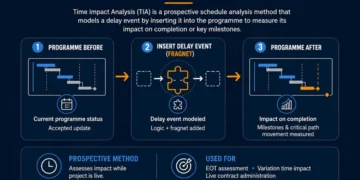
That is where methods such as Time Impact Analysis or a structured Window Analysis Method review may become more useful. Those approaches are generally better suited to showing how delay affected criticality over time rather than simply comparing the opening plan with the eventual outcome.
The right question is not whether as planned vs as built is inherently good or bad. The right question is whether it matches the project record, the contractual issue, and the level of proof the forum or decision-maker will require.
Common Mistakes in Using the Method
The most common problems are predictable:
- treating the method as a chart comparison with no proper causation analysis
- assuming every late activity caused critical delay
- relying on an untested or unrealistic baseline
- ignoring resequencing, mitigation, and recovery
- failing to distinguish activity slippage from project delay
- using a whole-project review where the dispute really requires a windowed application of the same method
- arguing responsibility before establishing variance and critical effect
- overlooking notice obligations and time-bar issues
Those mistakes weaken both claims and defences because they turn a potentially useful factual method into an incomplete advocacy exercise.
Conclusion
As planned vs as built is one delay analysis method based on comparing the planned programme with the actual sequence of the works. Used properly, it can show where the project moved away from the baseline, identify broad delay patterns, and provide a practical platform for claims, defences, and commercial decisions.
Its value is greatest where the project record is sound, the baseline is credible, and the delay story is relatively stable. Its weakness appears where criticality moved, events overlapped, and mitigation changed the route to completion. In those cases, the method still has value, but usually as part of the wider delay strategy rather than the complete answer.
If the decision in front of the team is whether to issue notices, resist damages exposure, advance an EOT position, or invest in a more detailed forensic review, as planned vs as built can be the right starting point. The key is to use it as a disciplined planned-versus-actual method tied to causation, contract administration, and commercial consequence.
FAQ
What is as planned vs as built in construction?
As planned vs as built is one delay analysis method. It compares the baseline programme against the actual sequence and timing of the works to show where the project departed from plan and to help assess whether that variance matters for entitlement, responsibility, and commercial exposure.
Is as planned vs as built a comparison between two separate methods?
No. That is a common misunderstanding. As planned vs as built is one method based on planned-versus-actual comparison. A whole-project review and a windowed review are simply different ways of applying the same method.
When is as planned vs as built analysis most useful?
It is most useful where the baseline is reasonably reliable, the as-built record can be reconstructed from good project records, and the delay story is relatively stable. It is often a practical first step in assessing whether there is a credible extension of time claim or whether the matter needs a more detailed forensic review.
What are the limits of as planned vs as built delay analysis?
Its main weakness is that it may show slippage without proving the full critical path effect of each event. That becomes a serious issue where the project involved resequencing, mitigation, shifting criticality, fragmented work fronts, or concurrent delay.
Is as planned vs as built enough for a complex delay claim?
Sometimes no. On more complex claims, it may be a useful starting point but not a complete answer. If the dispute turns on changing critical paths, overlapping events, or detailed causation, a more dynamic method such as Time Impact Analysis or a structured Window Analysis Method review may carry more evidential weight.
How does as planned vs as built affect contractors and owners differently?
For contractors, it can help frame notices, support an EOT position, and show that employer-risk events affected progress. For owners and clients, it can be used to test whether a claim is actually supported by the project records and whether the alleged delay reached completion or another critical milestone.
Does as planned vs as built deal with time and money automatically?
No. Showing variance against the baseline does not automatically establish entitlement to time or compensation. The analysis still has to be tied back to causation, contract risk allocation, notice compliance, and commercial consequence, including issues such as prolongation costs and exposure to liquidated damages.
What should you do before relying on as planned vs as built?
Start by confirming the baseline programme, gathering the records needed to reconstruct the as-built sequence, and identifying whether the real issue is notice, EOT entitlement, damages exposure, or dispute preparation. If the records show a dynamic delay story, it is usually better to identify that early than to force a simple planned-versus-actual method beyond its limits.
Sources
- AACE International, Recommended Practice 29R-03 Forensic Schedule Analysis
- Construction Front, What are the Existing Delay Analysis Methods?
- Construction Front, Window Analysis Method
- Construction Front, Concurrent Delay in Construction
- Construction Front, Extension of Time (EOT) Claims
- Construction Front, Notice of Delay
- Construction Front, Float in Construction Program
- Construction Front, Prolongation Costs
- Construction Front, Time Bar Clauses
- Construction Front, Early Warning Notice
- Construction Front, Contract Administration and Construction Claims Explained
- Construction Front, Liquidated Damages in Construction Contracts
- Construction Front, Variation Request
- Construction Front, What Is a Variation Order?
- Construction Front, Latent Conditions in Construction
- Society of Construction Law, Delay and Disruption Protocol (2nd Edition)
Disclaimer: The articles on this blog are for informational and educational purposes only and do not constitute legal or technical advice. While we strive to provide accurate and up-to-date information on construction law, regulations may vary by jurisdiction, and legal interpretations can change over time.