

Delays are an unavoidable reality in construction. Whether caused by extreme weather, supply chain disruptions, or unforeseen site conditions, they can have serious consequences if not managed properly. The key to handling delays effectively lies in clear and timely communication and strong risk management, and that’s where a Notice of Delay (NoD) comes in. A NoD is more than just a formal procedure requirement—it can safeguard your rights under a construction agreement.
These days, many modern construction contracts require contractors to issue a NoD within a specific timeframe to preserve the right to claim an Extension of Time (EOT). Failing to do so could result in time bars / rejected claims, exposure to liquidated damages, and potential disputes that could have been avoided with proper documentation.

On this article, we will walk through some details around Notice of Delays —what it is, when to issue one, and how to draft it effectively—so you can protect your interests and keep your project on track.
What is a Notice of Delay (NoD)?
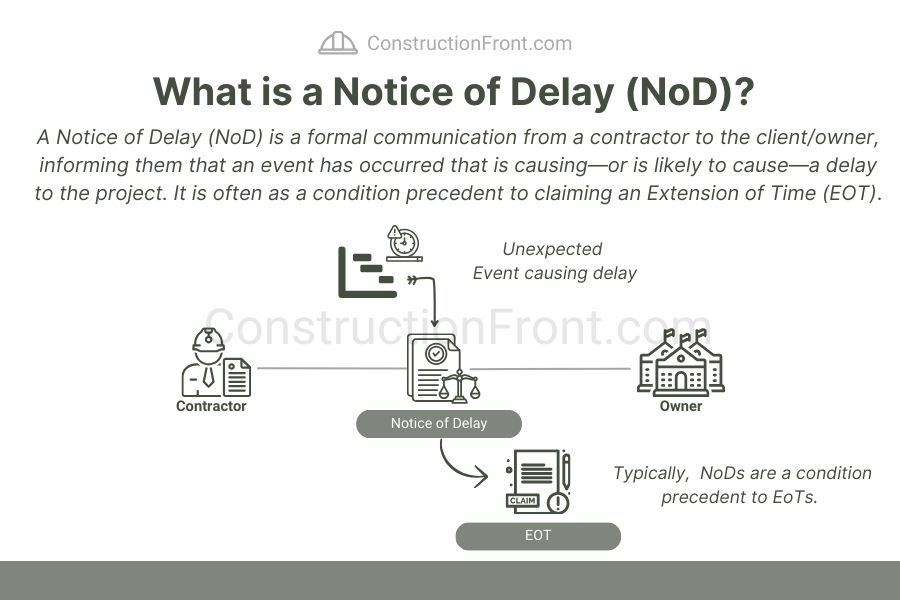
A Notice of Delay (NoD) is a formal communication from a contractor to the client, informing them that an event has occurred that is causing—or is likely to cause—a delay to the project. It’s essentially an early warning notice that gives all parties a chance to assess the situation and take action before the delay (or potential delay) worsens.
Most modern contracts require a NoD to be submitted within a specific timeframe, often as a condition precedent to claiming an Extension of Time (EOT). In simple terms, if you don’t issue a NoD on time, you may lose the right to claim extra time or other compensations related to a specific event later—even if the delay wasn’t your fault. This can leave you exposed to liquidated damages and costly disputes that could have been avoided with proper documentation.
When Should a Notice of Delay Be Issued?
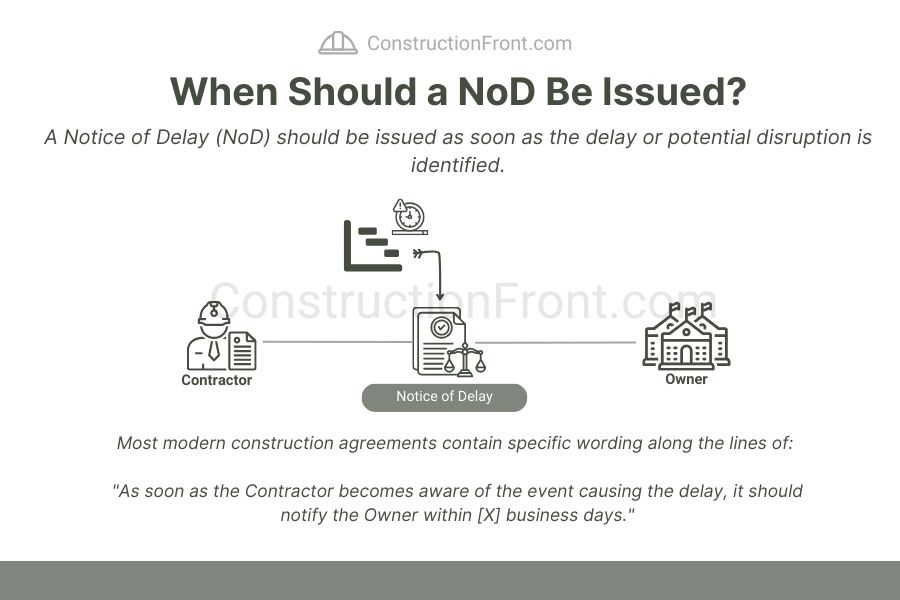
In short, as soon as you become aware of the delay or disruption (or potential delay/disruption), you should formally notify it to the owner. Most construction agreements contain specific wording along the lines of: “As soon as the Contractor becomes aware of the event causing the delay, it should notify the Owner within [X] business days.”
This means that even if the full impact of the delay is not yet clear, submitting a Notice of Delay (NoD) promptly is crucial to preserving your rights under the contract. Many contracts also contain time bar provisions, which set strict deadlines for issuing a NoD to ensure an entitlement o.
If a contractor fails to notify the owner within the stipulated timeframe—often within days of recognizing the delay—the right to claim additional time or cost relief may be forfeited. These time bars are generally enforceable, and courts and arbitral tribunals often uphold them, making it essential to act quickly.
What Events Typically Trigger the Need for a Notice of Delay?
In construction projects, delay and disruption events can arise from various sources, including weather conditions, supply chain disruptions, unforeseen site conditions (i.e. latent conditions), or client-related delays, such as demurrage due to late site access or failure to provide materials on time. Below is a breakdown of common delay events and their typical causes.
Type of Event | What It Is | Example |
Adverse Weather | Severe weather conditions preventing site work. | Heavy rainfall halting excavation work. |
Material Shortages | Supply chain disruptions causing material delays. | Delayed steel deliveries affecting structural works. |
Design Changes | Modifications requiring rework or additional approvals. | Revised architectural drawings delaying façade installation. |
Unforeseen site conditions impacting progress. | Encountering unexpected rock formations requiring additional excavation. | |
Regulatory Delays | Permit approvals or compliance issues slowing progress. | Delayed environmental approvals preventing foundation works. |
Client Delays | Actions or inactions by the client affecting timelines. | Late approvals for shop drawings postponing fabrication. |
Demurrage by Client | Additional costs or delays caused by the client’s failure to provide access, materials, or approvals. | Site access restrictions preventing equipment delivery, resulting in idle machinery costs. |
Why are NoDs important for construction projects?
More broadly, Notice of Delays (NoD) are a critical tool for managing project risks, ensuring transparency, and protecting contractual rights for both owners and contractors. It provides early communication of potential disruptions, allowing all parties to assess the impact and take appropriate action.
Among many other things, NoDs are important for:
Maintaining Contractual Integrity and Fairness – NoDs ensure that both contractors and owners adhere to contractual obligations, preserving rights to extensions of time and cost recovery when delays occur. This prevents misunderstandings and protects all parties from unintended financial or legal consequences.
Facilitating Early Problem-Solving – By promptly notifying stakeholders of potential disruptions, NoDs create opportunities for mitigation strategies such as resequencing work, adjusting resources, or negotiating alternative solutions, reducing the overall impact on the schedule.
Enhancing Collaboration and Decision-Making – Effective communication through NoDs keeps all parties informed, promoting a collaborative approach to managing delays. This alignment helps ensure that decisions are made based on accurate, real-time project conditions rather than reactive responses.
Minimizing Financial and Legal Risks – Delays can lead to costly disputes, liquidated damages, and additional overheads. A well-documented NoD serves as a formal record that supports claims, protects against liability, and reduces the likelihood of drawn-out legal battles that could derail the project.
Keeping the Project on Schedule and Budget – By addressing delays proactively, NoDs help project teams maintain realistic timelines and cost controls, preventing minor setbacks from escalating into major project failures.
How to write a Notice of Delay?
A well-drafted Notice of Delay (NoD) is essential for maintaining transparency, protecting contractual rights, and ensuring smooth project execution. While specific contract requirements may vary, an effective NoD should be clear, timely, and well-documented to support any potential claims.
Most construction contracts specify the key elements that a NoD must include. A robust NoD typically contains:
Section | Details to Include |
Project Information | Project name, contract number, and location. |
Date of Notice | The date the NoD is issued. |
Cause of Delay | A brief but clear explanation of the event causing the delay. |
Affected Work Scope | Details of the impacted activities or project components. |
Expected Impact | Estimated delay duration and potential consequences on the schedule. |
Mitigation Measures | Steps being taken to minimize the impact of the delay. |
Notice of Delay - Template
A Notice of Delay should be clear, concise, and aligned with the specific requirements of the contract. Always review the contract before issuing a NoD to ensure compliance with notice periods and required content.
[Contractor's Name]
[Company Address] · [City, Postal Code] · [Date]
To: [Owner/Client's Name] · [Client's Address]
Subject: Notice of Delay - [Project Name]
Dear [Client's Name],
We hereby provide formal notice of a delay affecting the progress of [Project Name] in accordance with Clause [XX] of the Contract. The delay has been caused by [brief explanation of the delay event], impacting the completion of [specific work scope].
The estimated impact of this delay is [XX days], and we are actively implementing mitigation measures, including [list mitigation actions]. We will continue to assess the situation and provide further updates as necessary.
Contractual Basis: This notice is issued pursuant to Clause [XX] of the Contract as a condition precedent to any Extension of Time claim arising from this event. The Contractor reserves all rights to additional time and cost relief pending full assessment.
Reservation of Rights: The Contractor reserves entitlement to an Extension of Time and associated prolongation costs arising from this delay event, to be substantiated in a subsequent formal EOT submission.
Please confirm receipt of this Notice at your earliest convenience.
Sincerely,
[Contractor's Name]
[Title] · [Company Name]
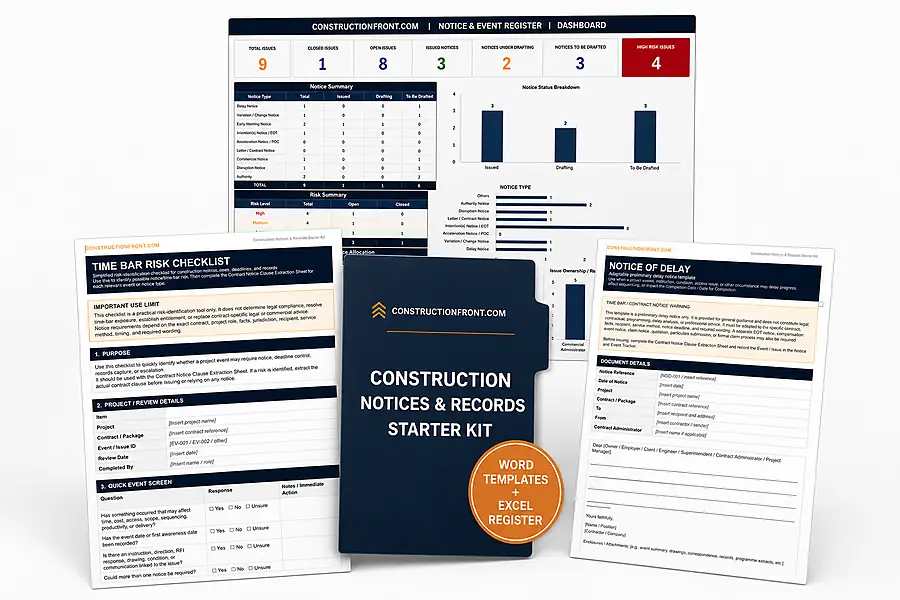
The full Notice of Delay template includes contractual basis, reservation of rights language and time-bar guidance.
FAQ - Notice of Delay (NoD)
What is the difference between the NoD and EoTs?
A Notice of Delay (NoD) is an early notification informing the client and relevant parties that a delay has occurred or is likely to occur. It does not request additional time but ensures compliance with contract requirements for notifying delays.
An Extension of Time (EOT), on the other hand, is a formal request seeking an adjustment to the project completion date due to delays beyond the contractor’s control. Most contracts require a NoD as a condition precedent to submitting an EOT claim.
What is a condition precedent?
A condition precedent is a contractual requirement that must be fulfilled before a party can exercise a specific right or claim a benefit under the contract.
In the context of construction contracts and delays, many contracts state that issuing a Notice of Delay (NoD) within a specified timeframe is a condition precedent to claiming an Extension of Time (EOT).
If the contractor fails to meet this requirement—such as missing the deadline to submit a NoD—the right to claim an EOT may be lost, potentially exposing the contractor to liquidated damages or other penalties. Condition precedents are strictly enforced in many contracts, emphasizing the need for timely and accurate notices.
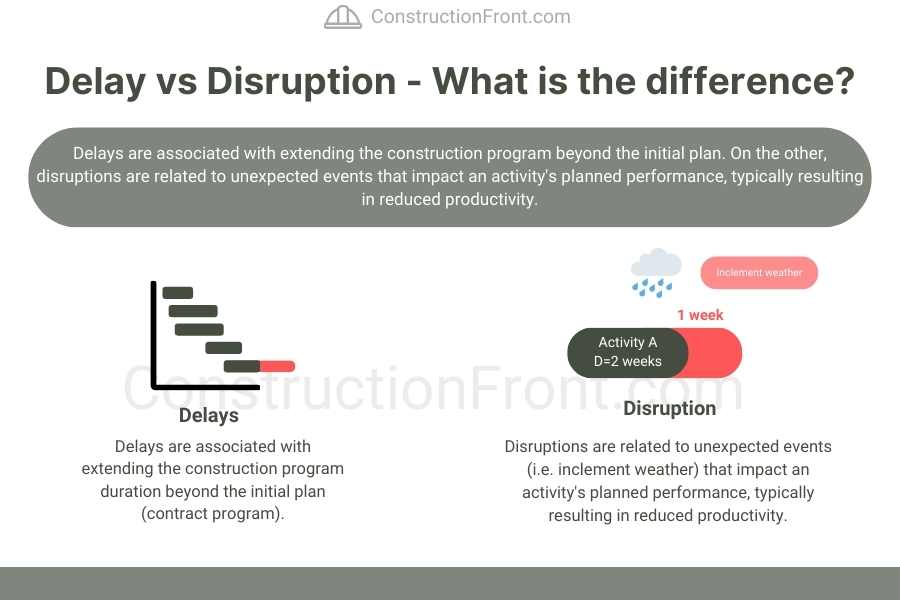
What is the difference between the Delay and Disruption?
Delays are associated with extending the construction program beyond the initial plan.
On the other hand, disruptions are related to unexpected events that impact an activity’s planned performance, typically resulting in reduced productivity but not necessarily linked to an overall program delay.
Suggested Reading: Delays, Disruptions, and Liquidated Damages in Construction Contracts
Need Help with a Notice of Delay (NoD)?
Do not hesitate to contact us (click here) for specialised advice in the construction industry.
Sources
- Understanding time delay disputes in construction contracts (International Journal of Project Management)
- Construction Delays: Understanding Them Clearly, Analyzing Them Correctly – Ted J Trauner
- Delay Analysis Techniques in Construction Projects
- Contractual Approach for Facilitating the Resolution of Dispute over a Contractor’s Failure to Comply with Time Limit for Notice of Delays | Journal of Legal Affairs and Dispute Resolution in Engineering and Construction | Vol 1, No 3
- DISPUTE RESOLUTION IN RELATION TO DELAY OF CONSTRUCTION PROJECT
Disclaimer: The articles on this blog are for informational and educational purposes only and do not constitute legal advice. While we strive to provide accurate and up-to-date information on construction law, regulations may vary by jurisdiction, and legal interpretations can change over time.