

Knowing how to write a variation order matters because this document does more than record a change. It is the contract record that instructs or confirms a change to the works and states how scope, valuation, time impact, and unresolved issues will be handled. If the drafting is loose, the project usually pays for it twice: first through poor administration, then through cost, delay, disruption, or liability arguments.
Research consistently links variation orders with cost growth, delay, coordination failures, and disputes where changes are poorly defined or poorly managed, including Variation orders on construction projects: value-adding or waste? and Significant Causes and Effects of Variation Orders in Construction Projects. On a live project, a good variation order must do four things clearly:
- identify the change
- state the contractual basis
- deal with valuation and time
- preserve unresolved rights where agreement has not been reached
This guide shows how to draft the document properly, when to separate it from earlier change correspondence, and how to avoid accidental waiver. It includes a practical template, a worked example, a short FAQ, and a final pre-issue checklist.
Why Drafting a Variation Order Matters Commercially
A variation order is not just a site instruction with a price attached. It changes risk, resource allocation, sequencing, procurement, testing, and often the final account. If the wording does not clearly state what changed, who instructed it, and how the consequences will be assessed, it becomes a gateway to later construction claims and contract administration.
A strong variation order should leave no doubt about three commercial questions:
- What work changed?
- How will the change be valued?
- What happens to time and downstream cost?
Leave those questions open and the parties start arguing about scope creep, rework, productivity loss, delay responsibility, prolongation cost, milestone slippage, and sometimes liquidated damages. Rights are often protected or weakened at drafting stage, not only at claim stage.

Variation Order vs Variation Request
Do not treat a variation order and a variation request as the same document. They may sit in the same workflow, but they do different jobs.
| Document | Main purpose | Typical status | Main risk if drafted badly |
|---|---|---|---|
| Variation order | Instructs or confirms the changed work and records how it will be administered | Binding instruction, agreed change, or instruction pending valuation | Later dispute over scope, price, time, or waiver |
| Variation request | Proposes a change or asks for approval before instruction | Pre-approval or quotation stage | Informal scope growth or unauthorised work |
| Quotation or pricing proposal | Prices the proposed change | Commercial proposal only | Proposal later treated as fixed agreement without assumptions |
Many disputes start because the parties blur these documents together. A quotation gets treated as approval. A request gets treated as instruction. An acknowledgement gets treated as agreement on time and money. Good drafting prevents that confusion by stating document status expressly.
What a Variation Order Must Contain
Before writing, separate the approved change from the earlier request, quotation, or discussion trail. Then make the document self-explanatory. At minimum, the variation order should contain:
- project name, contract reference, and variation number
- date of instruction or agreement
- identity of the instructing party
- status of the document: instruction only, agreed variation, agreed scope only, or instruction pending valuation
- precise description of the changed work
- drawings, specifications, sketches, schedules, or marked-up documents attached
- reason for the change
- valuation basis
- stated effect on interim milestones, sectional completion, and overall completion where relevant
- express reservation where time or cost remains under assessment
- signatures or issue authority under the contract
Useful status wording includes:
- “Instruction only. Valuation to follow.”
- “Agreed scope only. Time and cost consequences remain under assessment.”
- “Agreed variation at the stated amount with no other effect except as set out below.”
If your form of contract uses a different label, such as change order, site instruction, architect’s instruction, or compensation event notice, the same drafting discipline still applies. Labels vary, but the requirement does not: define the physical change and the commercial consequences clearly enough to administer them later.
How to Write a Variation Order Step by Step
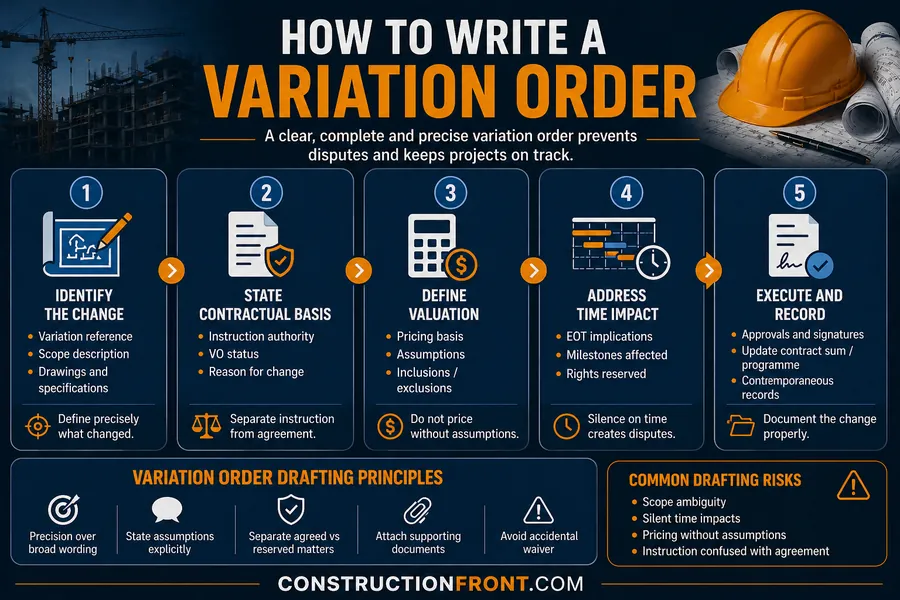
The infographic below detail 7 steps to help you drafting your variation order.
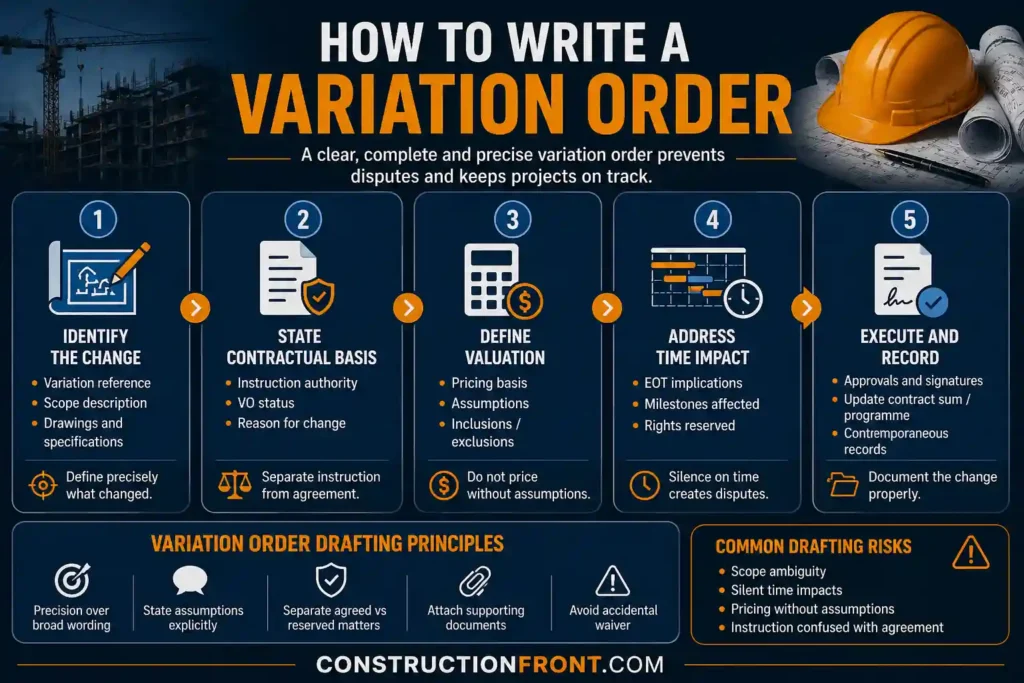
1. Identify the contractual authority
Start with the clause or administrative mechanism that authorises the change. Every contract has one — whether it is a variation clause, an engineer’s instruction power, a change order provision, or a superintendent’s direction. Write it into the document rather than leaving authority implied.
- Example: “Issued under Clause [X] of the Contract as an instruction to vary the Works.”
That line matters for two reasons. First, it anchors the instruction to contractual power rather than leaving it as informal correspondence that either party can later characterise however suits them. Second, it forces a basic but important check: is the person issuing this variation actually authorised to do so under the contract? Authority is not always obvious on a large project.
Site managers, project engineers, and even senior client representatives may direct changes in practice without holding the contractual power to do so. An instruction from the wrong person may not bind the contractor to proceed – and may not bind the owner to pay.
2. Describe the scope change with precision
Describe exactly what is added, omitted, substituted, relocated, resequenced, or revised. Avoid phrases like “additional works as discussed on site.” A useful scope description should answer:
- where the change applies
- what is removed, added, or substituted
- what drawing or specification is revised
- whether existing work must be broken out, protected, tested, or reworked
- whether the change affects interfaces with other trades
- whether procurement status affects the change
If the change alters completed work, say so directly. That often drives rework cost and time. If the change omits work, describe the omitted scope with the same care as added work. Omissions often trigger disputes over unused materials, cancellation charges, off-site fabrication, and recovery of preliminaries.
3. State the valuation basis
If the price is agreed, say it is agreed and identify the amount. If it is not agreed, say how it will be valued. Do not leave valuation implied. Common approaches include:
- existing contract rates
- derived rates
- fair valuation
- daywork
- provisional estimate pending substantiation
Good commercial drafting should also say what the price includes. If the amount is intended to include overhead, profit, attendance, design input, testing, protection, reinstatement, wastage, or out-of-hours working, say so. If it does not, say that too.
Where time-related cost may arise, say that valuation will include demonstrated delay or disruption consequences where contractually recoverable, including prolongation costs if the change affects completion or critical resources.
4. Address time impact expressly
A variation order should not stay silent on time unless the contract clearly requires a separate process and that separate process is already underway. If the impact is known, state it. If it is not yet known, reserve it.
Good drafting language is direct: “Time impact is under assessment. The Contractor reserves its entitlement to an extension of time and associated cost subject to contract notice and substantiation.” That wording helps preserve the route to an extension of time claim instead of allowing the other side to argue that the change was absorbed with no time consequence.
Do not limit the time statement to overall completion if the contract also uses sectional completion dates, access dates, or key milestones. A variation may miss a milestone without moving the final completion date, and that still matters commercially. If notice is required, reference it and issue it. A carefully drafted variation order cannot repair a missed notice of delay.
5. Record assumptions and exclusions
This is where many rights are lost. If the variation price is based on assumptions, list them. If access, working hours, design release dates, utility shutdown windows, or material lead times affect the price, say so. Examples:
- price based on work in normal hours
- price excludes out-of-sequence working
- price excludes standby due to late access
- price assumes design information issued by a stated date
- price excludes delay and disruption unless separately agreed
- quotation valid only if instruction is issued by a stated date
Assumptions turn an ambiguous number into a defensible commercial position. They also stop a provisional quotation from being treated later as a fixed and unconditional agreement.
6. Attach supporting documents
Attach the marked-up drawing, revised specification, sketch, measurement sheet, quotation, site instruction, and relevant program note. A variation order without attachments is often only a summary of a later argument.
Where the change may affect time, attach a short program narrative or marked-up extract showing the impacted activities. That does not replace formal delay analysis, but it anchors the time discussion to actual project logic.
7. Preserve unresolved rights in writing
If time, disruption, or downstream costs remain unresolved, say so. Do not let an interim valuation read like full and final settlement unless that is truly intended.
Use clear wording such as: “This variation order records the instructed change only. Any effect on time, productivity, disruption, prolongation, or other contractual entitlement remains reserved unless expressly agreed in writing.”
That sentence matters most where the contractor acknowledges receipt of the instruction. Receipt should not be confused with agreement on valuation or waiver of later entitlement.
Practical Variation Order Template
Use this as a working draft on live projects and adapt it to your contract form.
VARIATION ORDER TEMPLATE
Project: [Insert project name]
Contract: [Insert contract title and reference]
Variation Order No.: [Insert number]
Date: [Insert date]
Issued By: [Insert employer / contract administrator / superintendent / architect / engineer]
Contractual Authority: Issued under Clause [X] of the Contract.
Status of Document: [Instruction only / agreed variation / instruction pending valuation / agreed scope only]
Description of Variation: [State clearly what work is added, omitted, substituted, relocated, or revised. Identify drawing numbers, specification sections, and locations.]
Reason for Variation: [Client requirement / design development / discrepancy / authority requirement / site condition]
Valuation Basis: [Agreed lump sum / contract rates / derived rates / dayworks / provisional estimate] Amount: [Insert amount or "TBC subject to measurement"] Price includes: [...] Price excludes: [delay / disruption / acceleration unless stated]
Time Impact: [No effect / affects milestone only / under assessment / EOT to be submitted] The Contractor reserves the right to submit entitlement for extension of time and associated cost in accordance with the Contract.
Assumptions / Exclusions: [List all assumptions and exclusions]
Reservation of Rights: Except as expressly stated above, rights relating to valuation, time, disruption, prolongation, and other contractual consequences are not waived.
Signatures: Issued by: __________________ Received by: __________________ Date: __________________
The complete template includes all fields, assumption clauses, reservation of rights language and worked examples.
Worked Example
A variation should be drafted to show not only the changed work, but also the commercial and time logic behind it. If delay is possible, assess the impact against the program using a coherent approach rather than broad assertion. That is where delay analysis methods start to matter.
Example Scenario
The owner instructs relocation of underground drainage after part of the trenching and bedding work is complete because the issued services layout conflicts with a late architectural change.
Weak Draft
“Please relocate drainage to suit revised layout. Cost and time to follow.” This is weak because it does not identify the exact revised layout, affected area, rework already caused, valuation basis, document status, or whether completion or interim milestones are impacted.
Better Draft
Contractual Authority:
Issued under Clause 13.1 of the Contract as an instruction to vary the Works.
Status of Document:
Instruction pending agreement of final valuation and time consequences.
Description of Variation:
Relocate the underground drainage line between Gridlines C4 and E4 from the alignment shown on Drawing M-12 Rev 2 to the alignment shown on Sketch VO-07. Remove and dispose of installed pipework completed on 12 April 2026, make good trench bedding where disturbed, and install revised pipework and inspection chamber locations as shown on Sketch VO-07. Pressure testing and as-built records for the revised section are included.
Valuation Basis:
Measured using contract rates for trenching, bedding, pipe installation, testing, and backfilling. Additional rework, disposal, remarking, and reinstatement to be valued as derived rates. Estimated interim value: $18,400 pending final measure. This interim value excludes delay, disruption, and any additional preliminaries arising from extended occupation of the work area.
Time Impact:
The instructed rework affects an activity currently on the critical path and may also delay the downstream hardscape milestone. The Contractor will assess resulting delay and reserves entitlement to extension of time and associated cost. If completion is affected, the parties should address any knock-on exposure to liquidated damages through the contract mechanism rather than after the fact.
Assumptions / Exclusions:
Price assumes revised IFC information is final and access to the affected area remains unrestricted from 15 to 19 April 2026. Price excludes disruption arising from further resequencing of follow-on trades.
Why This Draft Works Better
- It identifies the changed work and exact reference documents.
- It separates instruction status from final agreement on valuation and time.
- It explains how the work will be valued instead of implying a lump-sum agreement.
- It preserves time and cost rights without overstating entitlement.
- It records assumptions that can later determine whether the estimate still stands.
For Owners / Clients
For owners and clients, a good variation order is a control document. It should stop informal scope growth, force a clean record of why the change is required, and show the likely cost and time consequences before they spread through the project.
The main discipline points are:
- issue changes through the contract mechanism, not only through email or meetings
- require clear scope definition and attached documents
- distinguish an instruction from an agreed price
- insist that time effect is stated, even if the answer is “under assessment”
- identify whether the change may trigger broader delays, disruptions, and liquidated damages
Owners also need to avoid drafting that accidentally converts a disputed issue into an approved variation. If the contractor is asserting wider consequences than you accept, record the instructed change and state which elements remain unagreed. A vague “approved as quoted” can create more exposure than expected.
If the change omits work, deal expressly with off-site materials, cancellation charges, design already carried out, and treatment of preliminaries rather than assuming the omission is cost-neutral.
For Contractors
For contractors, the variation order is one of the first places entitlement can be protected or lost. If you sign or accept a poorly drafted instruction, you may later struggle to prove scope growth, rework, delay effect, pricing assumptions, or downstream resource impact.
Key contractor disciplines are:
- tie the document to the instruction date and contract clause
- state whether the document is instruction only or an agreed commercial settlement
- state the effect on access, sequencing, procurement, testing, and resources
- reserve time and cost consequences where they are not yet agreed
- issue separate notices where the contract requires them
- identify overlap with existing delay events, especially where concurrent delay may become relevant
Do not rely on the variation order alone if the contract requires separate notices or claim submissions. Use it as part of a coordinated record set. The best drafting in the world will not solve a notice failure. It also will not fix poor records, so keep contemporaneous labour, plant, progress, and procurement records aligned with the wording of the variation order.
Common Variation Order Drafting Mistakes
The most common mistakes are simple, but expensive:
- describing the change in broad language instead of precise scope terms
- failing to cite the contractual authority
- not stating whether the document is an instruction, an agreement, or both
- omitting attachments
- stating a price without assumptions or stated inclusions
- saying nothing about time effect on milestones or completion
- using wording that looks like full and final settlement by accident
- mixing instructed change with disputed causation issues in one vague paragraph
- having the document signed by someone without contractual authority
Another frequent problem is treating the document as administration only. Variation orders often sit close to delay, disruption, prolongation, and claims strategy. If the wording ignores those connections, the project record becomes commercially weak very quickly.
FAQ
Can a variation order be issued before the price is agreed?
Yes. In many projects that is exactly what happens. The key is to state the document status clearly, identify the valuation mechanism, and reserve unresolved time or cost issues rather than implying a full agreement that does not exist.
Is a variation order the same as a change order?
Often the commercial function is similar, but terminology varies by contract and jurisdiction. The important point is not the label. It is whether the document clearly records the change, authority, valuation route, time effect, and any reservations.
Should a variation order deal with time as well as cost?
Yes. If the time effect is known, state it. If it is not yet known, say it is under assessment and preserve the contractual route for later time entitlement. Silence on time is where many downstream disputes begin.
Does signing a variation order waive a later claim?
Not necessarily, but badly drafted wording can create that argument. If valuation, disruption, prolongation, or extension of time issues remain open, the document should say so expressly.
What is the difference between agreed variation and instruction pending valuation?
An agreed variation records both the changed work and the commercial deal. An instruction pending valuation records the change first and leaves all or part of the pricing and time consequences to later assessment under the contract.
Final Pre-Issue Checklist
Before issuing or signing a variation order, check the following:
- Is the instruction tied to a contract clause or formal authority?
- Is the issuing person authorised under the contract?
- Does the document clearly state whether it is an instruction, an agreed variation, or an instruction pending valuation?
- Is the changed work described precisely enough for someone outside the site meeting to understand it?
- Are the correct drawings, sketches, specifications, and supporting records attached?
- Is the valuation basis stated clearly?
- Does the document say whether the price is agreed, provisional, or subject to measurement?
- Does it state what the amount includes and excludes?
- Does it deal with time impact on milestones and completion expressly?
- Have assumptions and exclusions been written down?
- Are rights reserved where time, disruption, or downstream costs remain unresolved?
- Have any required notices been issued separately?
- Does the document avoid accidental waiver or full and final wording?
A variation order should leave the parties with a workable record, not a bigger argument. If it clearly defines scope, valuation, time effect, document status, and reserved issues, it does its real job: controlling change while protecting rights.
Sources
- Cape Peninsula University of Technology, Variation orders on construction projects: value-adding or waste?
- Aftab Hameed Memon, Ismail Abdul Rahman and Mohamad Faris Abul Hasan, Significant Causes and Effects of Variation Orders in Construction Projects
- Construction Front, What Is a Variation Order?
- Construction Front, Variation Request
- Construction Front, What Is an Extension of Time Claim?
- Construction Front, Notice of Delay
- Construction Front, Prolongation Costs
- Construction Front, Delay Analysis Methods
- Construction Front, Liquidated Damages in Construction Contracts
- Construction Front, Delays, Disruptions, and Liquidated Damages
- Construction Front, Construction Claims and Contract Administration
- Construction Front, Concurrent Delay
Disclaimer: The articles on this blog are for informational and educational purposes only and do not constitute legal or technical advice. While we strive to provide accurate and up-to-date information on construction law, regulations may vary by jurisdiction, and legal interpretations can change over time.