

Delay is one of the most disputed issues on construction projects, but some delay disputes are more difficult than others. One of the clearest examples is concurrent delay. The concept sounds straightforward at first, yet in practice it often gives rise to difficult arguments about responsibility, extension of time entitlement, liquidated damages, and the recovery of prolongation costs.
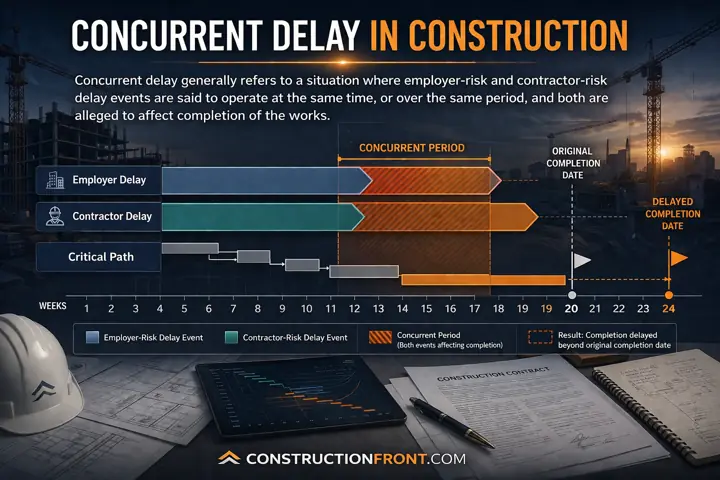
In construction, concurrent delay occurs when an employer-caused delay and a contractor-caused delay happen at the same time and both are claimed to delay the critical path and, consequently, the completion of the works. If both parties contributed to critical delay during the same period, the immediate questions become whether the contractor should receive an extension of time, whether the employer remains entitled to liquidated damages, and whether prolongation costs can be recovered.
The answer may differ depending on the contract wording, the governing law, and the quality of the programme evidence. Concurrent delay is therefore not just a programming concept. It is also a major issue in contract administration, claims strategy, and dispute resolution.
In simple terms, concurrent delay matters because it sits directly at the intersection of time, money, causation, and contractual risk allocation.
Concurrent Delay Definition
Concurrent delay in construction generally arises where two delaying events overlap in time and both are said to affect completion of the works.
A typical example is where:
- the employer causes delay by issuing information late
- the contractor causes delay by failing to mobilise resources properly
- both events are alleged to affect the same period of critical delay
In broad terms, the question is whether the project was being delayed by both sides at the same time and, if so, what contractual consequence follows.
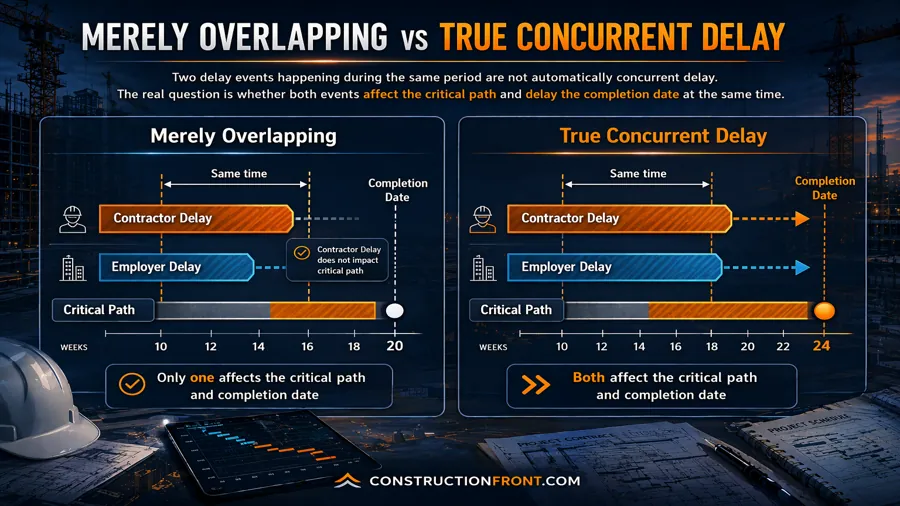
This is where the concept becomes more difficult than it first appears. Not every overlapping delay amounts to true concurrent delay. Two events may occur in the same month, or even in the same week, but unless both actually affect completion, they may not amount to concurrency in the relevant contractual or legal sense.
The Society of Construction Law Delay and Disruption Protocol takes a narrower view of true concurrent delay. It describes it as the occurrence of an Employer Risk Event and a Contractor Risk Event at the same time, where both are effective causes of delay to completion and their effects are felt at the same time. That is an important qualification, because it means concurrency is not simply about events happening together. It is about whether both events were actually operating on completion during the same period.
What Is True Concurrent Delay?
- a contractor delay affects a non-critical activity, such as landscaping or a secondary building area; and
- at the same time, an employer delay affects the critical path, such as late design information for the main structure.
Although both issues exist during the same period, only the second one delays the completion date. The first delay may consume float or affect a non-critical activity, but it does not move the finish date. In practical terms, this is not true concurrent delay.
True concurrency only exists where two separate events both push the critical path and completion date out at the same time.
A useful way to think about it is:
- If only one event delays the critical path, there is no true concurrent delay.
- If two events both delay the critical path during the same period, there may be true concurrent delay.
There is also an important difference between concurrent delay and sequential delay. Sometimes one event has already delayed the project before a second event occurs. For example, if the project is already four weeks late because of contractor delay, and an owner-caused delay arises afterwards, the later event may not create concurrency. The key question becomes whether the second event caused any additional delay beyond the delay that already existed.
The practical test is therefore not whether two events overlap in time. The real question is whether both events were actively delaying completion at the same time.
Why Concurrent Delay Matters
Concurrent delay matters because it can directly affect:
- extension of time
- liquidated damages
- prolongation costs
- responsibility for delayed completion
- the strength of contractor and employer claims
- the overall commercial outcome of a dispute
In many cases, the contractor argues that an employer-risk event delayed completion and that time relief should therefore be granted. The employer responds that the contractor was already in culpable delay during the same period, so the contractor should not benefit from the employer-side event in the way claimed.
This is one of the reasons concurrent delay becomes so heavily contested in delay claims. It sits at the intersection of entitlement, causation, critical path analysis, and contractual risk allocation.
What Is the Usual Effect of Concurrent Delay?
A commonly adopted practical position, reflected in the SCL Protocol, is that where there is true concurrent delay between an employer-risk event and a contractor-risk event, the contractor’s concurrent delay should not reduce any extension of time that is otherwise due.
This is often summarised as time but not money.
The logic is that the employer should not be entitled to liquidated damages for a period during which its own risk event also delayed completion. The position on compensation is different. In general, the contractor may struggle to recover prolongation costs for the same period because its own delay was also operating at the same time.
As discussed in Luigi Di Paola and Paolo Spanu’s paper on concurrent delays, the contractor may not recover compensation in respect of the employer event unless it can separate the loss flowing from that event from the loss flowing from the contractor-risk event.
That position is common, but it should not be treated as universal. Different contracts, governing laws, and tribunal approaches may produce different results, particularly where the contract contains express concurrency provisions or adopts a different approach to causation and entitlement. Some contracts may even modify the extension of time outcome that would otherwise apply.
A Simple Example of Concurrent Delay
Assume a contractor is building a processing plant. During a critical period:
- the employer issues revised drawings late
- the contractor is also behind because key subcontractors were not properly managed
If both issues affect the same critical path activities and both contribute to delaying completion, the employer may argue that the contractor was already delaying the works, while the contractor may argue that the late drawings independently prevented completion.
If that situation is established as true concurrency, the dispute is likely to focus on:
- whether an extension of time should be granted
- whether liquidated damages can still be applied
- whether the contractor can recover prolongation costs
This example shows why concurrent delay is rarely just a scheduling debate. It quickly becomes a commercial and contractual one.
Why Not Every Overlapping Delay Is Concurrent Delay
This is one of the most important practical points in any concurrency analysis. Project teams often label delays as concurrent too quickly. True concurrent delay usually requires more than simple overlap in time. It is not enough that two events existed at the same time. Both events usually need to affect completion.
In practice, that means the analysis should focus on whether:
- both events were operating on the critical path
- both events were affecting completion rather than only intermediate activities
- one event had already exhausted the available float
- the later event made any additional difference to completion
Without that discipline, concurrency arguments can become loose, unconvincing, and commercially dangerous. Many concurrency arguments also fail for a simpler reason: the party advancing the argument cannot actually show that both events were delaying completion at the same time. That is often where broad assertion gives way to a much more difficult evidentiary question.
Why Programme Analysis Matters So Much
Concurrent delay cannot usually be assessed properly without careful programme analysis. To understand whether true concurrency exists, the parties often need to examine:
- the baseline programme and any accepted updates
- critical path logic
- actual progress
- delay events and when they arose
- whether float existed (and who owns the float)
- whether the impacted activities were truly critical
In practice, disputes often become more difficult because the programme record is imperfect. The parties may not have a clean accepted programme, the logic may have changed over time, or the contemporaneous updates may not reflect what was really happening on site. Those weaknesses do not make analysis unnecessary. They simply make it more contentious.
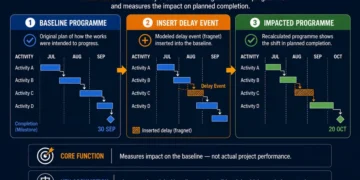
For that reason, delay disputes involving concurrency often rely on structured forensic methods such as the Window Analysis Method. Without disciplined analysis, parties can easily end up making broad assertions about overlapping events that are not actually supported by the programme evidence.
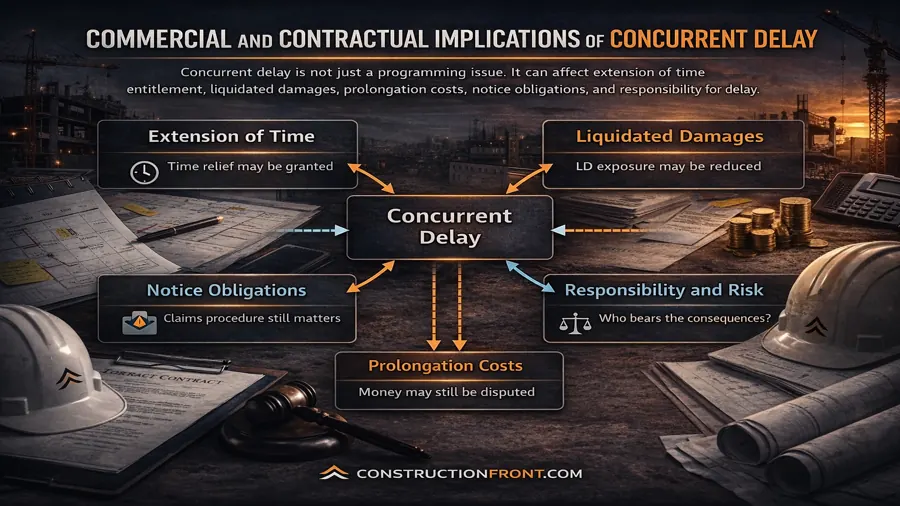
Commercial and Contractual Implications
Concurrent delay is not just a technical scheduling issue. It has direct commercial and contractual implications across the project.
Extension of Time
One of the most important consequences of concurrent delay is its effect on extension of time entitlement. Where an employer-risk event and a contractor-risk event both delay completion during the same critical period, many contracts and legal approaches support granting the contractor an extension of time for that period.
The practical reasoning is fairly clear. If the employer’s own event also delayed completion, it becomes difficult for the employer to insist on liquidated damages for that same period as if the delay were solely the contractor’s responsibility.
Even so, the answer will still depend heavily on:
- the wording of the contract
- the governing law
- whether true concurrency is actually established
- whether the contractor complied with notice obligations
Liquidated Damages
Concurrency can materially affect the employer’s ability to levy liquidated damages. If true concurrent delay is established, the employer may lose the right to apply liquidated damages for the relevant period. On a large project, that can have a significant commercial impact, particularly where the delayed period is long or the liquidated damages regime is substantial.
This is one reason concurrency is often central to employer-side delay defences and contractor-side time claims.
Prolongation Costs
Even where concurrency supports time relief, the position on money is often more difficult. A contractor may obtain an extension of time for a concurrent period but still struggle to recover prolongation costs or other compensation if its own delay was also operating at the same time.
This is one of the hardest commercial realities for contractors. They may avoid liquidated damages for the concurrent period, yet still be left carrying part or all of their own extended cost exposure.
Notice Obligations and Claims Strategy
Concurrency arguments cannot be separated from the contract’s claims machinery. Even where an employer-risk event exists, the contractor may still need to comply with:
- notice of delay requirements
- time-bar clauses
- extension of time procedures
- record-keeping obligations
- cause and effect substantiation requirements
A concurrency case can be weakened significantly if the contractor fails to notify the relevant event properly or cannot show how it affected completion.
Responsibility Allocation and Risk
Concurrent delay also matters because it tests how the contract allocates responsibility. If both parties contributed to delay, the dispute often becomes less about whether delay occurred and more about who bears the contractual consequences of that delay. That is where concurrency becomes a major issue in claims, disputes, and negotiations over commercial resolution.
How Concurrent Delay Affects Employers?
Concurrent delay is not only a contractor issue. It also matters greatly to employers and contract administrators. If concurrency is established, the employer may lose the right to levy liquidated damages for the relevant period. On a large project, that can materially affect the employer’s commercial position.
For employers, this means it is important to:
- keep robust records of contractor performance
- analyse whether the contractor was already in culpable delay
- assess whether the alleged employer event actually affected completion
- respond carefully to claims and notices
- avoid assuming that every employer-side event automatically gives full contractor entitlement
A concurrency defence, however, should not be asserted casually. If the programme evidence does not show that the contractor-risk event was actually delaying completion during the same period, the argument may be weak.
How Contractors Should Approach Concurrent Delay?
For contractors, concurrency requires discipline, evidence, and careful positioning. A contractor facing potential concurrent delay should usually:
- identify the employer-risk event clearly
- show how it affected the critical path or completion
- preserve records of progress and impact
- issue required notices promptly
- avoid assuming that mere overlap equals concurrency
- analyse the financial consequences separately from the time consequences
This is especially important because concurrency arguments can weaken poorly prepared claims. If the contractor cannot distinguish between true concurrency and simple overlap, the claim may lose credibility very quickly.
Depending on the facts, the surrounding issues may also connect with notice of delay, the time bar clause, prolongation costs, and broader delay and disruption claims.
Practical Signs a Concurrent Delay Argument May Arise
A concurrent delay argument often arises where:
- the contractor was already behind programme
- the employer then introduces a late instruction, late drawing, or access issue
- both parties rely on events occurring in the same period
- Project completion is delayed and responsibility becomes disputed
- the programme record is incomplete, inconsistent, or heavily contested
In these situations, concurrency often becomes central to the claims strategy on both sides.
Final Thoughts
Concurrent delay in construction is one of the most disputed and misunderstood concepts in project claims.
In broad terms, it refers to a situation where employer-risk and contractor-risk delay events are both said to affect completion during the same period. The real difficulty lies in establishing whether true concurrency actually existed and then determining what consequence follows under the contract and the applicable legal framework.
For contractors, concurrent delay may support time relief while leaving money in dispute. For employers, it may affect the ability to apply liquidated damages and resist time-based claims. For both sides, the issue ultimately turns on records, programme analysis, contract wording, and disciplined claims management.
It is not enough to show that two problems existed at the same time. The more important question is whether both were truly delaying completion. That is usually where the real argument begins.
FAQs
What is concurrent delay in construction?
Concurrent delay generally refers to a situation where two delay events overlap and both affect project completion, often with one event being the employer’s risk and the other the contractor’s risk.
What is true concurrent delay?
True concurrent delay usually means that both delay events were operative causes of delay to completion during the same period. Simple overlap in time is not always enough.
Does concurrent delay mean the contractor gets more time?
Often yes, if true concurrency is established and the contract supports that outcome, but it depends on the contract wording, the governing law, and the underlying facts.
Can the contractor recover prolongation costs during concurrent delay?
Not always. A common practical outcome is that the contractor may receive time relief but not necessarily money for the same concurrent period.
Does concurrent delay prevent liquidated damages?
In many cases, true concurrency may prevent the employer from levying liquidated damages for the relevant concurrent period, but that will still depend on the contract and the applicable legal approach.
Does every overlapping delay amount to concurrent delay?
No. Overlap in time alone is not enough. Both events usually need to affect completion, often by operating on the critical path during the same period.
How do you prove concurrent delay?
Concurrent delay is usually assessed through programme analysis, contemporaneous records, critical path review, and a careful examination of whether both events were actually affecting completion during the same period.
Does concurrent delay depend on the critical path?
In most cases, yes. The question is usually whether both delay events were affecting completion, which often means analysing whether they were operating on the critical path during the relevant period.
Why is concurrent delay so disputed?
Because it directly affects extension of time, liquidated damages, prolongation costs, and responsibility for late completion, all of which can materially change the commercial outcome of a dispute.
Need Help?
Do not hesitate to contact us (click here) for specialised advice in the construction industry.
Sources
-
-
Luigi Di Paola and Paolo Spanu, “Concurrent Delays”
-
Society of Construction Law, “Delay and Disruption Protocol, 2nd edition (February 2017)”
-
Disclaimer: The articles on this blog are for informational and educational purposes only and do not constitute legal or technical advice. While we strive to provide accurate and up-to-date information on construction law, regulations may vary by jurisdiction, and legal interpretations can change over time.