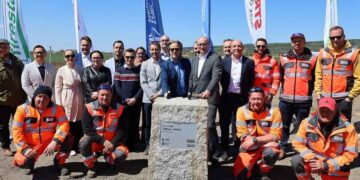


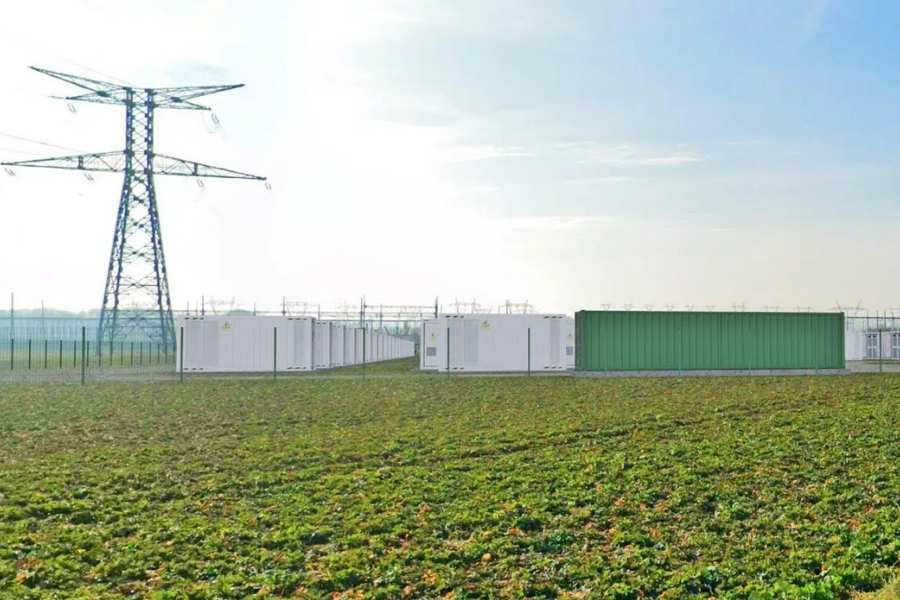
Neoen has launched what it says will be France’s largest battery project, a 248 MW / 496 MWh battery energy storage system at Vernou-la-Celle-sur-Seine, southeast of Paris. The project will be delivered with Nidec ASI, with construction scheduled to begin in summer 2026 and operations targeted for 2028.
The milestone moves one of France’s biggest storage assets from development into execution. It also reflects how battery projects are increasingly being treated as core grid infrastructure rather than secondary renewable add-ons.
Vernou-la-Celle-sur-Seine battery project – Project Background
According to Neoen, the project is located around 90 kilometres southeast of Paris and will be the first battery connected directly to RTE’s 400 kV high-voltage transmission network. Neoen said the system will have an installed capacity of 248 MW and storage capacity of 496 MWh, making it the largest battery announced in France to date.
The battery is intended to support the electricity network in the Ile-de-France area. That places it in the highest-value end of the storage market, where assets are designed to contribute to flexibility, system stability, and renewable integration rather than only short-term price arbitrage.
The project also fits within Neoen’s broader European storage platform. The company already operates major battery assets in Sweden and Finland, and this French project extends that strategy into a transmission-level role in one of Europe’s most important demand centres.
France’s largest battery project – Milestone details
Neoen has signed a contract with Nidec ASI for delivery of the Vernou-la-Celle-sur-Seine battery. The project has a contracted scope of 248 MW / 496 MWh, and Neoen said the battery modules will be assembled in France at Nidec’s facility in La Fouillouse, near Saint-Etienne. Construction is due to start in summer 2026, with commissioning planned for 2028.
From a procurement standpoint, the announcement appears to indicate that Nidec ASI will supply the battery systems, while the remaining balance-of-plant and enabling works may be delivered under separate arrangements, contrasting to major EPC agreements. That is common in large BESS developments, where battery suppliers are brought in alongside other contractors responsible for civil, electrical, and connection infrastructure.
That procurement logic can be efficient, but it also raises coordination and integration risks. Where interfaces between the BESS supplier, civil contractor, grid connection team, and owner are not tightly managed, issues can emerge around design clarification, scope boundaries, and late-stage technical changes. In practice, those are the types of situations where project issues can drift into major variations and claims, or where poor contract administration creates downstream delay and cost exposure.
Battery storage delivery – Project insights
Projects of this size are shaped by many of the same pressures seen on other major energy assets: equipment lead times, grid-connection sequencing, contractor coordination, and commissioning complexity. The connection to the 400 kV network raises the technical threshold further because storage systems, substation works, protection systems, and network operations all need to align tightly.
The location in the Ile-de-France region also gives the project a strategic network role. In practical terms, this is not simply a battery built where land was available; it is a battery being deployed where flexibility has clear system value. That increases the importance of operational readiness and interface management from the start of construction.
Storage also sits directly in the wider discussion around curtailment in renewable energy and market design. As renewable penetration rises, large batteries are increasingly one of the most practical tools available to absorb excess generation, provide balancing services, and reduce stress on constrained parts of the grid.
European battery storage outlook
Neoen’s announcement reinforces the shift toward transmission-connected battery systems as core infrastructure in Europe. The market is moving beyond pilot-scale storage and smaller merchant assets into large utility-scale systems designed to support flexibility, resilience, and renewable integration.
That trend is visible in projects such as MW Storage and Fluence’s 100 MW / 200 MWh BESS in Germany and CIP’s decision to begin construction on two 500 MW BESS projects in Scotland. It also aligns with the growing role of PPAs and hybrid commercial structures in supporting dispatchability and reducing exposure to renewable curtailment.
For developers and contractors, the direction is clear: large batteries are increasingly being procured and delivered as strategic infrastructure assets. For grid operators and energy users, they are becoming essential tools for maintaining reliability in systems with rising renewable penetration and growing electricity demand.
Related Project and News
- MW Storage and Fluence partner to deliver 100 MW / 200 MWh BESS in Germany
- Copenhagen Infrastructure Partners (CIP) reaches FID for two 500MW BESS in Scotland
- Curtailment in Renewable Energy Projects: What is it?
- Power Purchase Agreements (PPAs): What They Are and Their Relevance to the Construction Sector
- Balance of Plant (BoP) Contract: What is it? How it Works?