

On many construction projects, one of the hardest commercial questions is when to lock in the final price. If the price is agreed too early, the contractor may include large contingencies for unresolved design and risk. If it is agreed too late, the owner may struggle to manage budget certainty. A Guaranteed Maximum Price (GMP) is one of the most common ways of balancing those competing pressures.
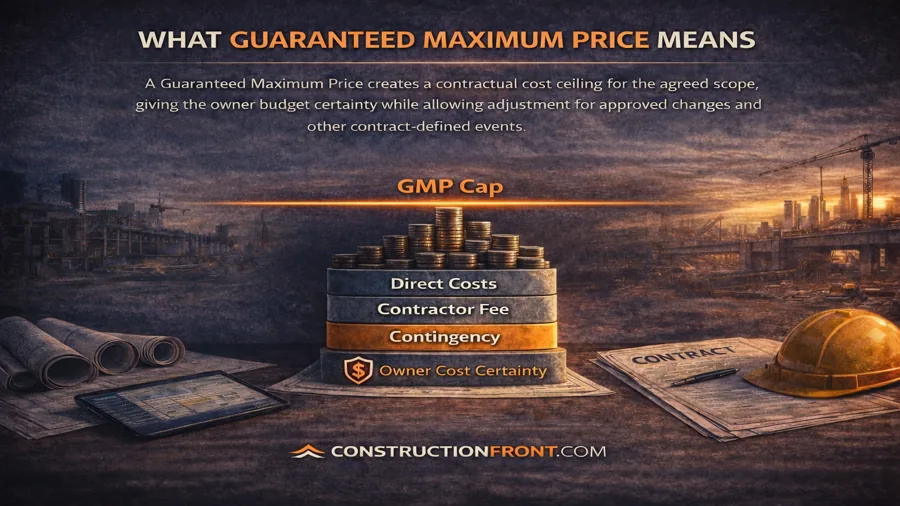
A Guaranteed Maximum Price (GMP) is a pricing mechanism in which the contractor agrees that the cost of delivering the defined scope of work will not exceed a stated maximum amount, except where the contract allows adjustments such as approved scope changes, client-driven variations, or other agreed compensation events. In practical terms, GMP is used to give the owner a higher degree of cost certainty than open-ended cost reimbursement, while preserving more flexibility than a fully fixed lump sum agreed too early.
This guide explains what GMP means, how it works, where it is used, how it differs from lump sum and target cost structures, and what the main commercial risks are in practice.
What does Guaranteed Maximum Price mean?
Davis and Stevenson, in Guaranteed Maximum Price contracts in Western Australia, found that while the market did not always have a perfectly uniform definition of GMP, there was a common principle that the price should not increase unless the client changed the scope. That is still one of the clearest practical ways to understand GMP.
At a basic level, a Guaranteed Maximum Price means there is a ceiling on what the owner will pay for the agreed scope of works. If the contractor’s actual costs exceed that ceiling, the contractor will usually bear that overrun unless the contract allows the GMP to be adjusted. That is the fundamental commercial attraction for owners: cost certainty with a cap.
What is important, however, is that GMP is not the same thing as “the contractor takes all risk no matter what happens.” The cap applies within the commercial framework of the contract. If the owner changes the scope, if a risk event sits with the owner, or if the contract provides another adjustment mechanism, the GMP may still move and the contractor may seek compensations for that through a variation request for example. So, the better way to think about GMP is not as a rigid absolute number, but as a contract-governed maximum price for a defined basis of scope and risk.
How does a GMP mechanism work in a contract?
In practice, a GMP arrangement usually sits on top of a broader delivery model rather than existing in isolation. The contract sets out the project scope, the pricing basis, the assumptions behind the GMP, the treatment of contingencies, the process for variations, and the rules for what happens if actual cost comes in below or above the agreed ceiling.
Many GMP arrangements are structured as cost-plus GMP contracts. Under this approach, the contractor is reimbursed for actual project cost plus an agreed fee, but only up to the Guaranteed Maximum Price unless the contract allows adjustment.
That structure is one reason GMP is often attractive on projects where the parties want more transparency than a conventional lump sum. The contractor may develop the GMP progressively, often through open-book pricing, package-level estimating, and cost review during the preconstruction phase. This is especially common in CMaR and progressive design-build arrangements.
However, it is important to note each project might deal with the GMP sum slightly different. For example, a huge risk that is usually not included in the GMP element is soil contamination, unknown utilities, archaeological findings and latent conditions. These are very difficult to predict and pricing in into the construction budget, and owners and contractors tend to negotiate it apart in most instances.
What is typically included in the GMP?
One important issue to be clarified is what is exactly included under the GMP figure. A simplified cost structure often looks like this:
| Element | Typical treatment under a GMP |
|---|---|
| Direct construction costs | Included within the GMP |
| Contractor overhead and profit | Included within the GMP |
| Contractor contingency | Usually included within the GMP |
| Approved client changes | Often able to adjust the GMP |
| Shared savings | Sometimes split between owner and contractor |
| Cost overruns above the GMP | Usually borne by the contractor unless the GMP is adjusted |
Why owners and contractors use GMP?
Understandably, owners are usually attracted to GMP because it offers a balance between flexibility and cost control. On one side, it gives more pricing certainty than a pure cost-plus arrangement, which is essential for project financing. On the other, it can be more realistic than forcing a full lump sum too early on an immature design.
Davis and Stevenson identified price certainty, faster completion, and a team-based delivery approach as some of the major perceived advantages of GMP in Western Australia. That aligns with how the mechanism is often used in practice today. Owners want a clearer ceiling on cost exposure, but they may also want the benefits of early contractor involvement, constructability input, and progressive pricing before the final number is locked.
That is particularly relevant where the owner wants to move early on a project but still needs time to develop the design, retire key risks, or refine packaging strategy. In those cases, GMP can function as a commercial bridge between early collaboration and later execution certainty and can enable final investment decision and a future notice to proceed for construction.
Contractors may also prefer GMP where it allows earlier involvement, more transparent pricing development, and a reduced need to price large contingencies against immature scope. In the right commercial setting, GMP can create a more workable balance between owner cost certainty and contractor pricing realism and better allocate risks.
Where GMP is commonly used?
As discussed before, Guaranteed Maximum Price is not a standalone delivery model in the same way as design and construct or IPD. It is more accurately a pricing mechanism that can sit within several delivery models. The most common contracting settings include:
- Construction Manager at Risk (CMaR)
- Early Contractor Involvement (ECI)
- Progressive Design-Build
- some managing contractor frameworks
- selected negotiated design-build structures
This is one reason GMP is often discussed alongside procurement and contract strategy, rather than as an isolated commercial term. The real question is usually not just “what is GMP?” but “in what project structure is GMP being used, and at what stage is it being agreed?”
Guaranteed Minimum Price vs Other Pricing mechanisms
GMP versus lump sum
One of the most common sources of confusion is the difference between GMP and lump sum. A lump sum is usually a fixed price for delivering the defined works. If the contractor can deliver below that price, it typically keeps the benefit unless the contract says otherwise. If it underpriced the work, it generally bears that risk. The commercial commitment is usually made earlier and more definitively.
A GMP is different – It provides a price ceiling with cost savings typical shared by the parties and overruns borne by the contractor. It often sits in a more transparent or progressive pricing environment. It may be built from open-book cost information, negotiated package pricing, and agreed allowances. It also commonly involves more explicit treatment of contingency and a detailed explanation of shared savings.
A practical comparison looks like this:
| Feature | GMP | Lump Sum |
|---|---|---|
| Price certainty | High, but within contract adjustment rules | High, usually more rigid |
| Pricing transparency | Often higher | Often lower – price “locked in” at contract award |
| Early design maturity | Moderate | Usually higher |
| Typical fit | Collaborative or progressive delivery | More defined scope and risk transfer |
| Treatment of underruns | May involve shared savings | Contractor often keeps savings |
| Treatment of overruns | Contractor usually bears above GMP (within the contracted scope) | Contractor bears overruns within scope |
GMP versus target cost
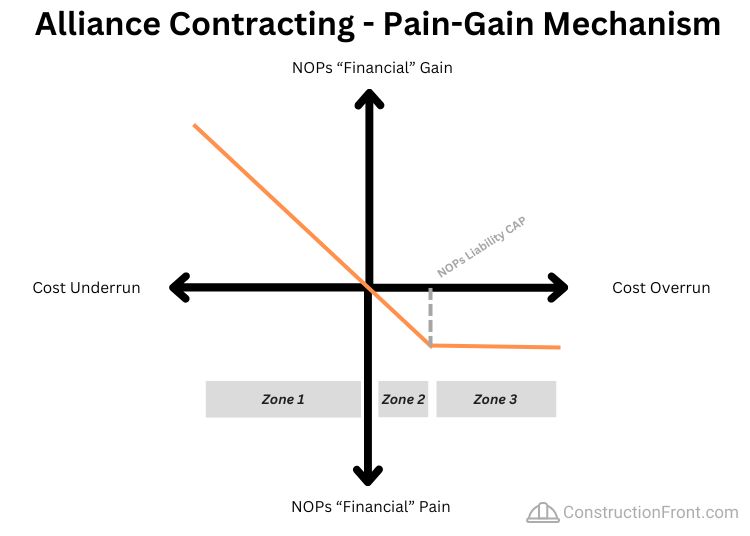
It is also useful to separate GMP from target cost or alliance-style pricing. In a target cost model and alliance contracting , the parties often share pain and gain around an agreed target up to a certain threshold (see figure below), rather than setting a hard ceiling that the contractor bears above a defined point.
Conversely, GMP generally creates a clearer upper boundary for owner cost exposure, with cost overruns within the contracted scope being contractor’s responsibility and underruns split by the parties under a pre-agreed proportion.
Target cost models usually create stronger shared incentives but may involve a less rigid cost cap. That difference matters when owners are thinking about risk allocation, governance, and the commercial behaviours they want to encourage.
Open-book pricing and transparency
One of the reasons GMP is often associated with collaborative procurement is that it commonly relies on open-book pricing. That does not mean there is no negotiation or commercial tension. It means the owner has more visibility into how the number is being built, including direct costs, allowances, preliminaries, contingency, subcontract packages, and contractor fee.
This can improve owner confidence, but it also changes expectations. Once pricing is more transparent, owners often expect deeper scrutiny of assumptions, stronger challenge of contingency levels, and clearer visibility into how cost risk is being managed. Contractors, in turn, need stronger estimating discipline and clearer internal logic around how the GMP has been assembled.
Main advantages of GMP
A practical summary of the main GMP advantages looks like this:
| Advantage | Why it matters |
|---|---|
| Cost ceiling for the owner | Improves budget certainty |
| More flexibility than early lump sum | Better suited to evolving design |
| Better fit with early contractor involvement | Supports constructability and pricing development |
| Often more transparent pricing | Helps owners understand cost build-up |
| Can support collaborative behaviour | Encourages earlier discussion of scope and risk |
| Potential for shared savings | Can align incentives if structured properly |
The Western Australia study by Davis and Stevenson captures some of the same themes in practical terms: price certainty, faster completion, and a team-based approach to delivery. Those benefits help explain why GMP remains attractive in procurement strategies that sit between rigid fixed-price contracting and more open collaborative models.
Main risks and drawbacks of GMP
GMP also has important risks, and these should not be understated, as detailed in Palihakkara and Perera’s work on Identification of Significant Risk Factors of Guaranteed Maximum Price (GMP) Contracts. Their findings are especially practical because they identify poorly defined scope of work and design changes as the most significant risk factors in GMP contracts.
That should immediately resonate with any contractor or owner who has seen a project move into execution before the scope was truly mature enough. The main risks associated with using the GMP mechanism include:
- incomplete or unclear scope definition
- design changes after GMP agreement
- weak documentation
- misunderstanding of the GMP concept itself
- inappropriate contingency levels
- financial failure by either client or contractor
- poor risk allocation between the parties
Those risks matter because they go directly to the core promise of GMP. If scope is weak, design is unstable, or documentation is poor, the “guaranteed” element becomes much harder to manage in practice. The contract may still say there is a maximum price, but commercial friction will usually follow as the parties argue over what sits inside or outside that maximum, often leading to disputes.
Commercial and contractual implications
The GMP shapes parties; behaviour around risk, design maturity, change, contract administration and claims. The pricing cap may look commercially clean at award, but entitlement, notices, change control, and record keeping still determine how well that cap works in practice once the project is live.
Scope definition
One of the clearest messages from the risk literature is that GMP works best when the underlying scope is properly developed. If the scope is immature, then the parties are effectively trying to lock a cap around uncertainty. That may look attractive at procurement stage, but it often shifts pressure into claims, contingency disputes, and arguments over whether a later change was already included in the original scope.
Design changes are a major pressure point
The Palihakkara research is especially useful here because it highlights design changes as one of the most significant GMP risks. That is commercially important because design change is exactly where many owner-contractor disputes start.
If the owner continues changing the project after the GMP has been agreed, then the commercial logic of the cap becomes unstable very quickly and the contractor might argue that the GMP is no longer a reference for the project.
If the same event also affects programme, the issue may extend beyond cost and into notice of delay and extension of time claim issues.
Claims and disputes
GMP does not eliminate claims. In fact, if poorly implemented, it can sharpen claims around scope boundaries, contingency entitlement, and what qualifies as a change. Therefore, it is essential that both parties clearly understand the agreement and have competent commercial teams on board. Although designed to be collaborative, contracts with the GMP mechanism can quickly become a dispute administration nightmare if not structured properly.
A simple practical example
- Imagine an owner engages a contractor under a CMaR framework for a complex health or transport project.
- During the early phase, the contractor provides preconstruction services, package-level estimating, sequencing advice, and constructability input.
- Once the design reaches a suitable level of maturity, the parties agree a GMP for the main works.
- If the project proceeds largely in line with the agreed basis, the owner benefits from a clear cost ceiling and the contractor benefits from a structured, negotiated path into delivery.
- However, if the owner continues changing room layouts, performance requirements, staging assumptions, or specialist package interfaces after the GMP is set, then the pressure quickly moves into change control and contract administration.
- The contractor may say those changes sit outside the original GMP. The owner may argue they were always implied, potentially leading to disputes around scope creep, project prolongation costs, disruption claims, etc.
What kinds of projects the GMP mechanism suit the best?
Guaranteed Maximum Price is usually most suitable where the owner wants stronger cost certainty than cost-plus, but still needs more flexibility than a conventional lump sum will allow at the same stage of project development.
That often includes:
- projects where early contractor involvement is meaningful and valuable
- projects needing stronger constructability input before final pricing
- schemes where design is still developing at procurement stage
- projects where the owner wants transparency into cost build-up
It is generally less suitable where the scope is highly unstable, the owner is not ready to engage actively in design and pricing development, or the procurement strategy is built around pure early risk transfer regardless of scope maturity.
It is important to note that GMP might not be suitable for all clients. Even though the mechanism has many benefits, it is worth noting that the owner must have a significant level of maturity to put it in place and enjoy its upsides. If the owner has limited experience in project development and construction delivery, procurement and contracting methodologies with higher level of risk transfer, such as EPC contracts, Design-Contract Agreements might be better suited.
Final thoughts
A Guaranteed Maximum Price (GMP) can be a very effective commercial mechanism when a project needs more cost certainty than a pure cost-plus model, but is not yet mature enough for a clean early lump sum.
Used well, it can support earlier contractor involvement, better constructability input, more transparent pricing development, and a more realistic path to commercial agreement once scope and risk are better understood.
However, GMP should never be treated as a shortcut to certainty. It only works well when the underlying scope is sufficiently developed, the risk allocation is clear, the pricing assumptions are properly documented, and the contract administration is disciplined from the start.
If those foundations are weak, the GMP can quickly become the centre of disputes about what was included, what changed, who carries the risk, and whether the agreed cap still applies.
That is why GMP is best understood as a commercial tool rather than a magic solution. In the right setting, especially under models such as Construction Manager at Risk (CMaR), ECI, or progressive design-build, it can create a better balance between collaboration and cost control. In the wrong setting, particularly where design is unstable, governance is weak, or change control is poor, it can simply defer commercial conflict rather than prevent it.
For owners, the key question is not whether GMP sounds attractive in principle, but whether the project is mature enough and the team is capable enough to support it. For contractors, the key question is whether the scope, assumptions, contingency structure, and change mechanisms are clear enough to make the capped price genuinely workable.
In both cases, the success of GMP depends less on the label and more on the quality of procurement strategy, contract drafting, and project administration behind it.
FAQ
What is a Guaranteed Maximum Price in construction?
A Guaranteed Maximum Price is commercial mechanisms that stipulates the maximum amount the owner will pay for the agreed scope of work, subject to the contract’s change and adjustment provisions.
Is GMP the same as lump sum?
No. Both create price certainty, but GMP often involves more transparency, more progressive pricing development, and a clearer treatment of contingency and change than a pure lump sum.
Who bears the risk above the GMP?
Usually the contractor bears cost overruns above the GMP unless the contract allows the GMP to be adjusted because of approved changes or owner-risk events.
Is GMP commonly used in progressive design-build?
Yes. GMP is often the commercial mechanism used at the transition from Phase 1 to Phase 2 in progressive design-build projects.
What are the biggest risks in GMP?
Research suggests the biggest risks include poorly defined scope, design changes, weak documentation, and misunderstanding of how the GMP mechanism actually works.
Is GMP better than target cost?
Not necessarily. GMP usually gives the owner a firmer cost ceiling, while target cost models often rely more on shared pain/gain mechanisms. The better fit depends on project complexity, governance, and commercial objectives.
Is GMP the same as cost-plus?
Not exactly. Many GMP contracts are structured as cost-plus arrangements with a cap. That means the contractor is reimbursed for actual project cost plus an agreed fee, but only up to the Guaranteed Maximum Price unless the contract allows an adjustment.
Need Help?
Do not hesitate to contact us (click here) for specialised advice in the construction industry.
Sources
- Davis, P. R. and Stevenson, D., Guaranteed Maximum Price contracts in Western Australia
- Anvuur, A. M. and Kumaraswamy, M. M., Promises, Pitfalls and Shortfalls of the Guaranteed Maximum Price Approach: A Comparative Case Study
- Palihakkara, A. D. and Perera, B. A. K. S., Identification of Significant Risk Factors of Guaranteed Maximum Price (GMP) Contracts
- Construction Front, Construction Manager at Risk (CMaR): What is it? How it Works?
- Construction Front, What is an ECI Contract? (And How It Works)
- Construction Front, Design and Construct (D&C) Contracts – How do they Work?
- Construction Front, What Is Progressive Design-Build?
- Construction Front, Integrated Project Delivery (IPD): What is it?
- Construction Front, Construction Claims and Contract Administration Explained
- Construction Front, What is a Variation Order?
- Construction Front, What is a Variation Request?
- Construction Front, What is a Time Bar Clause?
- Construction Front, Are Time Bars Enforceable in Construction Contracts?
- Construction Front, Notice of Delay: What is it? How to Draft one?
- Construction Front, What is an Extension of Time Claim (EOT)?
- Construction Front, What is a Latent Condition in Construction?
- Construction Front, What Is Concurrent Delay in Construction?
Disclaimer: The articles on this blog are for informational and educational purposes only and do not constitute legal or technical advice. While we strive to provide accurate and up-to-date information on construction law, regulations may vary by jurisdiction, and legal interpretations can change over time.