


On a live project, the procurement route shapes more than who carries out the works. It affects how early the delivery team gets involved, how specialist packages are bought, how much control the client keeps over design, and how quickly the team can move before the full price is known. That is why management contracting matters commercially.
That distinction matters in practice. Most project teams are not debating terminology. They are deciding whether this route gives them the right balance of delivery speed, package control, cost visibility, and risk allocation for the project in front of them. In that sense, management contracting often sits closer to early procurement and delivery-strategy decisions than to downstream contract administration alone.
This article explains how management contracting works, where it tends to fit best, how it compares with construction management and design and build, and what clients and contractors should check before choosing it.
What is the Managing Contractor Model?
Management contracting is a procurement route under which the client appoints a managing contractor early to support design development, package strategy, procurement sequencing, and delivery planning. The works are then delivered through separate package contracts that the managing contractor procures and administers.
The key commercial point is that the client is not usually buying a fully designed, fixed-price construction solution at the outset in the way it often would under a lump-sum design and build contract. Instead, the client is buying a managed delivery structure in which packages are procured progressively as design information becomes ready.
In practice, management contracting is usually considered where:
- the design is still developing
- early buildability and sequencing input would improve delivery
- the project involves multiple specialist packages or difficult interfaces
- the client wants to retain meaningful influence over design and package decisions
- parts of the works need to start before the full project is completely designed and priced.
How the Management Contracting Procurement Route Works?
Under a management contracting route, the client enters into a contract with the managing contractor. The managing contractor helps plan package strategy, advise on sequencing, coordinate delivery input during design development, and procure separate works packages as the design matures.
In most cases, the commercial structure looks like this:
- the client contracts with the managing contractor
- the managing contractor procures and enters into separate package contracts with works contractors or trade contractors
- the managing contractor coordinates programme, logistics, interfaces, progress reporting, and package administration
- the client remains more involved in design, procurement, and change decisions than it usually would under a standard design and build route
This structure can allow earlier procurement and earlier site progress even while some design information is still being developed. That can be valuable on programme-driven or interface-heavy projects, but it usually means the final outturn cost becomes clearer progressively rather than being fixed in full at the start.
For readers comparing this route with other early-contractor-involvement models, there is a useful overlap with two-stage tendering, although the commercial structure and downstream package arrangements are not the same.
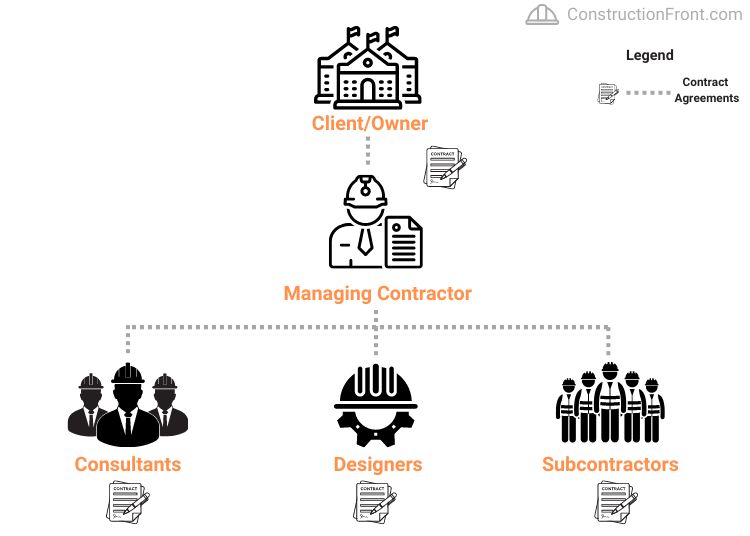
It is worth noting that, in contrast to construction management agreements, the MC bears legal responsibility for design and construction, since it directly engages designers, consultants, subcontractors, etc.
The Role of the Managing Contractor
The managing contractor is the delivery lead within the management contracting route. It is usually appointed for its procurement, coordination, and management capability rather than to self-perform the whole of the works.
Typical responsibilities include:
- advising on buildability during design development
- helping shape package breakdown, procurement sequencing, and tender strategy
- identifying interface risks between trades, design disciplines, utilities, operations, and existing works
- procuring and administering work packages
- coordinating programme, logistics, site access, temporary works interfaces, and trade sequencing
- reporting on cost, time, quality, risk, and progress
- administering change and maintaining commercial controls across packages
The exact scope depends on the form of contract and the project set-up, but the core function is consistent: the managing contractor manages the delivery system and package structure rather than simply delivering one direct works package.
Contract Structure and Risk Allocation
The real importance of management contracting lies in its responsibility structure and risk allocation.
Under management contracting, the managing contractor usually sits contractually between the client and the package contractors. That gives the client more delivery structure than pure construction management, but it does not usually create the same single-point risk transfer associated with a more traditional design and build arrangement.
The commercial position commonly looks like this:
- the client retains more involvement in design development and key procurement decisions
- packages are usually procured progressively rather than all being priced and fixed at the outset
- cost visibility improves as package tenders are obtained and committed
- the managing contractor carries substantial coordination and administration responsibility across the package structure
- design completeness, change control, approval timing, and package definition remain critical client-side issues
A common misunderstanding is that appointing a managing contractor automatically transfers most project risk away from the client. In practice, the route can improve coordination and package control, but it does not remove the need for disciplined scope definition, timely decisions, and strong governance. If design information is late, package boundaries are unclear, or approvals drift, those problems will still affect cost and programme.
It is also important not to overstate the managing contractor’s responsibility. The managing contractor may hold the package contracts and manage their performance, but that does not mean it has accepted a blanket guarantee of overall cost certainty or taken every consequence of incomplete design. The contract wording, package procurement strategy, and reporting regime still matter.
Where the route starts to break down, the issue often shifts from procurement choice into construction claims, especially if package interfaces, authority lines, or change controls are weak.
Package Procurement and Progressive Pricing
Package procurement is one of the defining features of management contracting. Rather than buying the whole project in one step, the works are broken into packages and let in sequence as the design and procurement programme allow.
Early packages may cover enabling works, demolition, groundworks, structure, temporary works, major services, or other critical path elements, with later packages following as design information is completed.
That approach can help a project move earlier, but it changes how pricing develops:
- early cost plans are usually built from estimates, market testing, and emerging package strategy
- firmer prices are obtained as individual packages are tendered and awarded
- the overall project cost becomes progressively clearer as more packages are bought
- late design changes can affect not just one package but several package interfaces
- procurement timing has a direct effect on both programme and cost outcome
This is where commercial discipline matters. Progressive pricing is not the same as loose pricing. The route still needs strong cost planning, clear package scopes, disciplined tender processes, and reliable package-by-package reporting. Without that, the client can end up with movement in the outturn cost but poor visibility on why it is moving.
If package changes begin flowing into downstream instructions, the project can quickly start crossing into variation requests, change order / variation order territory, depending on the contract mechanism being used.
Client Involvement and Decision-Making
Management contracting usually gives the client more influence than design and build, but that influence comes with responsibility. In practice, the client often remains closely involved in matters such as:
- design development and approval
- package strategy and tender timing
- award approvals for major packages
- change decisions
- budget control and contingency use
- consultant coordination and information release
That level of involvement is often useful where the client wants control over quality, phasing, design intent, or operational constraints. It is less attractive where the client wants to step back after award and rely on a single party to carry most delivery decisions.
The route tends to work best where the client team understands that retained influence also means retained governance obligations. Slow approvals, late instructions, and unclear authority levels can weaken the route quickly.
Management Contracting vs Construction Management
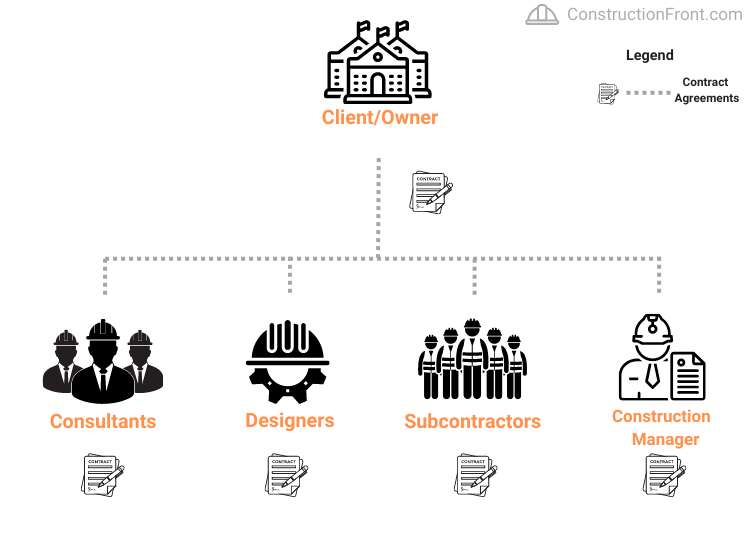
Under management contracting, the managing contractor usually enters into the downstream package contracts and administers them. Under construction management, the construction manager usually provides management services only, while the client contracts directly with the package contractors.
That difference affects responsibility, administration, and exposure to package-level issues.In practical terms:
- under management contracting, the managing contractor usually sits between the client and the package contractors
- under construction management, the client usually contracts directly with the package contractors
- management contracting generally gives the client more contractual buffering
- construction management generally gives the client more direct exposure to package performance, trade claims, and interface administration
For a more detailed route comparison, see management contracting vs construction management.
Management Contracting vs Design and Build
Management contracting is also materially different from design and build, even though both routes can involve early contractor input.
Under design and build, the client usually appoints a single contractor with combined design and construction responsibility, often with a stronger push toward overall price certainty at contract award. Under management contracting, the design usually remains more open for longer, the client keeps more influence, and packages are commonly let progressively.
Broadly, the difference looks like this:
| Aspect | Design and Build | Management Contracting |
|---|---|---|
| Responsibility | Usually offers stronger single-point responsibility. | Usually separates delivery through a managing contractor and multiple work packages. |
| Design Control | Usually gives the client less ongoing design influence after contract award. | Usually offers more design flexibility and greater ongoing client influence. |
| Client Involvement | Usually reduces client involvement after contract award. | Usually requires more active client decision-making. |
| Cost Position | Usually aims for earlier overall price certainty. | Usually accepts a more developing cost position as packages are progressively procured. |
| Procurement Approach | Usually packages delivery into a more fixed single-contract structure. | Usually allows earlier package movement and progressive procurement. |
| Commercial Trade-Off | Greater early certainty, but usually less flexibility. | More flexibility and package transparency, but usually less early certainty. |
A client seeking early lump-sum certainty may lean toward design and build. A client dealing with evolving scope, specialist interfaces, operational constraints, or staged procurement may find management contracting more suitabl
Advantages and Disadvantages of Management Contracting
Advantages
Management contracting tends to show its strengths on projects that are complex enough to justify structured package-based delivery. Common advantages include:
- early contractor involvement during design development
- better buildability and sequencing input before the whole job is fixed
- progressive procurement of specialist packages
- improved coordination across difficult interfaces
- more visibility into how package prices are being obtained
- greater client influence over design development and package strategy
- better fit for fast-track, phased, or technically evolving projects
Disadvantages
The disadvantages usually appear when the team wants flexibility but has not set the route up tightly enough. Common disadvantages include:
- less early cost certainty than a fully fixed procurement route
- heavier client involvement in design, approvals, procurement, and change
- more administration across multiple packages
- interface risk where package boundaries are poorly defined
- exposure to package market movement as procurement progresses
- programme pressure if information release lags package tendering
- disputes over mark-up, procurement transparency, value for money, or package award decisions if governance is weak
The route is not better simply because it appears more collaborative or flexible. It is better only where the project complexity, programme pressure, and client capability justify that structure.
When Management Contracting Is the Right Procurement Route
Management contracting should usually be considered where one or more of the following conditions apply:
- the design is incomplete, but early delivery input is commercially valuable
- the project has multiple specialist packages or difficult interfaces
- the client wants to retain meaningful control over design development
- the programme requires phased or progressive procurement
- the works involve live operations, access constraints, or staged delivery
- stakeholder requirements are likely to continue evolving during procurement and early delivery
Typical examples include:
- hospitals and healthcare facilities
- transport and infrastructure works with staging or possession constraints
- large refurbishments in occupied or live environments
- technically complex buildings with major services integration
- venues, stadia, and specialist public-use developments
It is usually less suitable where the scope is already well defined, the client wants to minimise ongoing involvement, and the main commercial objective is to lock in early lump-sum certainty.
Managing Contractor - Project Examples
Below is a list of projects which have successfully used the managing contracting model:
- The Royal Liverpool Hospital in the UK.
- Margaret Court Arena in Melbourne (Australia)
- Queensland Country Bank Stadium in Townsville, Queensland (Australia)

Key Points For Owners and Clients
For owners and clients, management contracting can be attractive because it preserves influence over design and package procurement while still placing a professional delivery layer between the client and the package market.
That said, the route works best when the client is clear about what it is retaining as well as what it is appointing the managing contractor to do. In practice, clients should test the following points before choosing it:
- Do we want to stay actively involved in design and package decisions?
- Do we have the internal team or adviser support to manage that involvement properly?
- Is the project complex enough to justify package-based procurement rather than a simpler single-contract route?
- Are we comfortable with an overall cost position that will firm up progressively as packages are bought?
- Have we set clear approval, reporting, contingency, and procurement governance rules?
- Are we prepared to make timely decisions so package procurement does not stall?
For clients, management contracting is often strongest where flexibility, market access, and design influence are commercially valuable, not where the only aim is early risk transfer.
Key Points For Contractors
For contractors, management contracting creates a different delivery and commercial profile from a conventional main contract. The managing contractor is not simply building the job. It is organising package procurement, managing interfaces, administering multiple contract lines, and controlling delivery in an environment where design and package information may still be developing.
Before taking on that role, contractors should assess:
- whether the client team understands the route and can make timely decisions
- whether package scopes are likely to be defined well enough to procure competitively
- whether the fee and preliminaries properly reflect the management and reporting burden
- whether package procurement obligations and transparency requirements are clearly stated
- whether programme logic allows sensible tendering and award of key packages
- whether insurance, liability, and package administration obligations match the actual role being accepted
- whether there is enough authority to manage underperforming packages and interface problems in practice
A weak management contracting arrangement can leave the managing contractor carrying heavy coordination obligations without enough fee, authority, information quality, or programme support to manage them properly.
How the Managing Contractor Is Paid
Management contracting is usually fee-based rather than a single all-in lump-sum build price.Common payment structures include:
- fixed management fee
- cost reimbursable arrangements plus agreed fee
- reimbursable preliminaries plus management fee
- schedule-based recovery for management staff and site resources
- target cost or incentive mechanisms on more bespoke projects
The commercial detail matters. The contract should deal clearly with:
- what the management fee covers
- how package costs are tendered, evaluated, approved, and reported
- whether any agreed mark-up applies to package costs or particular project overheads
- how preliminaries are priced, adjusted, and recovered
- how savings, pain/gain, contingencies, or overruns are dealt with
- what approval process applies to package awards, variations, and reprocurement
If those points are left loose, arguments can develop quickly over transparency, fee entitlement, package selection, procurement strategy, and whether the client is receiving value for money.
Practical Checklist: Is Management Contracting the Right Route?
Use this checklist at project strategy stage.
- Is the project too complex, interface-heavy, or programme-driven for a clean single-stage lump-sum procurement?
- Will early contractor input materially improve buildability, logistics, sequencing, or package strategy?
- Does the client want to retain influence over design and major package decisions?
- Are specialist package interfaces a major delivery risk?
- Can the client team support timely approvals and progressive procurement governance?
- Is the client comfortable with less early price certainty in exchange for flexibility and package visibility?
- Does the proposed managing contractor have proven package procurement, reporting, and coordination capability?
- Are change control, contingency use, package approval, and cost reporting clear enough to operate in practice?
If most answers are no, management contracting may be the wrong route. If most answers are yes, it is worth serious consideration.
Worked Example: When Management Contracting Makes Sense
A hospital expansion project needs new clinical space, major services integration, phased delivery beside live operations, and specialist packages for medical gases, controls, mechanical systems, and infection-sensitive works. The client wants early site progress and needs delivery input before every design element is fully frozen.
Under a standard design and build route, the contractor may either price substantial uncertainty or resist taking full responsibility until more of the design is complete. Under pure construction management, the client may end up carrying more direct package administration and trade interface exposure than it wants.
Under management contracting, the client appoints a managing contractor early to help shape the package strategy, coordinate logistics around live operations, and procure specialist packages in sequence as the design matures. The client keeps more influence over design and package decisions, while the managing contractor provides a stronger contractual and management layer over package procurement and delivery.
That does not remove risk. The client still needs strong decision-making, and the contract still needs clear package scopes, reporting rules, approval gateways, and change controls. But this is exactly the kind of project where management contracting can be commercially rational rather than theoretical.
Common Pressure Points in Live Projects
Management contracting usually becomes difficult for familiar reasons:
- package scopes go to market before they are ready
- client approvals are too slow for the procurement sequence
- design development continues too far into delivery
- interfaces between packages are not defined tightly enough
- cost reporting does not show a reliable package-by-package position
- variations are not captured consistently across package boundaries
- responsibility between consultants, the managing contractor, and package contractors becomes blurred
- the fee and preliminaries do not reflect the actual management burden created by the route
These are not abstract procurement issues. They are the issues that usually drive time, cost, and dispute problems on live projects. If those problems start affecting scope, price, or timing, they often spill into formal disputes and claims.
Conclusion
Management contracting is best treated as a procurement route decision, not just a role definition. It is most useful where the client needs early contractor input, package-based delivery, design flexibility, and closer visibility into how the project is being procured and assembled.
For clients comparing management contracting with construction management, or weighing it against design and build, the real issue is not which label sounds more collaborative. It is which route best matches the project’s design maturity, interface risk, programme pressure, and governance capability.
Used in the right setting, management contracting can be an effective route for complex and evolving projects. Used on the wrong project, or with weak controls, it can create exactly the uncertainty the client was trying to manage.
FAQ
What is management contracting in construction?
Management contracting in construction is a procurement route where the client appoints a managing contractor to support design development, procure work packages, and manage delivery through separate package contractors.
What is the difference between management contracting and construction management?
The main difference is the contract chain. Under management contracting, the managing contractor usually contracts with the package contractors. Under construction management, the client usually contracts directly with them.
What is a managing contractor?
A managing contractor is the party appointed under the management contracting route to coordinate package procurement, programme, interfaces, commercial administration, and delivery.
When should management contracting be used?
It is usually used where the project has evolving design, specialist package complexity, interface risk, operational constraints, or a need for early contractor involvement before everything is fully defined.
Is management contracting better than design and build?
Not automatically. Management contracting usually offers more flexibility and package visibility, while design and build usually offers earlier price certainty and stronger single-point responsibility.
Does management contracting give the client more control?
Usually yes, particularly over design development, package procurement, and key commercial decisions. That added control also means more client involvement and governance responsibility.
Sources
- Construction Front, What is a Managing Contractor? (Details, Examples & Tips)
- Construction Front, Managing Contracting vs Construction Manager – Key Differences & Tips
- Construction Front, How Two Stage Tendering Works? (And When to Use it)
- Construction Front, Contract Administration and Construction Claims Explained
- Construction Front, What is a Variation Request? (And How to Submit one!)
- Construction Front, Contractor Variation Request Process: Step-by-Step Guide to Preserving Entitlement
- Construction Front, Change Order in Construction: Meaning, Process, Pricing, Types, and Common Risks
- Construction Front, Construction Change Directive (CCD): What It Is, Contractor Rights, Process, and Entitlement Protection
- Construction Front,
What is a Variation Order? (With Templates and Examples)