

One of the critical aspects of a construction project development is ensuring that the most suitable contracting approach is implemented.
With several options and contracting risk profiles available, construction management and managing contractors’ agreements are similar approaches (yet, different) that emerge as viable options for clients that do not have in-house project management capabilities for delivering their projects and are looking to engage specialists.
But what is the difference between construction management and managing contractor agreements?
The distinction between construction management and managing contractor agreements lies in the contractual structure among various project stakeholders (such as subcontractors, consultants, designers, and project managers) engaged in the construction process.
In a managing contractor agreement, the emphasis is on a singular master contract, providing the owner or client a single point of contact. Conversely, the construction management approach requires the principal to handle and oversee multiple sub-packages individually.
This article will explore the key differences further, their suitability, and the best practices associated with these two models.
What is a Managing Contractor Agreement?
The Managing Contractor (MC) model is a procurement approach widely used by many clients in complex projects requiring significant design coordination during the front-end phase.
Typically, the owner/client hires the MC to manage the construction project, which will contract designers, consultants, and subcontractors to support the client in developing the project’s feasibility studies, design and oversee construction progress, and handover tasks (see picture below).
One of the key characteristics of this approach is that it provides a single point of contact for the client, streamlining and facilitating communication and decision-making.
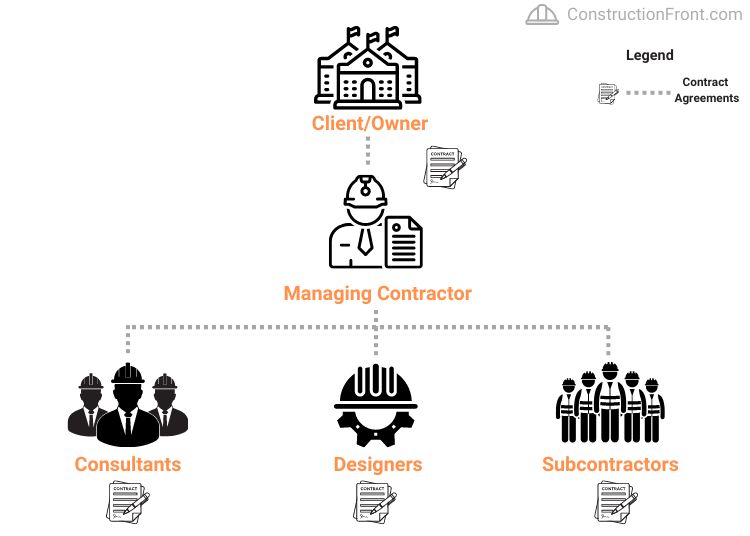
From a commercial perspective, managing contractors tend to have increased legal exposure (when compared to construction managers), given they enter into downstream agreements with other parties and typically bear the coordination risks between the group of subcontractors.
Recommended Article: What is a Managing Contractor? (Details, Examples & Tips)
What is a Construction Manager Agreement?
As with MCs, Construction Managers (CMs) are typically engaged in the project’s early days and tend to undertake a similar scope of work from project inception to handover as MCs do.
However, construction managers do not engage subcontractors, designers, or consultants to help on the project but only manage and coordinate the interfaces between them.
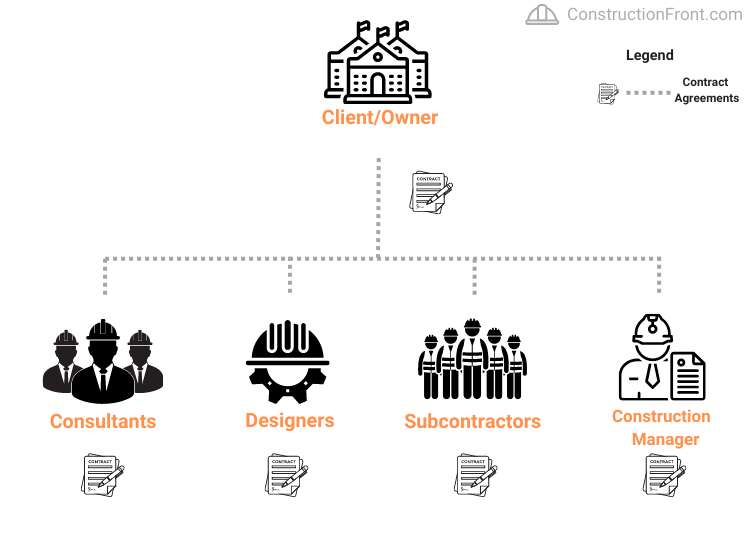
As detailed in the picture above, construction managers do not have any contract relationships with other parties (sometimes interface agreements or tri-partite agreements govern the interfaces between them).
Consequently, this contract arrangement transpires in diminished contractual liabilities for the Construction Manager, as it only has upstream obligations with the owner.
Managing Contracting vs Construction Management - What is the Difference?
As detailed above, the critical difference between managing contracting and construction management agreements is the contract arrangement between all parties involved in the project.
The managing contractors are responsible for entering into agreements with subcontractors, designers, and consultants and creating a single-touch point with Clients (as shown in Figure 1 above).
From an Owner’s perspective, this translates into less administrative burden (only one contract to manage) and fewer interface and integration risks, as the managing contractor typically wraps up these risks.
On the other hand, Construction Manager Agreement has a “lighter” risk profile (from a contractor perspective), given the inexistence of downstream agreements (refer to Figure 2 above, again). Construction Managers will coordinate the construction activities and support the client in procuring tradies and required packages.
For this reason, construction managers can also be considered “consultants”, as they bring their valuable expertise to the project but typically have limited legal exposure to cost overruns and project delays.
Aspect | Managing Contractor | Construction Manager |
Contract Arrangement | Direct agreements with subcontractors, designers, and consultants, creating a single touchpoint with clients. | Unique upstream agreement with Client/Owner. |
Administrative Burden for Owner | Reduced burden for owners, as managing contractor is a single touch point for the project. | Increased workload as the Owner will have to administer multiple engagements. |
Interface & Integration Risks | Fewer risks, typically managed by the managing contractor. | Increased, as Construction Manager typically have limited legal exposure |
Relationship with designers, subcontractors, and consultants | Owner will have an indirect relationship, with less control over them | Owner has increased control over these parties, given direct agreement with each. |
Role | Comprehensive project management responsibility. | More akin to a consultant Consultative role. |
Note: Construction Manager at Risk (CMAR) Agreements are a variant in which the Construction Manager ensures that the construction project will not pass a pre-established cost threshold, also referred to as the Guaranteed Maximum Price (GMP), and, consequently, it bears significant more risks than a vanilla CM agreement.
Managing Contracting vs Construction Management - When to use each framework?
Overall, each option will rely solely on the client’s preferences and market conditions and best practices.
For example, a client may want to engage a small group of professionals that do not have overhead and financial structure and background to manage multiple downstream agreements but will bring valuable insights for the project development through their expertise. In this case, a Construction Management Agreement would suit better.
Alternatively, an owner might have a thin administrative structure and would like to engage an experienced contractor to manage complex, evolving and multidisciplinary project needs and establish a single point of contact. In this scenario, a Managing Contractor Agreement makes more sense.
Managing Contracting - Practical Examples
Below is a list of projects which have successfully used the managing contracting model:
- The Royal Liverpool Hospital in the UK.
- CPB Contractors appointed as Managing Contractor for the new Bundaberg Hospital in Queensland (Australia)
- Queensland Country Bank Stadium in Townsville, Queensland (Australia)
Construction Management - Practical Examples
A famous example of a Construction Management At Risk is the construction of the new Tennesse Titan Stadium – Read more here: Tennessee Titans awards Construction Manager Contract to JV with Turner Construction

Final Thoughts
Choosing the right contracting approach will significantly affect project success. Managing Contracting and Construction Management Agreements are very useful when early contractor involvement is helpful.
Albeit very similar when it comes to the scope of work, these contracting approaches differ significantly when commercial and legal aspects are taken into account.
Managing contractors establish a unified framework by entering comprehensive agreements with various stakeholders, providing clients with a single touchpoint for streamlined communication and reduced interface risks.
Conversely, construction managers typically play a role akin to a consultant and have limited legal exposure. Ultimately, the decision between these models depends on your project’s complexity, organizational structure, and owner’s preference.