

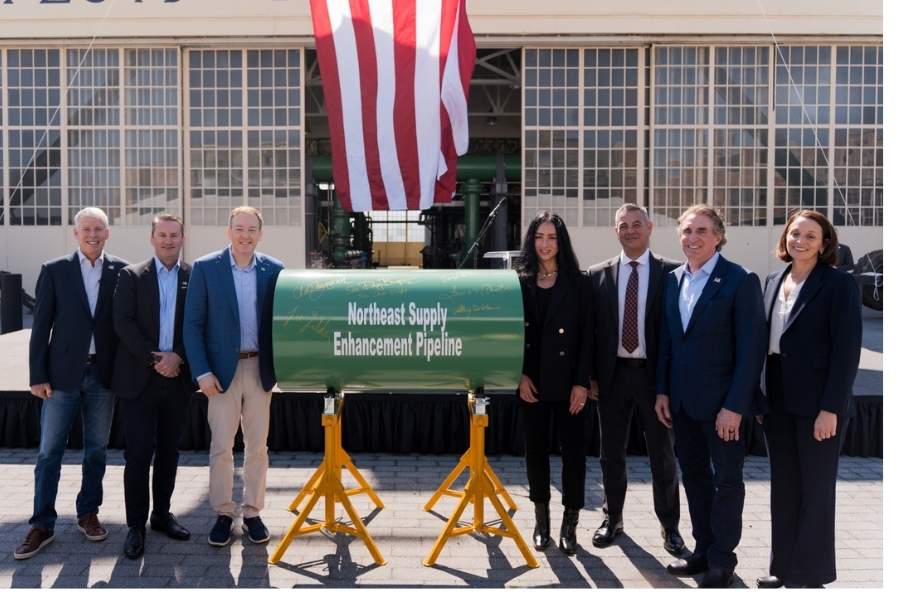
Williams has marked the start of construction on the Northeast Supply Enhancement (NESE) Project, a regulated expansion of its existing Transco pipeline system across the U.S. Northeast. The company held a groundbreaking ceremony in Brooklyn and said the project remains on track to enter service in the fourth quarter of 2027.
The milestone is important because it moves a long-advanced gas infrastructure project into physical execution after federal and state construction permits were secured. For a project of this kind, construction start is the moment when regulatory approvals, owner-side commitment, and delivery risk begin to convert into active field works.
NESE Project – Project Background
Williams describes NESE as an expansion of the existing Transco system across Pennsylvania, New Jersey, and New York, designed to add roughly 400,000 dekatherms per day of capacity. According to the company, that is enough energy to serve the equivalent of about 2.3 million homes and is aimed at peak-demand periods in the Northeast.
The broader project page shows NESE as an upgrade of existing transmission infrastructure rather than a greenfield corridor. That matters from a delivery perspective because expansion works on an operating gas network usually place more emphasis on staging, tie-ins, interface control, and permitting continuity than a simple one-package construction narrative would suggest.
Williams’ own fact sheet also positions the project as a response to regional energy constraints, particularly in densely populated markets such as Brooklyn, Queens, Staten Island, and Long Island. That gives the article a stronger search and editorial hook than a generic pipeline-start story because the project is tied directly to a known regional supply issue.
NESE construction start – Milestone details
Williams said the groundbreaking marks the official start of construction and that the project remains scheduled for service in Q4 2027. The company did not disclose a contract value or identify the major construction contractors in the release.
What is clear is the project stage: this is no longer a permitting or development story. With construction permits in hand, the NESE Project has moved into execution on an existing interstate pipeline system that already serves the region. That shift matters commercially because the project risk profile changes once works begin. Regulatory uncertainty may reduce, but field coordination, schedule management, environmental compliance, and interface execution become more important.
The release also emphasizes the project’s role in supplying homes, businesses, and critical infrastructure during peak demand periods. Whether or not one agrees with the policy framing, that is commercially relevant because infrastructure justified on reliability and peak-demand grounds is usually assessed differently from projects driven mainly by market expansion.
Project Delivery considerations
A pipeline expansion on an operating system creates a different delivery challenge from a greenfield build. The work has to be integrated into existing infrastructure while maintaining system reliability, meeting regulatory conditions, and controlling disruption across multiple jurisdictions, creating significant coordination challenges and risks associated with contractual administration and claims.
Williams also frames NESE as part of a broader energy affordability and reliability case for the region. In practice, that means the project will be judged not only on whether it is built, but on whether it enters service when promised and performs as intended during seasonal peak demand. On infrastructure of this type, timing is not a secondary issue; it is part of the commercial value of the asset itself.
U.S. gas and LNG infrastructure outlook
NESE reflects a broader U.S. pattern in which energy infrastructure owners are still advancing targeted brownfield expansions where existing networks can be upgraded faster than entirely new corridors can be developed. That trend sits alongside a wider build-out in gas and LNG infrastructure, where developers are moving projects through staged development, Final Investment Decision (FID), notice to proceed, and early execution milestones with increasing commercial discipline.
That wider pattern is visible in recent LNG projects already covered on Construction Front, including Technip Energies’ substantial authorization to advance Commonwealth LNG ahead of FID and Cheniere’s FID and notice to proceed for the Corpus Christi Midscale LNG Expansion. The commercial structures differ, but the underlying theme is similar: owners are pushing critical gas infrastructure forward through tightly managed approval and execution gates rather than treating development and delivery as separate worlds.
Related Articles and News
- Technip Energies receives substantial authorization to advance Commonwealth LNG ahead of FID
- Cheniere reaches FID for Corpus Christi Midscale LNG Expansion and issues notice to proceed to Bechtel
- Construction Claims and Contract Administration Explained
- Notice to Proceed in Construction: What is it?
- What is Final Investment Decision (FID)?