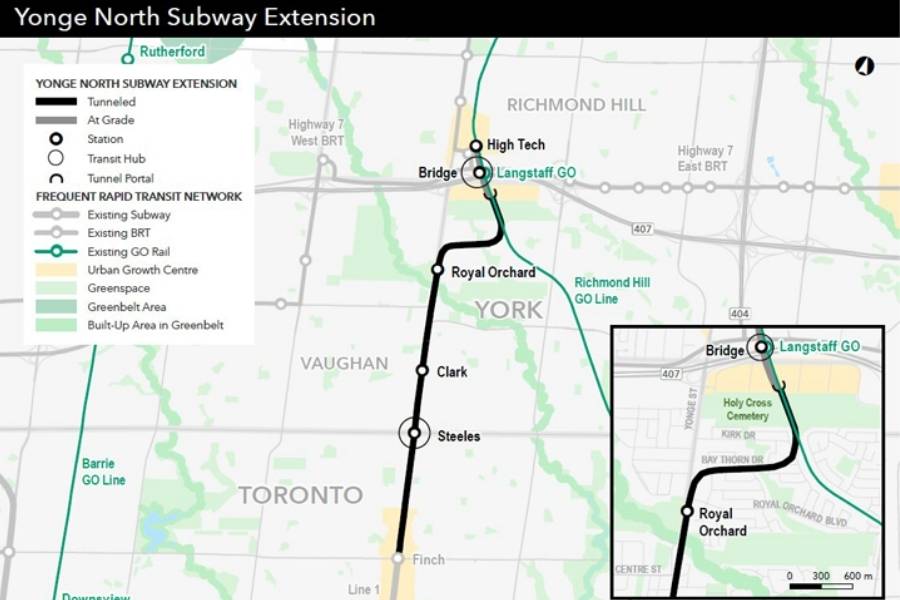
Infrastructure Ontario (IO), in partnership with Metrolinx,, has issued a Request for Qualifications (RFQ) for the Stations, Rail & Systems (SRS) contract for the Yonge North Subway Extension (YNSE) — an eight-kilometre expansion of Toronto’s Line 1 (Yonge–University) that will extend service from Finch Station to Richmond Hill.
The release of the RFQ marks a major procurement milestone for the project, advancing it into its next phase of delivery and reinforcing the Province of Ontario’s commitment to expanding the Greater Toronto Area’s rapid transit network.
Yonge North Subway Extension – Project Details
The YNSE will add approximately eight kilometres of new subway infrastructure, connecting Toronto to York Region through Vaughan and Markham before reaching Richmond Hill. Once complete, the extension will serve thousands of daily commuters, reducing congestion and improving regional connectivity.
The Stations, Rail & Systems (SRS) package will cover the design, construction, and integration of key surface and underground transit infrastructure, including:
Five new subway stations, each with supporting bus terminals, entrances, and passenger amenities.
Emergency exit buildings, traction power substations, and tunnel cross-passages to ensure operational safety and reliability.
Rail, power, and signalling systems along the full alignment.
A new train-storage facility for fleet maintenance and operations.
Modifications to the existing Finch Station tail tracks to connect with the extension.
Full systems integration with the ongoing Advance Tunnelling contract, which is currently progressing excavation and lining works.
The SRS contract represents the most comprehensive delivery package for the YNSE and will be critical to enabling full system commissioning.
Procurement Strategy & Delivery Model
The Stations, Rail & Systems contract will be procured and delivered under a Progressive Alliance model, a modern, partnership-based procurement strategy emphasizing early contractor collaboration and transparency.
A progressive procurement model brings the owner and contracting partner together early to jointly define project requirements, scope, and design through a Development Phase, comparable in purpose to Integrated Project Delivery (IPD) method or Front-End Engineering Design (FEED) contracts typically implemented in oil and gas projects.
During this phase, both parties work collaboratively to establish pricing, manage risks, and optimize technical solutions before moving into a final target-price agreement for delivery.
This method, already being applied across Ontario’s major infrastructure pipeline, is designed to:
Foster collaboration and shared problem-solving between owner and contractor.
Introduce cost-control measures such as affordability caps to guide design development within a set budget.
Enable earlier decision-making by government stakeholders compared to traditional P3 or design-build approaches.
Reduce risk through joint planning and transparent pricing mechanisms.
According to Infrastructure Ontario, the final contract value will be announced upon project’s financial close, indicating the use of the PPP framework contracting.
Related Project and News
- Infrastructure Ontario Awards $1.4B PPP Contract for Yonge North Subway Extension Advance Tunnelling
- LA Metro Chooses FlatironDragados for Two Significant Rail Projects Worth $900 Million
- Infrastructure Ontario Advances QEW Skyway Twinning Project with Flatiron-Dragados JV as Development Partner
- Aecon-Pomerleau JV Reaches Financial Close on $609M Montreal Port Expansion In-Water Works