

New Era Energy & Digital has closed a multi-tranche senior secured term loan credit facility of up to $290 million with Macquarie Group to finance its flagship Texas Critical Data Center (TCDC) project in Ector County, Texas. The facility supports development and construction of a large-scale AI and high-performance computing campus planned to scale beyond 1 GW over time..
The milestone matters because project-level financing is often one of the most important triggers for construction progression, indicating that a project is moving closer to commercial and financial close. According to the company, the new funding will be used for general corporate purposes, including the acquisition, improvement, and equipping of properties tied to the TCDC project.
Texas Critical Data Center Campus - Project Background
New Era, through Texas Critical Data Centers LLC, is developing a 438-acre AI and high-performance computing campus in Ector County, outside Odessa, Texas. According to the company, the site is master-planned as a multi-phase hyperscale campus with anticipated capacity scaling to more than 1 GW over time.
That scale places the project within the growing class of large digital infrastructure schemes being shaped by demand from AI workloads, hyperscale compute, and energy-intensive data processing. The broader market signal is that data center projects are increasingly being treated like utility-scale infrastructure, with powered land, phased delivery, and financing structures that increasingly resemble large energy or transport developments.
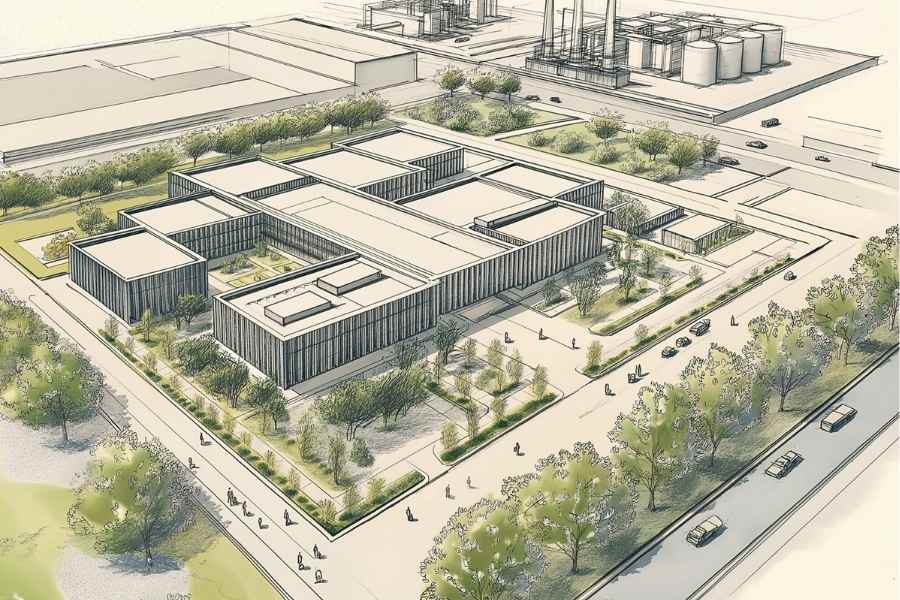
The Texas site also benefits from direct proximity to critical enabling infrastructure, including major intrastate natural gas transmission lines, high-capacity fiber optic networks, and nearby combined-cycle power generation facilities. That matters because these assets can materially improve deployment speed and long-term scalability, especially for AI-oriented campuses where power availability is often the primary development constraint.
New Era is also pursuing acquisition of an additional 54-acre corridor adjacent to the site, which would expand the campus to 492 acres. According to the company, securing that corridor would improve its ability to structure direct power offtake arrangements, optimize transmission interconnection, and preserve long-term development flexibility.
The company’s broader platform strategy extends beyond Texas. In Lea County, New Mexico, New Era has also secured a land option purchase agreement for approximately 3,500 acres for a separate multi-gigawatt AI infrastructure campus.
The new $290 credit facility
The transaction establishes a multi-tranche senior secured term loan credit facility of up to $290 million with the Commodities and Global Markets business of Macquarie Group. The structure includes a $20 million committed Term Loan A-1, a $30 million Term Loan A-2, a $40 million Term Loan A-3, and a $200 million delayed draw term loan, subject to conditions precedent. The loans mature on the third anniversary of closing.
New Era said the proceeds will support development and construction of the Texas Critical Data Center project and will also be used for general corporate purposes, including acquisition, improvement, and equipping of project properties. The package also includes a $5 million common stock purchase by Macquarie at a 20% premium to the five-day VWAP, plus up to $5 million of warrants tied to the first $50 million drawn.
This is relevant because the financing is being put in place at project level rather than simply as broad corporate liquidity. That usually signals a more advanced degree of project definition and a clearer pathway toward construction execution, even if a formal notice to proceed to a contractor has not yet been announced.
The structure also suggests a staged funding approach aligned to project progression rather than a one-time capital injection. That is common where owners want to preserve flexibility while still securing enough committed capital to move land, power, and enabling works forward ahead of full-scale deployment.
TDCD - Project Delivery Insights
Large-scale data center campuses are typically constrained by power access, grid interconnection timing, equipment lead times, and phased construction sequencing. That matters because securing capital is only one part of the execution equation; owners still need to align civil works, utility infrastructure, shell delivery, fit-out strategy, and tenant timing.
In this case, the project’s 1+ GW ambition strongly suggests a phased delivery pathway rather than a single build-out. That type of staging is common in digital infrastructure because it allows capital deployment, utility readiness, and customer demand to be matched progressively instead of front-loading all delivery risk into a one-time construction package.
The company’s Texas project page also indicates a behind-the-meter power model, strategic energy partnerships, and the use of critical generation equipment to support anchor tenant development and future expansion. That is important because it shows the project is not just competing on land availability, but on integrated energy strategy, which is increasingly becoming the decisive differentiator for large AI campuses.
Digital Infrastructure Outlook
This financing reinforces the shift in digital infrastructure from smaller standalone data halls toward large, master-planned campuses backed by structured project finance.
That trend is visible in projects such as CoreWeave’s multi-billion dollar AI data center campus in Pennsylvania and earlier construction milestones like Meta’s $800 million data center in Indiana.
This is relevant because rising demand from AI infrastructure and high-performance computing is driving owners to secure land, power, and financing earlier in the development cycle. It also suggests that project financing and construction sequencing are becoming just as important to competitive positioning as tenant demand itself.
For contractors, advisers, and infrastructure investors, the implication is clear: data center delivery is increasingly behaving like heavy infrastructure, not just commercial real estate. In that context, milestones such as project-level debt, powered land strategy, and long-term offtake optionality are becoming as important as the building works themselves.
Related Project and News
- Turner-Wohlsen JV to Deliver CoreWeave’s Multi-Billion Dollar AI Data Center Campus in Pennsylvania
- Turner to build Meta’s $800M Data Center in Jeffersonville – Indiana
- What is the Difference Between Commercial Close and Financial Close?
- Tonaquint, DIF’s investee, acquires EdgeX Data Centers located in Oklahoma City