


To respond to the evolving nature of the construction industry, professionals in the niche have developed different procurement approaches and incorporated different contractual mechanisms to improve risk allocation and suit clients’ preferences.
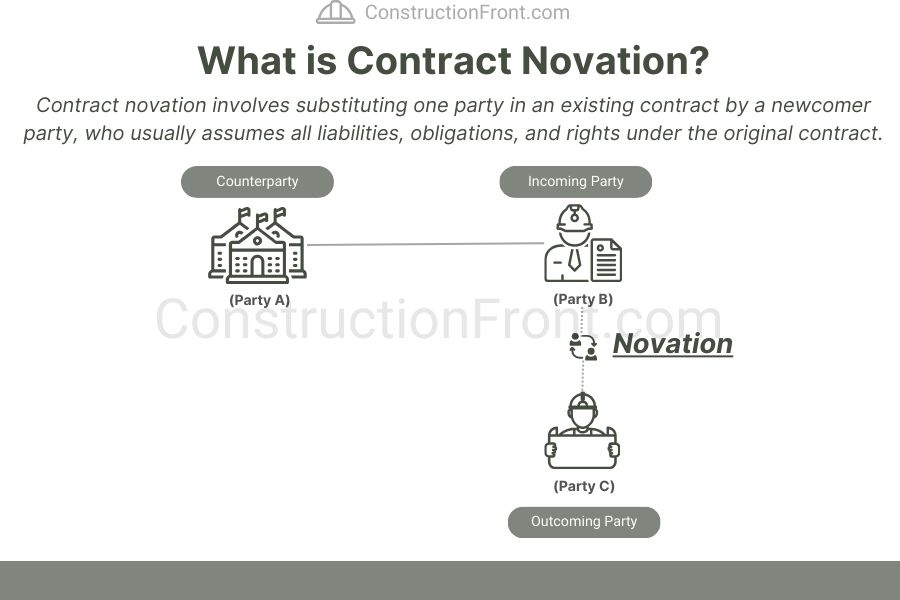
One common mechanism found in contemporary contracting approaches is contract novation. But what does it entail? Contract novation denotes a legal process whereby a new party or parties replace one or more original parties in an existing contract, with the newcomer(s) typically assuming all liabilities and obligations outlined in the original contract.
This specific contractual tool finds application in different scenarios. For example, sometimes, in design-build (DB) contracts, clients may wish the DB Contractor to novate an existing agreement with a specific designer that the client had already previously engaged.
In this article, we will explore the concept of novation in construction contracts further, re-visit its applicability, and understand its advantages and drawbacks, as well as other vital features of this legal concept.
What is Contract Novation?
Contract novation involves substituting one or more parties in an existing agreement by a newcomer party, who usually assumes all liabilities, obligations, and rights of the replaced party under the original contract.
To be implement, the novation requires the mutual agreement of all involved parties to release one party from their rights and obligations under the initial contract and transfer them to the new party. It effectively terminates the original contract, replacing it with a new one.
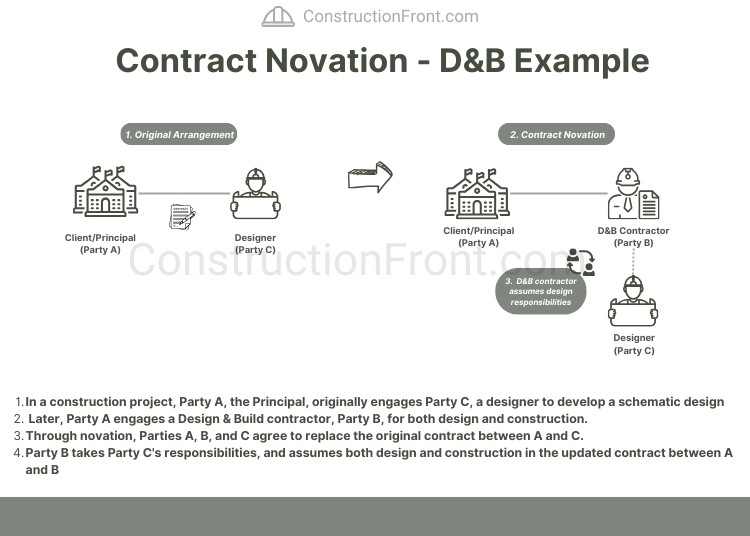
Contract Novation - An Example with D&B contracts
- In a construction project, Party A, acting as the Principal, initially engages Party C, a designer, for architectural planning.
- Later, Party A decides to engage a Design & Build (D&B) contractor, Party B, to manage both the design and construction aspects.
- Through novation, Party A (the Principal), Party B (the D&B contractor), and Party C (the Designer) mutually agree to replace the original contract between Party A and Party C with a new agreement.
- This process involves Party B (the D&B contractor) assuming the design responsibilities held by Party C under the initial contract between Party A and Party C.
- As a result, Party B becomes responsible for both the design and construction phases, effectively substituting Party C’s initial role under the updated contract between Party A and Party B.

Author’s Note:
- In some instances, the designer (party C) might become a subcontractor/consultant to the Design-Build Contractor, but no contractual relationship with the Principal exists, after novation takes place.
Key Features of Contract Novation
Some of the key features of contract novation are detailed in the table below.
Key Feature | Description |
Mutual Agreement | All parties involved must agree to substitute one party/obligation with another. |
Extinction of Original Contract | The original contract is terminated completely and replaced by a new one. |
Transfer of Rights and Obligations | Rights and obligations from the original contract are transferred to the new party. |
Release of Exiting Party | The outgoing party is relieved of its responsibilities and rights from the original contract. |
Creation of New Contract | A new contract is formed with the incoming party taking over the obligations and benefits. |
Consent of All Parties | Every party involved in the original contract must agree to the novation for it to be valid. |
When Novation is used in Construction Contracts?
There are many reasons why novation is used in the construction world, such as:
- Contractor Bankruptcy/Insolvency: If a contractor faces financial issues or goes bankrupt during a project, novation allows for the substitution of a new contractor, ensuring the project continues with a new party.
- Client/principal wishes to appoint a specific designer for the project: Sometimes, a client may want to engage a particular designer to develop the initial/concept design, which will, later, be novated to the Design-Build Contractor.
- Use of Early Contractor Involvement (ECI) Framework: In this framework, the Contractor is involved from the project’s outset in a role akin to a consultant/construction manager to support planning and design development (phase 1 – pre-construction). Upon completion of phase 1, a new construction agreement is executed with the ECI Contractor (phase 2 – construction phase), which might require the novation of design and/or other contracts.
- Novation of Supply Agreements in EPC Contracts: In some instances, following the execution of the Front-End Engineering Design (FEED) phase in industrial projects, the Project Owner may enter into specific supply agreements (i.e. turbines for a power plant) because of the long lead time. When the EPC Contractor is procured, the supply agreement for this specific equipment is novated by the EPC Contractor.
Challenges of Novation in Construction Contracts
The novation process in construction contracts is typically associated with some challenges and pitfalls, such as:
- Consent Requirements: Obtaining consent from all involved parties, especially during contractor bankruptcy, can be challenging, potentially causing delays or complications.
- Legal and Contractual Issues: Novation requires careful documentation and clear delineation of responsibilities to avoid misunderstandings or disputes regarding the transferred liabilities and obligations.
- Liability for services performed “pre-novation”: Even after novation, the outgoing party may still hold residual liabilities unless explicitly released. Determining the extent and clarity of this release can be complex and may require detailed negotiations.
- Relationship between new parties: Unless thorough planned and pre-agreed between parties, the negotiation and implementation of novation terms might strain relationships between parties involved. Disagreements over liabilities, terms, or other aspects can impact relationships.
- Limitation on Value-Engineering: Depending on the novation timing in design contracts, opportunities for contractors to implement value-engineering initiatives might be restricted.
- Contractors might require a higher premium to bear novation risks: Contractors might demand a higher premium to manage novation risks (i.e. if there are issues in the original designs non-identified at the time of novation, the Design-Build Contractor might bear responsibility)
FAQ - Contract Novation
Contract Novation vs Contract Assignment - What is the difference?
The primary difference between contract novation and assignment lies in the extent of change to the original contract.
In essence, while novation fundamentally replaces the original contract with a new one by substituting parties or obligations, the assignment process involves the transfer of specific rights or obligations to a third party without altering the original contract itself. The table below summarises the key differences:
Aspect | Contract Novation | Contract Assignment |
Nature of Change |
|
|
Extent of Change |
|
|
Consent Requirement |
|
|
Release of Outgoing Party |
|
|
Does novation create a new contract?
Yes, novation does create a new contract. When parties engage in novation, they effectively replace the original contract with an entirely fresh agreement, making it a new legal arrangement altogether.
Can you novate a contract without consent?
Novation requires the consent of all parties involved; without agreement between them, a contract cannot occur. Consent is crucial for the legal and valid replacement of the original contract with a new one.
Need Help?
Do not hesitate to contact us (click here) for specialised advice in the construction industry.
Sources
- Contractors’ risks in Design, Novate and Construct contracts – ScienceDirect
- Construction Contracts: Questions and Answers
- Understanding the dynamics of novation: a contractor’s perspective
- Contractor insolvency during a project – cliffordchance.com
- Novation Agreements in Design-Build Contracts (utm.my)
- Procurement Methods Guidelines NSW Contruction Leadership Group
- Australian-Institute-of-Architects_Novation-Survey_Victoria-2019.pdf (architecture.com.au)
- BLYTH AND BLYTH LIMITED v. CARILLON CONSTRUCTION LIMITED (scotcourts.gov.uk)