


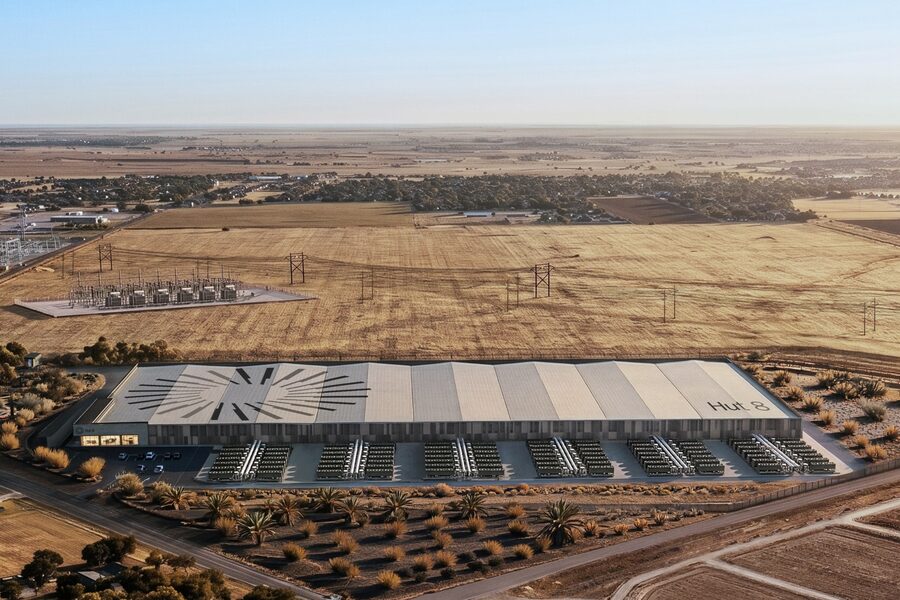
Jacobs has been awarded a sole-source EPCM contract by Hut 8 to deliver the Beacon Point AI data center campus in Nueces County, Texas.
The award covers engineering, procurement and construction management services for Hut 8’s second U.S. AI data center campus, a multi-phase development designed to support 1 GW of total utility capacity. Hut 8 states that 700 MW is expected to be delivered by Q1 2027, with the remaining 300 MW anticipated by Q4 2028, subject to system upgrades.
Beacon Point AI Data Center – Project Background
The Beacon Point campus is planned for Nueces County, Texas, as a greenfield AI compute development. Hut 8 describes the project as a multi-phase, multi-tenant campus, with key interconnection and site approvals secured for 1,000 MW of capacity.
The project has a stated site footprint of 525 acres and is intended to support artificial intelligence workloads rather than cryptocurrency mining. Hut 8’s project page says the campus is designed and permitted as a data center for AI applications, with staged development moving through land, power, design, commercialization, construction, energization and operations.
Beacon Point is being advanced in a region historically anchored in heavy industry. Hut 8 states that the first two phases are expected to represent a combined capital investment of approximately $17 billion, supporting around 1,900 construction jobs and approximately 230 permanent operations roles.
The project is also being developed with water and grid concerns front of mind. Hut 8 says the facility will use a closed-loop cooling system and that it has pre-funded necessary infrastructure costs required to serve its load.
Jacobs EPCM Scope and Delivery Model
Jacobs’ contract covers the EPCM role for Beacon Point, following its earlier EPCM appointment on Hut 8’s River Bend AI data center campus in Louisiana. The company said it will advance design, integrated procurement and construction management to support phased delivery, with initial energization and commissioning targeted for 2027.
Under an EPCM model, the contractor typically manages engineering, procurement strategy, construction coordination and delivery controls on behalf of the owner, while the owner retains a larger role in contracting and commercial decision-making than under a full EPC contract. That distinction is important on data center campuses, where equipment procurement, utility interconnection, commissioning and tenant requirements need to be coordinated in parallel. On fast-moving campuses, the EPCM structure can also support earlier package release and tighter interface control before final construction packages are fully committed.
Jacobs said it will apply proven design elements from Hut 8’s River Bend campus and deploy its data center digital twin to simulate critical assets. The stated objective is to help de-risk commissioning and reduce time to first revenue by accelerating deployment of AI workloads.
Jacobs Chair and Chief Executive Officer Bob Pragada said the follow-on award reflects Hut 8’s confidence in Jacobs’ ability to deliver complex AI infrastructure with “speed, safety and certainty.”
Beacon Point Project Data
| Project Element | Confirmed Detail |
|---|---|
| Project | Beacon Point AI data center campus |
| Owner / Developer | Hut 8 |
| EPCM Contractor | Jacobs |
| Location | Nueces County, Texas |
| Utility Capacity | 1,000 MW |
| Initial Capacity Timing | 700 MW expected by Q1 2027 |
| Remaining Capacity Timing | 300 MW anticipated by Q4 2028, subject to system upgrades |
| Site Footprint | 525 acres |
| Application | AI compute |
| First Two Phases | Approximately $17 billion combined capital investment |
AI Data Center Infrastructure Outlook
The Beacon Point award reinforces the way AI data center development is becoming a major infrastructure delivery market rather than a narrow technology build-out. Large campuses now require coordinated power procurement, grid interconnection, civil works, equipment supply, cooling systems, commissioning controls and long-term operational planning. Power strategy is increasingly central to bankability and delivery, particularly where projects rely on long-term offtake, utility agreements or structures similar to a Power Purchase Agreement.
Construction Front has tracked similar momentum across the sector, including the Turner-Wohlsen JV appointed to deliver CoreWeave’s AI data center campus in Pennsylvania and New Era securing a $290 million Macquarie facility for a Texas critical data center campus. Those projects show how digital infrastructure is increasingly being procured and financed with the same discipline applied to energy, industrial and transport megaprojects.
For contractors and consultants, this is relevant because AI campuses are creating demand for integrated delivery models, repeatable design, early procurement planning and sophisticated commissioning management. The same commercial questions seen on other major projects – scope control, interface risk, procurement timing, change management and power availability – are now central to digital infrastructure delivery.