
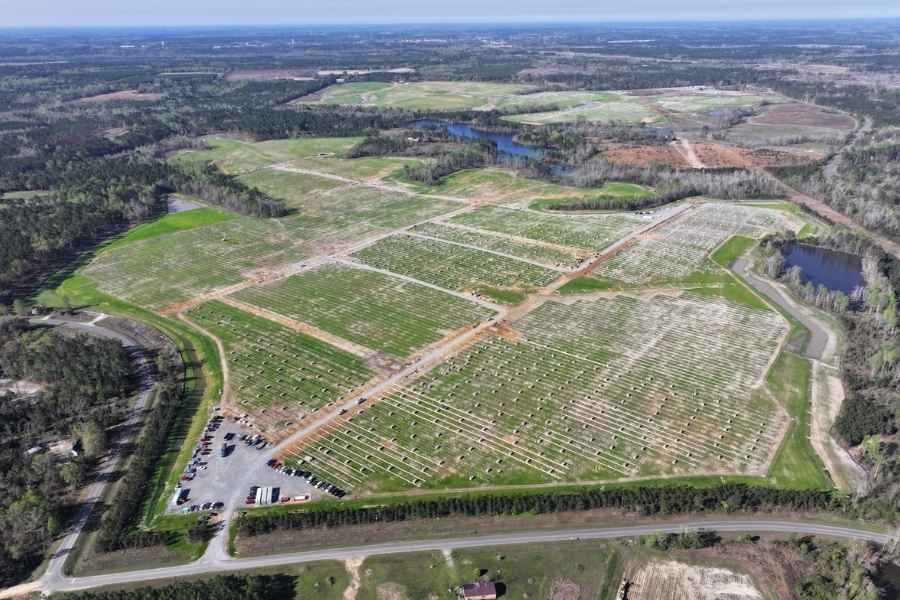
Heelstone Renewable Energy, a Qualitas Energy company, has achieved financial close and commenced construction on two U.S. solar PV projects backed by long-term corporate power purchase agreements with a hyperscale data center developer. The projects are the 104 MW Alligator Creek Solar project in Georgia and the 102 MW Murch Solar project in Michigan.
The announcement is commercially significant because it combines several execution gates in one milestone: Final Investment Decision (FID), financial close, EPC contract execution, and the transition into physical construction.
Alligator Creek and Murch – Projects Background
According to Heelstone, the two projects represent a combined installed capacity of 206 MW and are backed by long-term corporate power purchase agreements with a leading U.S. hyperscale data center developer. That pairing gives the portfolio a stronger commercial profile than a purely merchant solar development because contracted offtake is already in place before construction.
The projects also sit within Heelstone’s wider transition into a fully integrated independent power producer. That matters because this is not just a pair of isolated solar assets entering construction. It is part of a broader strategy to move from development into financing, construction, and long-term operation across a growing U.S. portfolio.
Financial close and construction start – Milestone details
Heelstone said construction follows the achievement of FID and the execution of EPC contracts with Pure Power Contractors, LLC for Alligator Creek and Greensol Renewables, LLC for Murch. Commercial operation of both facilities is expected by the end of 2026.
The financing structure is also unusually well disclosed for a project-start release. Heelstone said Alligator Creek reached financial close in December 2025, while Murch closed in March 2026. The projects were funded through non-recourse project financing at asset level, supported by debt and tax equity commitments for construction and long-term operations.
For Alligator Creek, Paragon Energy Capital advised on financing, Stonehenge Capital provided syndication and asset management services to the Production Tax Credit buyer, and Zions Bancorporation, N.A. acted as sole coordinating lead arranger under a construction-to-term loan facility. For Murch, CG/CRC-IB advised on the financing process, while Stonehenge Capital, ING Capital LLC, and Norddeutsche Landesbank Girozentrale supported the tax equity and debt package.
Delivery Considerations
The commercial structure is clear enough to show that both projects entered construction only after offtake, financing, and delivery arrangements had been put in place. That sequencing matters because schedule pressure on utility-scale solar projects often emerges at the interface between EPC delivery, financing conditions, and COD obligations under the PPA framework.
Although the projects are in different states and have separate EPC contractors, the delivery logic is similar: contracted revenue, defined financing, and fixed construction pathways established before field execution. On projects like these, any movement in equipment timing, scope clarification, or commissioning dates can quickly flow through to construction claims and contractors need to work carefully manage their agreements to limit exposure to potential liquidated damages associated with construction delays that might affect the Commercial Operation Date.
U.S. Solar and Corporate PPA Outlook
The Heelstone portfolio reflects a broader U.S. pattern in which renewable projects are being advanced through integrated development, financing, and delivery structures rather than relying on merchant exposure alone. Long-term PPAs remain central to that model, and hyperscale data center demand is becoming a more visible source of contracted offtake.
It also points to a wider shift in renewable procurement. As digital infrastructure demand expands, solar and storage developers are increasingly structuring projects around corporate offtake, tax equity, and staged project finance rather than waiting for broader market certainty.
Related Articles and News