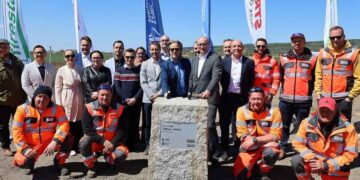


A consortium led by HOCHTIEF has secured the next construction phase of Prague’s new Metro Line D, adding another major urban rail package to Europe’s transport pipeline. The contract has a total value of almost EUR 1.23 billion and will generate EUR 428 million in revenue for HOCHTIEF.
The award matters because it advances Prague’s first fully automated metro line from early works into another major delivery phase. It also reinforces the continued use of large, multi-party contracting models for complex underground transport infrastructure in established European markets.
Prague Metro Line D - Project Background
According to the Prague Public Transit Company (DPP), Metro Line D is planned as a new driverless metro corridor with ten stations and is intended to improve public transport capacity in the southern part of the city. The line is a major strategic expansion for Prague rather than a routine extension, combining new underground civil infrastructure with a fully automated operating concept.
HOCHTIEF said the newly awarded phase includes three underground stations and several tunnel sections with a combined length of almost six kilometres. This follows earlier Line D work already underway, including the first phase in which HOCHTIEF is already involved. In 2021, the group and its partners secured the initial package covering two deep stations and a 1.2-kilometre tunnel section, giving the contractor continuity on the wider program.
The broader significance of Line D lies in its operating model as much as in its civil scope. Fully automated metro systems require closer alignment between tunnels, station design, platform systems, signalling, and operational control than conventional rail packages. In that sense, Metro Line D is not only a transport expansion project; it is also a systems-led modernization of Prague’s metro network.

The new Metro Line D construction phase
The newly awarded phase has a total contract value of almost EUR 1.23 billion. HOCHTIEF said the package will contribute EUR 428 million in revenue to the group, with the remaining value allocated across consortium partners. The client is the Prague Public Transit Company, while the contractor side is structured as a consortium rather than a single-contractor delivery model.
The scope includes construction of three underground stations and several tunnel sections totaling almost six kilometres. Construction is due to begin in the coming weeks, with completion of this phase planned for 2032. The wider Line D program is being delivered in stages, and DPP’s project information indicates the line is planned to enter operation from 2031, which reinforces the phased nature of the program.
From a commercial standpoint, this is a classic long-duration urban underground package where value lies not only in civil volume, but also in sequencing and interface control. Multi-stage metro programs are rarely procured as isolated tunnel jobs; they are typically packaged to preserve constructability, contractor continuity, and long-term systems integration across the life of the line.
Metro Line D - Project Delivery Insights
Urban underground rail projects are typically shaped by staging complexity, constrained work sites, surface disruption management, and systems coordination risk. Prague Metro Line D is no exception. The addition of a driverless operating model increases the delivery burden because station layouts, power, communications, signalling, and operational systems all need to be coordinated earlier and more precisely than on a conventional metro extension.
There is also practical value in delivery continuity. Because HOCHTIEF is already involved in an earlier phase, the next package benefits from accumulated program knowledge that can reduce friction between construction stages. On large tunnelling and station projects, that kind of continuity can improve interface management and reduce risk at handover points between packages.
European Urban Rail Outlook
The award reinforces the depth of Europe’s urban rail construction pipeline, particularly in cities still committing capital to new metro capacity rather than limiting investment to station refurbishments and maintenance. Prague’s Line D sits within that broader pattern of cities using major underground rail programs to improve capacity, resilience, and low-emissions mobility.
That direction is also supported by the city itself. DPP presents Metro D as a long-term strategic investment in network growth and modern automated operations, not simply as an incremental civil works package. Seen alongside projects such as HOCHTIEF and Implenia’s Ostbahnhof tunnel contract with Deutsche Bahn, the Prague award points to a market where technical capability, underground delivery experience, and systems integration discipline remain central to procurement success.
For contractors, this means the strongest position in European urban rail is likely to come from consortium capability and proven program delivery over long timeframes. For clients, these awards are increasingly about protecting schedule certainty and interface control across multi-phase network expansions, not just awarding the next station-and-tunnel package.