


• Home
  • News
  • Engineering
  • Knowledge Hub
  • Resources
No Result
View All Result
CF BRIEFING
Construction Front | Industry Knowledge Hub, News Portal
  • Engineering
  • News
  • Knowledge Hub
  • Resources
  • Contact Us
  • About us
Construction Front | Industry Knowledge Hub, News Portal
  • Home
  • News
  • Engineering
  • Knowledge Hub
  • Resources
No Result
View All Result
CF BRIEFING
Construction Front | Industry Knowledge Hub, News Portal
No Result
View All Result
Home Knowledge Hub Claims & Contract Administration
utilities as a latent condition

What is a Latent Condition in Construction? (Examples & Tips)

Denys S. by Denys S.
May,2026
in Claims & Contract Administration, Knowledge Hub
0 0
0
135
SHARES
1.2k
VIEWS
Share on EmailShare on TwitterShare on LinkedinShare on Facebook

Construction is known for its challenging nature – unexpected hurdles can often arise, leading to delays, budget overruns, frustration, and disputes between contractors and owners.

Among the unexpected issues, latent conditions emerge as one of the major concerns for all parties involved in a project. But what is it? 

Latent conditions are hidden construction issues or conditions that emerge after work begins (or after contract execution), which may lead to construction program disruptions and increased costs.

In this article, we will explore the concept of latent conditions further, as well as the best strategies to deal with it and detail some practical examples. Keep reading it! 

What is a Latent Condition?

Within construction law, a latent condition typically refers to an unanticipated problem that becomes evident only after construction activities have commenced or after contract execution.

Unlike apparent defects or conditions that can be reasonably detected during pre-construction inspections or identified in tendering documents, latent conditions remain hidden from view until work is underway. Some examples include soil instability, buried utilities, environmental factors, or hidden structural defects not previously identified.

These hidden challenges often lead to significant disruptions in the construction process and, very often, to disputes between Contractors and Owners.

utilities as a latent condition
Buried Unknown Utilities are a common latent condition

Latent Conditions - Examples

The list and table below provide some examples of common latent condition that might be encountered, such as: 

  • Asbestos
  • Unforeseen Utilities
  • Soil Contamination
  • Hidden Structural Issues
  • Unexpected Geotechnical Conditions 
  • Water/Infiltration issues 
  • Hidden Pest Infestations
  • Unseen Environmental Restrictions

Latent Condition Example

Description

Undiscovered Asbestos Insulation

During renovations, hidden asbestos insulation is found within walls, requiring specialized removal.

Unforeseen Utility Lines

While digging for foundations, unexpected utility lines are encountered, necessitating rerouting.

Soil Contamination

Soil analysis reveals previously unseen contaminants, demanding remediation before construction.

Hidden Structural Weaknesses

Latent conditions expose concealed structural defects in building components, affecting stability.

Unexpected Rock Formations

Excavation uncovers hidden rock formations, delaying foundation work and requiring adjustments.

Concealed Water Damage

Behind walls, hidden water damage is discovered, prompting repairs to prevent further deterioration.

Structural Erosion

Unanticipated soil erosion beneath a structure leads to potential foundation instability.

Hidden Pest Infestations

Concealed pest infestations, such as termites or rodents, are found, necessitating extermination.

Soil Shifting

Latent conditions reveal unexpected soil shifting that affects grading and landscape planning.

Environmental Restrictions

After construction begins, previously unnoticed environmental restrictions are unveiled.

The "Competent Contractor" Test in Latent Condition Evaluation

The competent contractor test plays a crucial role in navigating latent – this assessment gauges whether a skilled contractor (aka “experienced” or “competent” contractor) could reasonably anticipate a latent condition before project commencement.

Modern construction contracts include clauses and definitions to specifically deal with these issues. However, there are emblematic legal cases around latent conditions, such as Obrascon Huarte Lain SA (OHL) v Her Majesty’s Attorney General for Gibraltar, which involved issues related to unforeseen soil contamination.

An example of a contractual definition for latent condition is:

“Latent Condition means physical conditions of the Site which differ materially from the physical conditions which should reasonably have been anticipated by a Competent Contractor” (adapted from Lawinsider.com)

As expected, this topic is very sensitive from a legal perspective, and many different interpretations may arise concerning to the definitions of a “competent contractor” and what it should reasonably anticipate. 

latent condition - soil contamination
Geotechnical and Contamination Tests are essential to prematurely identify potential latent conditions.
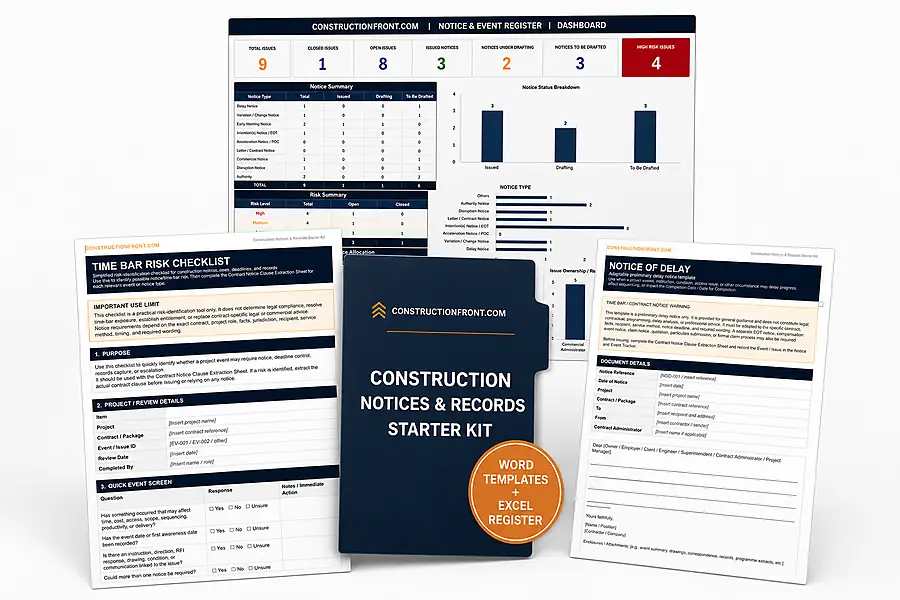
Construction Notices and Records Starter Kit
Notices and Records Starter Kit
When a latent condition surfaces, the notice needs to follow immediately.
Reservation of rights notice, Early Warning Notice template, time-bar checklist and event tracker. Built for live project use across NEC4, FIDIC and bespoke contracts.
Get the Starter Kit →

Who bears the Latent Condition Risks - Contractor or Principal (Owner)?

It depends, and different contracts have different approaches based on the project risk profile and the parties involved.

Typically, contractors accept the site conditions (check FAQ section for site condition definition) and bear the burden of unforeseen situations. The rationale is that the Principal/Owner engages the Contractor based on expertise and experience, and the Contractor is better positioned to identify, price, and manage these risks.

However, in some cases, tight procurement timelines and insufficient details during tendering processes might shift the risk profile, and Owners might ultimately bear these risks.

Ultimately, risk allocation should consider:

  1. Site Conditions
  2. Available Site Information and Investigations at the time of procurement and contract execution

To protect themselves, Principals usually provide an extensive documentation suit while refraining from offering a warranty on its accuracy.

Very commonly, contracts and tendering documents clearly state the contractor’s responsibility to conduct independent site investigations and verify any site-related information supplied by the Principal.

As expected, this topic is very sensitive from a legal perspective, and many different interpretations may arise concerning to the definitions of a “competent contractor” and what it should reasonably anticipate. 

How to Manage Latent Condition Risks?

Mitigating latent condition risks should comment before procurement and continue throughout project delivery. The next tables detail some indicative measures to mitigate and manage latent condition risks. 

Latent Condition - Risk Mitigation Initiatives during Project Procurement

The table below summarises some potential inatives to mitigate latent risks during project tendering. In this phase, measures can be considered as preventive. 

Procurement Phase

Preventive Measures

Site Investigations and Feasibility Studies

Engage experts like engineers, geologists, and surveyors to assess potential challenges hidden within the construction site.

Clear Contractual Language

Draft contracts with well-defined clauses addressing latent conditions, risk allocation, and procedures for dispute resolution.

Comprehensive Pre-Bid Meetings

Hold meetings to discuss latent condition risks with prospective contractors, promoting a better understanding of the project’s challenges.

Pre-Qualification of Contractors

Ensure contractors have the necessary expertise and experience to handle potential latent condition challenges during the project.

Risk Assessment and Adequate Allocation

Evaluate latent condition risks and allocate responsibilities based on the level of foreseeability and the ability to address these issues

Contingency Planning in Budget

Allocate a portion of the budget as contingency funds to address unforeseen latent conditions that might arise during construction.

Collaboration with Legal Experts

Consult construction law experts during the contract drafting phase to ensure the incorporation of fair and clear clauses related to latent conditions.

Collaboration with Insurance Experts

Engage with insurance professionals to determine the scope of coverage for latent condition-related risks and potential insurance claims.

Detailed Documentation of Site Assessments

Maintain detailed records of site investigations and feasibility studies, outlining the identified latent condition risks and their potential impact.

Latent Condition - Risk Mitigation Initiatives During Construction Phase

Throughout the construction phase, the initiatives detailed below take on a ‘corrective’ role, as Contractors and Owners may have already confronted the latent condition issue on-site

Delivery Phase

Initiatives

Transparent Communication Among Stakeholders

Maintain open dialogue (both informal and formal – i.e. notices) between contractors subcontractors, and project owners to foster collaboration and swift responses to latent conditions.

Detailed Documentation of Latent Conditions

Document the discovery, impact, and resolution of latent conditions thoroughly, creating a clear record for dispute resolution and cost allocation.

On-Site Monitoring, Recording and Assessment

Employ construction managers or experts for on-site monitoring, enabling swift identification, recording and assessment of latent conditions as they emerge.

Engaging Legal Counsel, Engineers and Advisors for Complex Cases

Seek expert advice in situations involving disputes or complex legal implications, ensuring adherence to contractual terms and proper risk allocation.

Revisiting Contractual Clauses and Requirements

Review contract clauses related to latent conditions and ensured contract requirements are met, especially if cost and time relief will be sought. 

Construction Notices and Records Starter Kit
Notices and Records Starter Kit
Risk allocation is decided in the contract. Entitlement is decided in the notices and records.
Notice templates, time-bar checklist, clause extraction sheet and event tracker to protect your position from the moment the latent condition is identified.
Get the Starter Kit →

How to contractually deal with Latent Conditions?

Contractors will typically seek cost and time recovery when encountering latent conditions. Even though each construction agreement has different requirements, the following notices are very standard:

  • Early Warning Notice – Contractual notifications issued proactively identify, mitigate and address potential risks or issues in a construction project, such as cost increases and program delays (usually condition precedent to Variation Claims and EOTs).

For More details, read What is an Early Warning Notice? (Click Here)

  • Variation Claim (Cost Recovery) – Contractual Notices by which Contractors seek cost relief arising from any issues. 

For More details, read What is a Variation Request/Claim? (Click Here)

  • Extension of Time Claim or EOTs (Time Recovery) – Refers to a formal request made seeking an extension of the project’s completion date or any other milestone date specified in the contract.

For More details, read What is an Extension of Time Claim? (Click Here)

Ensure that you read your agreement carefully and comply with the required timelines in order to avoid time-bar issues. 

FAQ

What Are Site Conditions?

Site conditions are all the physical, environmental, and geological aspects of a construction site. A thorough understanding of these conditions is mandatory for accurate project planning, precise risk assessment and allocation, and budgeting. 

Is Latent Condition and Latent Defect the Same?

No, they are distinct concepts. A latent condition refers to an unforeseen issue uncovered during construction.

On the other hand, a latent defect is a concealed problem that surfaces after the project’s completion, impacting the structure integrity or asset functionality over time.

Conclusion

As shown, latent conditions are unanticipated complications linked to construction projects. Unlike detectable problems, they remain hidden until work is underway and, when encountered, might lead to significant cost overruns and project delays.

The management of latent conditions should start during the project conception and procurement phases, with measures like site investigations and clear contracts preempting risks.

If unforeseen conditions are faced, project parties should rely on transparent communication and ensure contract compliance to address issues successfully.

Need Help Managing Latent Condition Claims?

Access our notices and records starter kit or our detailed variation and claims toolkit below.

Latent conditions are unpredictable. The notices and records response does not have to be.
Start with notices and records, or go straight to the full variation and claims workflow.
Construction Notices and Records Starter Kit
Start here
Notices and Records Starter Kit
Reservation of rights notice, Early Warning Notice template, time-bar checklist and event tracker. For teams managing live latent condition events on active projects.
Get the Starter Kit →
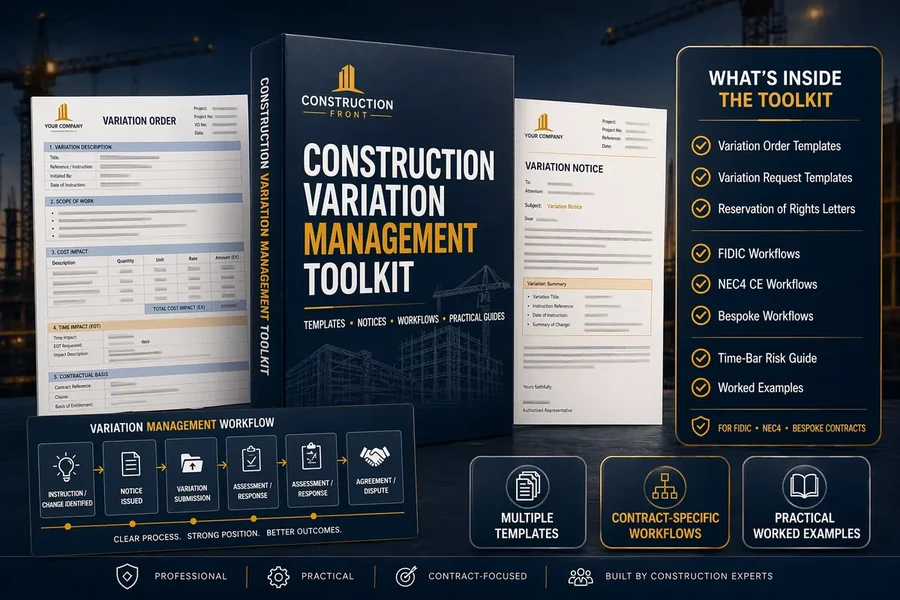
Variation Order and Claims Toolkit
Go deeper
Variation and Claims Toolkit
Full variation workflows, worked examples, entitlement checklists and FIDIC/NEC4 drafting support when the latent condition develops into a formal claim.
Get the Full Toolkit →
Tags: Claims & Contract Administrationconstruction law
Previous Post

Walsh-Kokosing JV awarded $3.6B Design-Build contract for the Brent Spence Corridor Project

Next Post

CPB Contractors appointed as Managing Contractor for the new Bundaberg Hospital in Queensland (Australia)

Denys S.

Denys S.

Denys Schwartz is a civil engineer and certified professional (PMP, CP3P, CAIA) with more than 15 years of experience in the construction industry, specialising in project development, project financing, procurement, contract administration, and dispute resolution for major infrastructure and energy projects. He holds a postgraduate degree in Corporate Finance and has worked on multibillion-dollar projects across Australia, Brazil, and other international markets.

Related Posts

What is a FIDIC variation infographic showing five common types of variation, including quantities, specification, drawings, sequence, and omission or addition changes.
Claims & Contract Administration

FIDIC Variation Explained: Engineer’s Role, Right to Vary, and How Contractors Protect Entitlement

by Denys S.
May,2026
nec4_compensation_event_process
Claims & Contract Administration

NEC4 Compensation Events: How to Notify Them, Protect Entitlement, and Common Commercial Risks

by Denys S.
May,2026
how_to_write_change_order_featured
Claims & Contract Administration

How to Write a Change Order in Construction: Step-by-Step Guide with Template

by Denys S.
May,2026
Change order infographic showing progression from identified change to commercial agreement and final formal change order including scope, price, and time position.
Claims & Contract Administration

Change Order in Construction: Meaning, Process, Pricing, Types, and Common Risks

by Denys S.
May,2026
Impacted as-planned analysis infographic showing baseline programme, inserted delay event (fragnet), and resulting impacted schedule with shift in planned completion.
Claims & Contract Administration

Impacted As Planned Analysis: What It Is, How It Works, and When It Fails in Construction Claims

by Denys S.
May,2026
Next Post
new Bundaberg Hospital in Queensland

CPB Contractors appointed as Managing Contractor for the new Bundaberg Hospital in Queensland (Australia)

Balfour Beatty is one of the preferred bidders for SSEN ASTI onshore programme

Balfour Beatty as the preferred bidder by SSEN for Pathway to 2030 Program

Jacobs to provide program management services in Chino Basin for IEUA

Jacobs appointed by IEUA to manage water supply program in the Chino Basin in California

Leave a Reply Cancel reply

Your email address will not be published. Required fields are marked *

I agree to the Terms & Conditions and Privacy Policy.

Stay Connected

Featured Resources

Notice Control — Templates + Checklists + Event Tracking Tool
Construction Notices and Records Starter Kit
Construction Notices & Records Starter Kit
Practical notice templates, checklists and an Excel register for tracking notices, events, deadlines and supporting records.
Access Starter Kit →
Variation Management — Templates + Workflows
Construction Variation and Claims Toolkit
Variation Order & Claims Toolkit
20+ templates, notice letters and workflows for FIDIC, NEC4 and bespoke contracts — contractor and owner side.
Access Variation Toolkit →
LinkedIn

Construction intelligence, commercial insight and practical resources for infrastructure and energy professionals.

Site Map

  • Home
  • News
  • Engineering
  • Knowledge Hub
  • Resources
  • Contact Us
  • About us

Recent Posts

Beacon Point AI data center campus in Texas EPCM contract award to Jacobs

Jacobs Awarded EPCM Contract for Hut 8’s 1GW Beacon Point AI Data Center Campus in Texas

May,2026
el-patrimonio-900x600

CPS Energy and Ashtrom Break Ground on 150MW El Patrimonio Solar Project in Texas

May,2026

Copyright © 2023 ConstructionFront.Com | Affiliate Disclosure | Privacy Policy | Terms & Conditions

Welcome Back!

Login to your account below

Forgotten Password?

Retrieve your password

Please enter your username or email address to reset your password.

Log In
No Result
View All Result
  • Home
  • News
  • Engineering
  • Knowledge Hub
  • Resources

Copyright © 2023 ConstructionFront.Com | Affiliate Disclosure | Privacy Policy | Terms & Conditions

This website uses cookies. By continuing to use this website you are giving consent to cookies being used. Visit our Privacy and Cookie Policy.

ConstructionFront.com - Newsletter!

Stay at the front of the construction industry with the latest news, market trends, and project insights — delivered by ConstructionFront.com

Name
Enter your email address

Thanks, I’m not interested

Privacy Policy - Terms and Conditions