

On large energy, infrastructure, and industrial projects, the term turnkey project is often used as if it settles the delivery model by itself. In practice, it does not. A developer may want turnkey delivery, lenders may want fixed-price discipline, and bidders may assume an EPC structure, yet the underlying contract can still contain retained owner interfaces, incomplete inputs, moving performance assumptions, and unresolved approvals. That gap is where later commercial trouble usually starts.
Those concepts overlap, but they are not interchangeable. A turnkey project can be delivered through an EPC contract without being procured on a hard LSTK basis. It can also be described as turnkey while the owner still retains specific risks, provided those retained risks are clearly carved out from the contractor’s single-point responsibility. The problem is not retained risk by itself. The problem is retained risk that is drafted loosely or priced as if it does not exist.
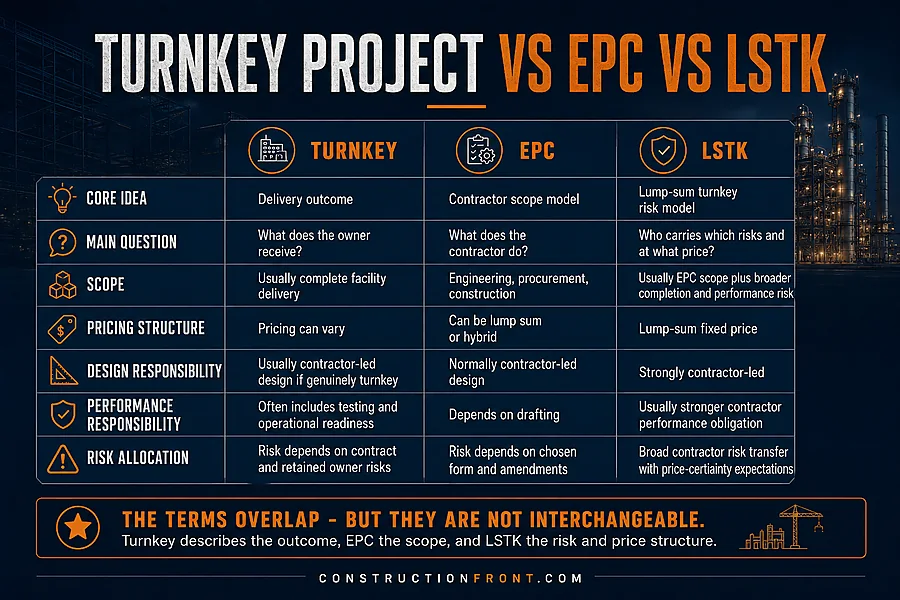
That distinction matters because a turnkey project does not remove risk. It transfers it, prices it, and concentrates it. Where the project is mature and the contractor can genuinely control the key interfaces, turnkey delivery can create discipline. Where the project is immature, the same structure often produces contingency pricing, qualifications, variation disputes, delay claims, commissioning conflict, and project distress.
What Is a Turnkey Project?
The quickest way to remove confusion is to separate delivery outcome, contractor scope, and commercial model.
- Turnkey project describes what the owner wants to receive: a completed facility ready for intended use, subject to the agreed completion and acceptance regime.
- EPC describes what the contractor is engaged to do: engineer the works, procure the plant and materials, and construct and complete the facility.
- LSTK describes how price and risk are structured: a lump-sum turnkey contract under which the contractor accepts broad delivery responsibility for that outcome.
In practice, these labels are often used loosely. That is especially risky in power, process, water, mining, and industrial infrastructure, where battery limits, performance guarantees, utilities, commissioning, and third-party interfaces usually matter more than the basic construction works.
Joseph Huse’s work on turnkey and EPC contracting is useful because it treats turnkey and EPC as commercial structures that need to be negotiated around actual project risk, not market shorthand (Huse). FIDIC’s own taxonomy reflects the same distinction: the Yellow Book is a plant and design-build form, while the Silver Book is framed as an EPC/Turnkey form with heavier contractor risk transfer.
Turnkey Project vs EPC vs LSTK
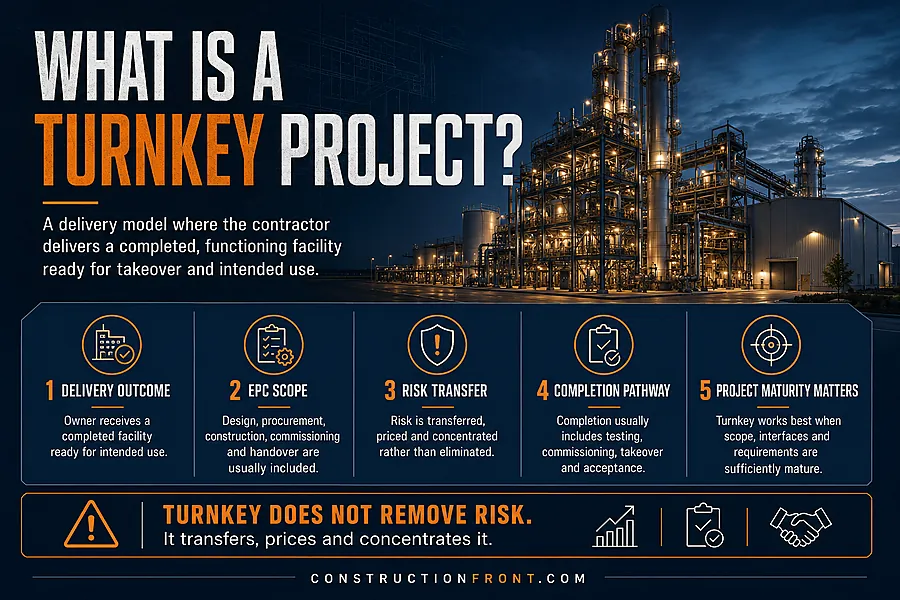
The table below summarises key distictions between turnkey, EPC, and LSTK terminology and shows why delivery outcome, contractor scope, and fixed-price risk transfer should not be treated as interchangeable.
| Aspect | Turnkey Project | EPC | LSTK |
|---|---|---|---|
| Core idea | Delivery outcome. | Contractor scope model. | Fixed-price turnkey risk model. |
| Main question answered | What does the owner receive? | What does the contractor do? | Who carries which risks, and at what price? |
| Scope | Usually complete facility delivery. | Engineering, procurement and construction. | Usually EPC scope plus broader completion and performance risk. |
| Pricing structure | Can be lump sum, target cost, reimbursable, or staged. | Can be lump sum, remeasurable, or hybrid. | Primarily lump-sum fixed price. |
| Design responsibility | Usually contractor-led if genuinely turnkey. | Normally contractor-led. | Strongly contractor-led. |
| Performance responsibility | Often includes testing, reliability, and output performance. | Depends on contract drafting. | Usually stronger contractor performance obligation. |
| Owner involvement | Can be low or high depending on retained interfaces. | Varies by structure. | Intended to reduce owner involvement after award, though often not in practice on immature projects. |
| Interface management | Should be largely contractor-managed if truly turnkey. | Shared or contractor-led depending on carve-outs. | Expected to be concentrated on contractor. |
| Risk allocation | Depends on contract terms and retained owner risks. | Depends on chosen form and amendments. | Broad contractor risk transfer with price-certainty expectations. |
| Completion obligations | More than physical construction. | Depends on defined completion regime. | Often includes completion, testing, performance, and handover obligations. |
The commercial mistake is to assume that if a contract is called turnkey, the owner no longer carries meaningful risk, or that if it is called EPC, the contractor automatically controls every interface. Neither is correct. The project still needs coherent technical information, workable completion mechanics, and a realistic allocation of site, interface, approval, and performance risk.
What Makes a Turnkey Project Truly Turnkey?
A turnkey project is not truly turnkey just because the contractor reaches physical completion. In an industrial or infrastructure setting, turnkey completion usually means the facility has passed through a sequence of obligations that make it usable for its intended purpose under the contract.
That often includes:
- completion of design
- procurement and supply of permanent plant
- construction and installation
- system integration
- pre-commissioning
- commissioning
- testing and performance demonstration
- reliability or endurance runs where required
- operational readiness for takeover
This is where many disputes begin. Parties use the word completion loosely, but the contract usually needs several separate milestones, each with different legal and commercial consequences.
Key completion stages that should be separated
On turnkey projects, many disputes start because the parties collapse several milestones into a single idea of “completion.” In practice, construction completion, mechanical completion, commissioning, performance testing, takeover, and final acceptance usually carry different legal and commercial consequences. The table below separates those stages in the way they are typically understood on major projects.
| Stage | What It Usually Means | Main Commercial Consequence |
|---|---|---|
| Construction completion | Civil and installation works substantially finished. | Often triggers punch listing, but not necessarily takeover. |
| Mechanical completion | Equipment installed and mechanically complete. | Often prerequisite for pre-commissioning. |
| Commissioning | Systems are energised, tested, and brought into operation. | High-risk period for interfaces, defects, and delayed inputs. |
| Performance testing | Facility demonstrates output, efficiency, capacity, or other guarantees. | Can trigger LD exposure, remediation rights, or acceptance consequences. |
| Takeover | Owner takes possession or beneficial use under defined conditions. | Shifts custody, insurance, and defects-period implications. |
| Final acceptance | All acceptance requirements, documentation, and residual obligations satisfied. | Often linked to final payment, release of retention, or security reduction. |
- On a power project, a gas turbine may be mechanically complete long before the plant is ready for integrated performance testing.
- On a water treatment plant, major structures may be complete while controls integration, operator training, and performance verification remain outstanding.
- On a solar-plus-storage project, the facility may be physically installed but still not commercially usable until grid compliance testing and dispatch integration are accepted.
That is why turnkey completion should not be reduced to built and handed over. It needs to be drafted as a full completion pathway with defined prerequisites, testing conditions, acceptance criteria, and consequences if owner-provided inputs are late or unavailable.
What Is a Turnkey Contract Agreement?
A turnkey contract agreement is the document that converts the idea of turnkey delivery into an actual risk allocation. In practice, it should do much more than say the contractor is responsible for delivering a complete facility.
A workable turnkey contract agreement should clearly define:
- contractor scope
- Employer’s Requirements
- design responsibility
- clear responsibility limits and interface boundaries
- retained owner risks
- completion stages
- testing and commissioning obligations
- performance guarantees and any related security, such as performance bonds
- change procedure
- delay relief
- liquidated damages
- takeover and final acceptance
This is also where contractor qualifications and exclusions become commercially important. In tendered LSTK projects, contractor qualifications and exclusions are often as important as the lump-sum price because they define what risk has actually been accepted.
If those matters are left loose, the contract may still look like a turnkey deal on its cover page, but the real delivery and risk position will remain uncertain.
Example of a Turnkey Project
A typical turnkey project could be a power plant, water treatment facility, solar farm, data centre, processing plant, or industrial facility where the contractor is responsible for design, procurement, construction, commissioning, testing, and handover of a functioning asset.
The owner does not simply receive completed construction works. It receives a facility intended to operate for its required purpose, subject to the contract’s acceptance regime. That is the practical difference between ordinary completion of works and a true turnkey result.
An live example is the GenusPlus EPC contract for the Koolunga BESS in South Australia – the lump-sum turnkey package includes engineering, procurement, construction, and commissioning for the balance-of-plant scope and BESS installation works, with a defined grid connection path through the Brinkworth Substation. It is a useful example because it shows a turnkey EPC package in an execution-ready battery project with approvals, grid interface, and delivery scope already substantially defined.
Why Project Maturity Matters in a Turnkey Project
Project maturity is often the deciding factor in whether a turnkey project becomes an efficient delivery structure or an expensive claims vehicle.
LSTK only works properly when the project is sufficiently mature for the contractor to realistically price and control the risks being transferred. If the contractor cannot reliably assess the technical baseline, interface map, site conditions, permitting path, or performance regime, the fixed price is not real certainty. It is a commercial assumption inside a hard-risk contract.
In practice, maturity means the project has enough definition in the matters that actually drive time and cost:
- clear Employer’s Requirements
- stable output specifications
- defined battery limits and interface boundaries
- usable site and geotechnical data
- understood utility and grid interfaces
- realistic authority and permitting assumptions
- measurable performance criteria
- workable testing and acceptance procedures
- identified owner-supplied items and owner dependencies
- a sufficiently developed design basis, often after front-end engineering design phase
Where those elements are immature, one of two things usually happens. Either the contractor prices a large contingency, which weakens value for money and still may not cover the real downside, or it prices aggressively to win and then looks to recover through qualifications, claims, variations, or strict contractual interpretation during execution.
This is the reason why immature scope is so dangerous under an LSTK contract. It drives the outcomes owners are usually trying to avoid: dispute pressure, change battles, cash-flow strain, defensive correspondence, and delayed completion.
Research on contract disputes continues to point back to the same practical issue: unclear conditions, uncertain obligations, and weak change mechanisms create fertile ground for claims. A recent comparative study by Abu Helw and Ezeldin makes the same point in different terms, highlighting the importance of clear responsibilities, notices, variations, and extension procedures in reducing project conflict.
Worked scenario: mature vs immature turnkey procurement
Consider two 300 MW open-cycle power projects.
- Project A goes to market after serious development work. The owner has a developed FEED package, grid studies, site investigation, geotechnical data, defined emissions basis, clear battery limits, identified owner obligations, and a draft testing protocol. Bidders still price risk, but they are pricing a defined job.
- Project B is pushed to market early because the sponsor wants headline price certainty for financing. Grid connection assumptions are still moving. The gas supply interface is unresolved. Geotechnical data is sparse. The drainage design is not developed. Performance liquidated damages are included, but test conditions are vague and ambient correction methodology is unsettled.
Project A can support a credible LSTK competition. Project B usually cannot. The winning price on Project B may look stronger at award, but it often contains hidden contingency gaps, qualifications, and future claims pressure. The immature project has not removed risk by going LSTK. It has simply transferred unpriced or underpriced risk into the contract and set up a later commercial collision.
Employer’s Requirements as the Baseline for a Turnkey Project
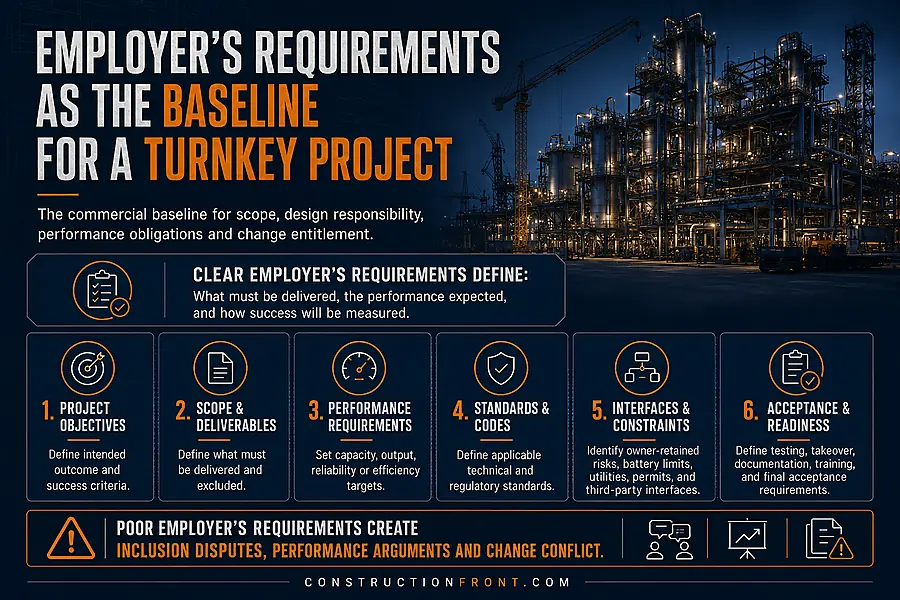
On a turnkey project, the Employer’s Requirements are not just a technical appendix. They are the commercial baseline for scope, design responsibility, performance obligations, and change entitlement.
If the Employer’s Requirements are incomplete or ambiguous, the turnkey risk model weakens immediately. Most later disputes return to four practical questions:
- What was included?
- What design outcome was required?
- What performance standard had to be achieved?
- What changed from the original baseline?
Poor Employer’s Requirements typically produce:
- inclusion and exclusion disputes
- ambiguity over design development versus scope growth
- disagreement over whether a requirement imposed fitness-for-purpose obligations or only a lower design standard
- arguments about whether contractor qualifications displaced the baseline
- variation disputes when assumptions prove wrong
- testing and performance interpretation conflict
This is one reason it is dangerous to speak casually about single-point responsibility. If the owner’s requirements are not clear enough to define the point being handed over, the contractor is not accepting a clean delivery risk. It is accepting interpretive risk, and interpretive risk is one of the most disputed forms of risk in turnkey work.
A disciplined owner treats the Employer’s Requirements as a commercial control document. A disciplined contractor interrogates them early, qualifies them where necessary, and maps them against tender assumptions before accepting a lump-sum position. That baseline also drives later change administration (i.e. variation requests and orders) because entitlement depends on what the original obligation actually was.
Interface Risk and Single-Point Responsibility
Owners often prefer a turnkey project because it appears to offer cleaner accountability. Instead of separately managing designers, long-lead vendors, civil contractors, process suppliers, and commissioning contractors, the owner expects one counterparty to integrate and deliver the facility.
That is commercially attractive for several reasons:
- fewer direct interfaces to administer
- stronger accountability for design and performance
- greater apparent price certainty
- a clearer financing narrative for lenders
- reduced coordination burden on owner teams
In the right setting, that logic is sound. It is one reason EPC structures remain common in power, oil and gas, process, transmission, and industrial infrastructure. But single-point responsibility only works where the contractor actually controls the interfaces it is being asked to own. If key dependencies remain outside its control, the single point becomes more theoretical than real.
Typical interface pressure points include:
- owner-supplied major equipment
- utility connections
- grid connection and energisation approvals
- authority inspections and permits
- third-party land access
- tie-ins to existing operating facilities
- adjacent contractors on shared infrastructure
- feedstock, fuel, or water supply interfaces
- operator staffing and operational readiness
A turnkey project can still include retained owner risks, but those retained risks must be clearly carved out from the contractor’s responsibility. If they are not, the contract is likely to become commercially unstable. The contractor will either qualify responsibility, include contingency, or later seek relief when the retained interface affects progress, testing, or performance.
Risks For Owners / Clients
Turnkey and LSTK can be the right choice where the owner wants financing discipline, limited internal coordination burden, and concentrated delivery accountability. But owners should pressure-test whether the critical interfaces are genuinely controllable by the contractor. If the owner is retaining approvals, utilities, owner-furnished equipment, or operational tie-ins, those retained risks need express drafting, realistic schedule logic, and workable relief mechanisms.
Risks For Contractors
The core question is not whether the project is labelled turnkey. It is whether the contractor has enough control to stand behind the promised outcome at the agreed price. If the contractor does not control the design basis, site information, owner dependencies, test environment, or third-party interfaces, the risk is not single-point delivery risk. It is unmanaged dependency risk inside a fixed-price wrapper.
Turnkey Project vs LSTK Under FIDIC Yellow Book and Silver Book
The FIDIC Yellow Book and Silver Book are often discussed as if the difference is mainly market preference. Commercially, the distinction is much more important.
The Yellow Book is generally viewed as a more balanced form for contractor-designed works, although the final risk allocation always depends on the Particular Conditions. Heavily amended Yellow Book contracts can still become very contractor-risk-heavy. The Silver Book is intended for EPC/turnkey procurement with stronger price-certainty expectations and broader contractor risk assumption.
In practice, the difference usually matters in the following areas:
- overall intensity of risk transfer
- contractor reliance on employer-provided information
- site and ground condition allocation
- extent of owner reliance on contractor expertise
- performance and completion responsibility
- price-certainty expectations
- maturity expected of the procurement baseline
The commercial position is straightforward. If a project is sufficiently mature, with a strong definition package and a contractor that can genuinely control the interfaces, a Silver Book-style allocation can work. If those conditions are absent, the same structure tends to drive either heavy contingencies or post-award claims behaviour.
That is why inappropriate Silver Book use on immature projects can be commercially damaging. The form assumes a level of certainty and transferability that the project may not actually support. The contract then becomes internally inconsistent: the owner wants fixed-price certainty, but the technical baseline is still moving; the contractor carries design and performance risk, but the owner still controls critical approvals or interface inputs.
Performance, Testing and Commissioning Risks
Testing and commissioning are where turnkey theory turns into real commercial exposure. Many major disputes on turnkey projects do not arise because cable quantities moved or steel tonnage changed. They arise because the facility does not achieve performance on time, test conditions are disputed, reliability runs fail, utilities are unavailable, or the owner seeks takeover before the contractual acceptance regime has actually been satisfied.
Typical risk points include:
- output or capacity guarantees
- heat rate, efficiency, emissions, or product-quality guarantees
- ambient correction methodology
- feedstock or utility quality during testing
- availability of commissioning power, water, or fuel
- owner attendance and witnessing requirements
- retry rights and remedial periods
- deemed acceptance mechanics
- performance liquidated damages
- linkage between takeover and successful performance demonstration
A common drafting problem is that the performance guarantees are detailed, but the test conditions are not. That leaves room for later arguments about whether the contractor had a fair opportunity to demonstrate compliance.
A renewable-plus-storage facility may be judged against dispatch behaviour that depends partly on owner or grid operator inputs. A treatment plant may be tested against influent conditions that do not match the design basis. A thermal plant may face performance LD exposure even though fuel quality or cooling conditions differ from the contractual assumptions.
Fitness-for-purpose obligations also need careful drafting because they can impose a higher performance responsibility than ordinary reasonable skill and care design obligations. In turnkey and EPC risk allocation, that distinction matters.
This is also where delay analysis becomes commercially important. If a test window is missed because of owner-caused interface delay, late access, or unavailable utilities, the contractor’s time and cost position needs to be evidenced and administered properly. That is why robust records and disciplined contract administration remain essential even on hard-money turnkey jobs.
Commercial Failure Scenarios in Turnkey Projects
The following scenarios recur because they expose the gap between headline risk transfer and actual project control.
1. Immature project pushed into LSTK
- A developer tenders a waste-to-energy facility on an LSTK basis before the process design, grid interface, and permitting assumptions are settled.
- Bidders are told to price full turnkey responsibility, but the Employer’s Requirements still contain provisional concepts and unresolved operating assumptions.
- The contractor wins on a competitive price, then faces repeated clarifications that materially reshape the design basis.
- Commercially, the contract starts to fracture around whether those developments sit within the original lump sum or amount to variations.
- The baseline was never mature enough to support hard-price risk transfer, so the project converts development risk into live claims and delay disputes.
2. Lump-sum site risk accepted on incomplete geotechnical data
- A transmission substation EPC contractor accepts broad site-condition risk under a fixed-price turnkey contract, relying on limited borehole data and a compressed tender period.
- During excavation, the contractor encounters materially different ground conditions requiring redesign of foundations, dewatering, and revised temporary works.
- The owner argues that the contractor accepted site risk under the LSTK bargain. The contractor argues that the information baseline was too thin to support that transfer.
- The likely result is programme slippage, major cost pressure, and a dispute over whether the contractor priced a real risk or an unknowable one.
3. Poorly defined commissioning and reliability testing
- A gas-fired peaking plant reaches mechanical completion, but takeover is tied to performance testing and a 72-hour reliability run.
- The contract sets out output guarantees but says little about dispatch assumptions, fuel quality variation, start-stop sequencing, or how failed runs are treated after owner-caused interruptions.
- Once testing starts, the parties disagree on whether aborted runs count, whether ambient conditions are valid, and whether the plant can be taken over with residual issues.
- The result is delayed revenue, disputed LD exposure, and argument over insurance and custody.
4. Owner-supplied equipment and weak interface drafting
- An owner procures long-lead transformers directly to save cost, then places the balance-of-plant works under a turnkey EPC contract.
- The EPC contractor is still expected to manage installation, integration, energisation, and overall completion.
- The transformers arrive late and with documentation gaps, delaying installation and later affecting energisation.
- The owner still argues for single-point contractor responsibility because the contract is labelled turnkey.
- The contractor claims time and cost, but the interface drafting is vague on custody, inspection rights, and consequences of late delivery.
- The result is a classic interface dispute created by unclear retained-risk drafting.
When a Turnkey Project May Be the Wrong Procurement Model
A turnkey project is not a premium contract type that should be preferred by default. It is a tool, and it works only when the project supports it.
It is often the wrong model where the project has one or more of the following characteristics:
- incomplete FEED or concept-level definition
- unresolved owner or third-party interfaces
- uncertain approvals path
- evolving scope or operational requirements
- unproven technology
- major owner-furnished equipment dependencies
- live brownfield tie-ins
- a need for owner flexibility during design development
- uncertain site data or geotechnical conditions
In those settings, forcing an LSTK structure often creates false certainty. The contract may look clean at award, but the price either contains expensive defensive contingency or proves too thin to support the risk being transferred.
Better alternatives may include:
- EPCM where the owner wants more flexibility and accepts a stronger management role, as discussed in our EPC vs EPCM article
- design-build with more balanced risk allocation
- FIDIC Yellow Book style procurement instead of heavier Silver-style transfer
- alliance or collaborative models for major uncertainty
- target-cost or pain/gain structures
- staged FEED-to-EPC strategies that defer full lump-sum commitment until the baseline is mature
From a contractor perspective, the wrong model is usually the one that expects fixed-price risk before fixed-scope reality exists. From an owner perspective, the wrong model is the one that promises bankability and project financing certainty on paper but still leaves the project exposed to qualifications, variations, and claims once execution begins.
That is also why strong commercial management capability matters even on supposedly simple turnkey procurement. The more risk is concentrated into one contract, the more disciplined the administration needs to be when pressure events arise.
Practical Takeaways for Owners and Contractors
The most useful way to approach a turnkey project is not to ask whether turnkey is good or bad. The better question is whether the project is mature enough, and the risk map clear enough, for turnkey and LSTK to function as intended.
Key Points for Owners / Clients
Owners should use a turnkey project model when they genuinely want an integrated delivery outcome and are prepared to invest in project definition before asking the market for fixed-price certainty.
That means mature requirements, clear interfaces, reliable data, and disciplined acceptance mechanics. If those foundations are weak, the likely result is not lower risk but a more adversarial and expensive form of risk.
In practice, the commercial test is simple: if the owner still needs major flexibility after award, a hard LSTK structure is often the wrong procurement choice.
Key Points for Contractors
Contractors should treat turnkey and LSTK bids as exercises in control, not just pricing. The core question is whether the team can actually manage the assumptions, interfaces, tests, and dependencies behind the lump sum. If not, the contract should be qualified, repriced, or declined. Winning an immature LSTK job at the wrong price is often the start of a distressed project, not a successful one.
Conclusion
Turnkey, EPC, and LSTK sit close together in market language, but they perform different commercial functions. Turnkey describes the delivery outcome. EPC describes the contractor’s scope. LSTK describes a fixed-price, concentrated risk-allocation model. Treating them as interchangeable creates confusion at tender stage and conflict during execution.
The more important point is practical rather than semantic. A turnkey project does not remove risk. It transfers it, prices it, and concentrates it. Where the project is mature and the contractor controls the critical interfaces, that can support efficient delivery, clearer accountability, and a more credible fixed-price position. Where the project is immature, the same structure often converts uncertainty into contingency pricing, claims pressure, commissioning disputes, delay exposure, and project distress.
For owners and contractors alike, the real commercial question is not whether turnkey sounds attractive. It is whether the project baseline, interface map, and acceptance regime are strong enough to support the level of risk transfer being proposed. LSTK works properly only when the project is sufficiently mature for the contractor to realistically price and control the risks being transferred.

FAQ: Turnkey Project, Turnkey Contract and LSTK Meaning
What is the meaning of turnkey project?
A turnkey project is a project delivery model in which the owner expects a completed, functioning facility ready for takeover and intended use, subject to the contract’s acceptance regime.
What is a turnkey contract?
A turnkey contract is a contract structured around delivery of a completed facility rather than just completion of discrete construction works. Depending on the deal, it may or may not also be a fixed-price LSTK contract.
What is the meaning of LSTK in construction?
LSTK means lump-sum turnkey. In practice, it refers to a fixed-price turnkey risk model under which broad design, procurement, construction, completion, and often performance responsibility sit with the contractor.
Is turnkey the same as EPC?
No. EPC describes the contractor’s scope: engineering, procurement and construction. Turnkey describes the delivery outcome expected by the owner. Many projects are both, but the terms do not mean exactly the same thing.
What is the difference between turnkey and EPC?
The difference between turnkey and EPC is mainly conceptual. Turnkey focuses on what the owner receives. EPC focuses on what the contractor does. An EPC contract may be structured to achieve a turnkey result, but not every EPC arrangement creates full turnkey responsibility in practice.
What is the difference between turnkey and LSTK?
The difference between turnkey and LSTK is that turnkey describes the intended delivery outcome, while LSTK describes a lump-sum fixed-price commercial structure used to procure that outcome. A project can be turnkey without being procured on a hard LSTK basis.
What is an example of a turnkey project?
A turnkey project example is a power plant, water treatment plant, solar farm, data centre, processing facility, or industrial asset delivered as a complete and functioning facility ready for takeover after commissioning and testing.
What should a turnkey contract agreement include?
A turnkey contract agreement should define scope, design responsibility, Employer’s Requirements, battery limits, owner-retained interfaces, completion stages, testing requirements, performance guarantees, change control, delay relief, liquidated damages, takeover, and final acceptance.
When is a lump sum turnkey contract a bad fit?
It is often a bad fit where the project has incomplete FEED, unresolved interfaces, uncertain approvals, major owner-supplied equipment risk, or live brownfield constraints that the contractor cannot fully control.
Does a turnkey EPC contract eliminate variations and claims?
No. Even on a turnkey EPC contract, changes, owner-caused delays, incorrect data, approval issues, and interface disruptions can still generate variations, time entitlement, and claims.
Sources
- Construction Front, Construction Claims and Contract Administration
- Construction Front, Construction Change Directive
- Construction Front, Change Order
- Construction Front, EPC Contract
- Construction Front, EPC vs EPCM
- Construction Front, Front End Engineering Design
- Construction Front, What Is a Variation Order
- Construction Front, Variation Request
- Construction Front, Time Impact Analysis
- Construction Front, Prolongation Costs
- FIDIC, EPC/Turnkey Contract 2nd Ed (2017 Silver Book)
- FIDIC, Plant and Design-Build Contract 2nd Ed (2017 Yellow Book)
- Hardjomuljadi, Sarwono, EPC/Turnkey Contract, Lump Sum Fixed Price Subject to Adjustment
- Huse, Joseph A., Understanding and Negotiating Turnkey and EPC Contracts
- Abu Helw, A. and Ezeldin, A.S., Reducing Contract Disputes: A Comparative Analysis of FIDIC and GCC Standard General Conditions of Contract for Construction Projects
Disclaimer: The articles on this blog are for informational and educational purposes only and do not constitute legal or technical advice. While we strive to provide accurate and up-to-date information on construction law, regulations may vary by jurisdiction, and legal interpretations can change over time.