


Construction contracts govern the relationship between contractors and owners and specify the obligations and rights of each party in a project.
In many instances, professionals without a solid legal background manage these agreements, and some legal jargon and terms used in construction law might leave them scratching their heads, such as estoppel.
Estoppel is a legal principle that prevents a party from breaking a promise or representation when doing so would harm the other party. In construction contracts, estoppel might arise if one party leads another to believe that specific contract terms will not be strictly enforced, such as time bars, only to rely on those requirements later.
In this article, we will further explore this principle, using a typical example, and clarify other important issues, such as the difference between estoppel and waiver – keep reading it.
What is Estoppel in Simple Words?
In simple terms, estoppel is a legal principle that arises when a party (i.e., Party A) leads, through words and/or actions, the other party (i.e., Party B) to believe that specific circumstances exist and act relying on them, even though it there is no explicit binding agreement on these assumptions.
In circumstances like that, Party A might be “estopped” from retracting its words and actions or enforcing contractual obligations towards Party B. To facilitate understanding, let’s go through a simple example below.
Estoppel Principle in Construction - Example
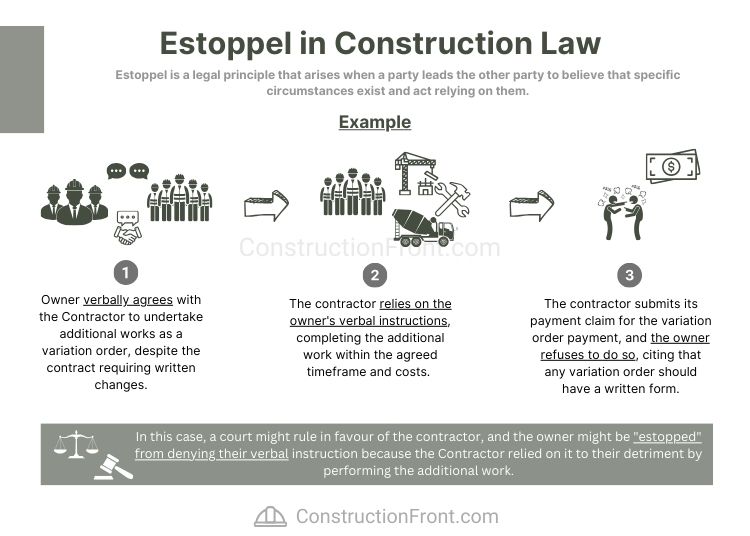
In a construction project, the owner (Party A) verbally instructs the contractor (Party B) to undertake specific additional works as a variation order, even though the contract specifies that any changes must be given in written form to be valid.
Relying on the owner’s words, the contractor goes ahead and completes the additional work within the timeframe required and costs agreed in principle. However, when the contractor submits its claim for payment, the owner refuses, citing that any variation order should have a written form.
In this circumstance, the estoppel principle can come into play – party A might be “estopped” from denying their verbal instruction because Party B relied on it to their detriment by performing the additional work. As such, party A must honor their initial commitment, preventing unfairness in the contract.
Estoppel Principle in Construction - A Real Case
In Valmont Interiors Pty Ltd v Giorgio Armani Australia Pty Ltd (No 2) [2021] NSWCA 93, the Court of Appeal of the Supreme Court of New South Wales, Australia, reached a significant decision.
Despite Valmont Interiors failing to meet the stipulated contract timeline requirements, the court ruled they were entitled to payment for a variation based on the estoppel principle.
Armani had previously paid Valmont for other non-compliant variation orders in this particular case. This history of payments led Valmont to reasonably believe that they were entitled to compensation for providing part of the joinery, as a third party failed to deliver as expected.
A summary of the case is detailed below.
Case | Valmont Interiors Pty Ltd v Giorgio Armani Australia Pty Ltd (No 2) [2021] NSWCA 93 |
Location | New South Wales (Australia) |
Background |
|
Disputes |
|
Court Decision |
|
What is Estoppel by Silence?
Estoppel by silence, also known as estoppel by acquiescence or estoppel by inaction, is a legal principle where a party is barred from making claims against the other because they remained silent or did not share information when they had a duty to do so.
In simpler terms, if party A has a legal obligation to say or clarify something, and their silence misleads party B to their detriment, party A may be prevented from later taking a contradictory position in a legal dispute.

Estoppel by Silence - Example in Construction
For example, in a construction contract, the owner silently observes as the contractor begins extensive renovations without obtaining the necessary written approval, a clear contractual requirement.
The contractor, in reliance on the owner’s silence, assumes that the work is authorized. However, in a subsequent dispute, the owner claims that the renovations were unauthorized due to the absence of written approval.
In this situation, the owner might be estopped from denying the authorization. This is because the owner’s initial silence led the contractor to believe the work was approved.
What is Promissory Estoppel?
Promissory estoppel, often called equitable estoppel, comes into play when one party makes an explicit promise to another party, and the second party relies on that promise to their detriment.
In such cases, the party who made the promise is prevented from breaking it or returning to their word. The critical elements of promissory estoppel typically include:
- A Clear Promise: There must be a clear and unequivocal promise, assurance, or commitment made by one party to another.
- Reliance: The second party must reasonably rely on the promise to their detriment. In other words, they took action or refrained from taking action based on the promise.
- Injustice, if Not Enforced: Allowing the party who made the promise to break it would result in injustice or unfairness.
Promissory estoppel is typically raised when there is no formal written contract but where a promise has been made and relied upon – for example, an owner verbally instructing the contract to proceed with specific works, only to deny payment entitlement later.
Promissory Estoppel - Example in Construction
In a construction project, the owner verbally promises the contractor a $10,000 bonus for completing the project ahead of schedule. The contractor, motivated by this promise, accelerates the work and reaches project completion within the agreed timeframes.
However, upon completion, the owner refuses to pay the bonus on the basis that a written agreement has never been executed by the parties with regard to the revised construction program.
The contractor invokes promissory estoppel to enforce the payment because the promise led them to accelerate the project, and it would be unfair for the owner to backtrack on their word.
Estoppel - Other common variations of this principle
Estoppel is a complex legal concept with several variations and applications. Here are some other common types of estoppel:
- Estoppel by Deed: This type of estoppel applies to situations involving real property or land. It prevents a party from denying the truth of a statement or fact in a deed, such as property ownership, once the deed is executed.
- Estoppel by Record: This type of estoppel is based on formal public records or documents, such as court judgments or official records, which can prevent a party from denying the facts contained in those records.
- Collateral Estoppel: Also known as issue estoppel, this type prevents the relitigation of a specific issue or fact already decided in a prior legal proceeding. It promotes finality in legal matters.
- Judicial Estoppel: This type prevents a party from taking a position in a legal proceeding inconsistent with a position they took in a previous one.
- Estoppel by Laches: This is a type of estoppel that arises when a party unreasonably delays in asserting a legal right, and that delay prejudices another party.
Estoppel vs Waiver vs Presumption - What is the difference?
Estoppel, waiver, and presumptions are relevant legal concepts in construction law, but are different when it comes to their application and implications:
- Estoppel, as detailed above, prevents a party from going back on a promise or representation if doing so would cause detriment to the other party.
- Waiver, on the other hand, occurs when a party intentionally gives up a known legal right, such as a contractual obligation, by acting in a way that contradicts such right. It’s a conscious decision not to enforce a right they have under the contract (i.e., An owner might waive time-bar requirements for the submission of an extension of time claim).
- Presumption involves accepting certain facts as true unless proven otherwise in legal proceedings. It simplifies the legal process by providing default assumptions that can be challenged with evidence when necessary.
The table below summarises key differences between these legal principles.
Aspect | Estoppel | Waiver | Presumption |
Purpose | Prevents a party from breaking a promise when it would harm the other party who relied on it. | Involves intentionally giving up a known legal/contract right by acting against it. | Involves accepting certain facts as true until proven otherwise in legal proceedings. |
Reliance Required | Requires the other party’s reliance on the promise or representation. | Doesn’t necessarily require the other party’s actions or reliance. | Does not require reliance; it is an assumption of fact. |
Enforcement | Enforces fairness and consistency in contractual agreements. | Involves the conscious decision to abandon a legal right. | Simplifies legal proceedings by providing a default assumption that can be challenged with evidence |
Impact on Rights | Focuses on preserving the rights of the party who relied on the promise. | Focuses on the party consciously forgoing their own rights. | Provides a starting point for legal proceedings, which parties can challenge with evidence as needed |
Example | Prevents a contractor from reneging on a verbal promise for extra payment in a construction project. | Occurs when an owner knowingly chooses not to enforce time bars with regards to notification requirements. | Presumes a verbal agreement/instruction is legally binding until parties provide evidence to the contrary in dispute resolution |
FAQ - Estoppel in Constuction Law
What is an Estoppel Certificate?
An estoppel certificate is a document typically used in real estate and financing transactions to confirm the current terms and status of a lease or financing agreement about a property.
Usually, it includes key details such as rent or loan payments, lease provisions, and any legal disputes, preventing potential misrepresentations or disputes between parties.
The main goal of these documents is to prevent disputes, protect new parties in property transactions, assess rental income for lenders, and ensure legal compliance.
What is a Time Bar?
Time bar clauses are contract provisions that set specific timelines for one party to notify the other concerning specific contractual issues or potential disputes.
For a detailed understanding, we suggest reading this article: What is a Time Bar Clause? (And Why it is so Important!)
Need Help?