


The development of client needs and desire to implement optimal risk profiles has led to the development and use of different contract styles in the construction industry, such as alliance contracts, design-and-build contracts, managing contracting, construction only, construction management, public-private partnerships, and many others styles.
Recently, major clients have started to use Early Contractor Involvement (ECI) agreements to draw expertise from contractors in the refinement of project requirements and concepts.
But what exactly is an Early Contractor Involvement (ECI)? ECI are a collaborative contracting approach, which typically contains two phases. In this framework, the contractor is involved from project’s outset supporting planning and design development (phase 1 – pre-construction), and eventually proceed project’s execution through a secondary construction agreement (phase 2 – construction phase).
The early involvement enables the contractor to provide valuable insights and expertise to the client/owner from the project’s inception, helping them to develop the project’s concept and design through to the construction phase.
In this article, we will explore ECI contracts further, their commonly used frameworks, how they work and how to procure them, when they should be used, and their pros and cons – keep reading it.
What is an ECI Contract?
An ECI (Early Contractor Involvement) framework is a collaborative project delivery approach in the construction industry where the contractor is involved in the project as early as in the feasibility and development phases.
In this framework, the contractor becomes an integral part of the project team from the project’s inception, working closely with the client, architects, designers, and other relevant stakeholders. The ultimate goal is to leverage the contractor’s expertise, insights, and practical experience to optimize project outcomes.
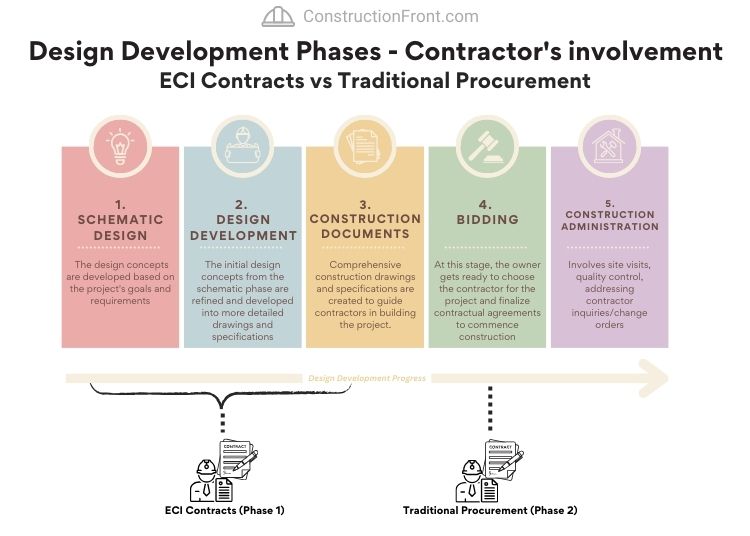
The crucial aspect distinguishing ECI contracts from traditional procurement is the timing of the contractor’s engagement in the project and in the design development, which is highlighted in the picture below (design development phases were adapted from the standards suggested by the American Institute of Architects).
In contrast to traditional procurement methods, where contractors typically become involved at the back end of the design development phase (during bidding phase), ECI agreements introduce contractors in the project as early as in the schematic design phase to support the development of concept design and construction documents.
How an ECI Contract Works?

Author’s note: The following paragraphs will detail generically how an ECI Contract works. We note that the dynamics of ECI Contracting might vary according to the client (private vs. public), project/contract specifics, jurisdiction/legal requirements, construction sector (i.e. Front-End Engineering Design Phase is a similar process in the industrial construction niche), and many others.
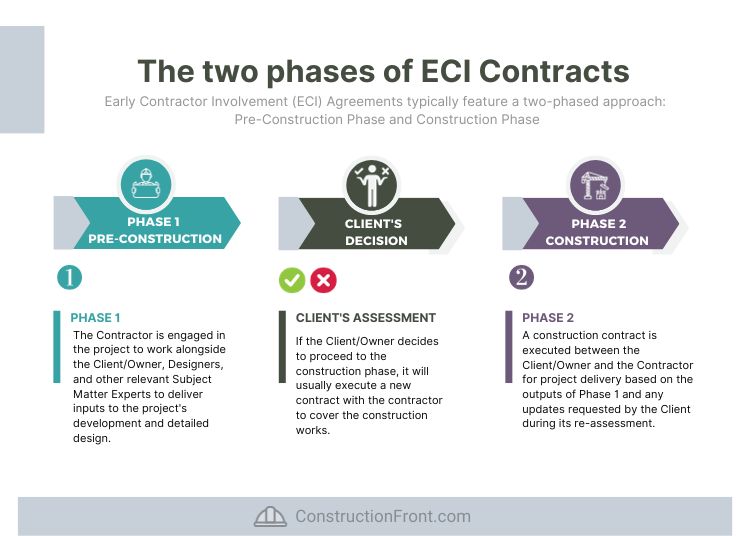
Early Contractor Involvement (ECI) Agreements typically feature a two-phased approach:
- Phase 1 – Design Development Phase (Pre-Construction Phase) – In this first ECI phase, the contractor is initially engaged for a fee to support the client on the project’s initial development. At this stage, the contractor’s remuneration can vary from a lump-sum agreement to a cost-plus-fee agreement, where the contractor is paid for its preliminary costs, overheads and profits.
- Phase 2 – Construction Phase – Once the design is concluded and the owner decides to proceed with the construction phase, a new contract is executed upon the agreement (further details on contracting options are detailed below). Usually, the commercial principles underpinning phase 2 are pre-agreed in Phase 1, and the remuneration typically occurs as the construction contract (i.e. monthly payment claims).
ECI Contract - Phase 1 - Pre-Construction
Typically, in the pre-construction or design development phase (phase 1), the Contractor is engaged in the project to work alongside the Owner, designers, and other relevant subject matter experts to deliver inputs to the project’s development and detailed design. This includes, but is not limited to:
- Overall Development Coordination
- Advice on Constructability aspects
- Cost planning
- Support to client’s feasibility studies
- Value-engineering
- Support the development of technical specifications
- Construction Program
- Others
At the end of the first phase, the Owner will have a sufficiently detailed design package, a reliable cost plan and a construction program and will be re-assess the project’s feasibility within the context.
ECI Contract - Phase 2 - Construction
If the client decides to proceed to the construction phase 2, it will usually execute a new contract (construction contract) with the contractor to cover the construction works. Overall, there are 3 different scenarios here:
- Scenario 1 – Typically, the client enters exclusive negotiations with the ECI Contractor to deliver the project. It is common practice that the client engages an independent cost consultant to ensure the contract price aligns with market conditions.
- Scenario 2 – In other instances, the client might decide to go through a competitive tendering process and invite other proponents, apart from the ECI Contractor, to bid for the project to ensure it gets the best value-for-money outcome in the ECI process.
- Scenario 3 – In other rare circumstances, client and the ECI Contractor are not able to agree on price for the project and the project is put in the market for tendering and the ECI Contractor withdraws from the process.
The scope of the construction contract might include design finalisation, equipment supply, and sometimes clients may wish to include some level of risk sharing mechanisms in a similar manner to alliance agreements.
Some of the contracting alternatives for the construction phase are:
What are the ECI contracting options?
ECI Contract - Phase 1 - Pre-Construction - Contracting Approach
It is very common that consulting/service agreements are executed in this phase, and the remuneration can be a lump-sum fee with payments based on milestones achieved, schedule of rates, cost-plus-fee, or other similar commercial structures.
ECI Contract - Phase 2 - Construction - Contracting Approach
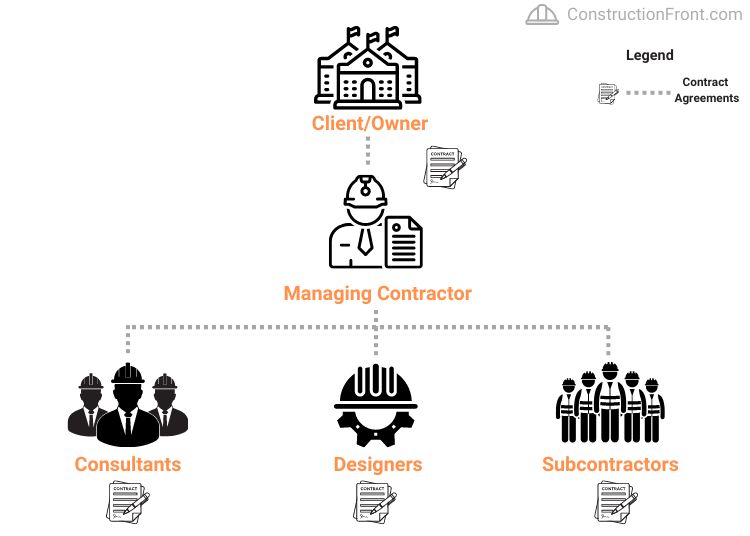
The contracting approach for the construction phase might vary according to client’s preference, but it is commonly underpinned by managing contractor or general contractor agreement, where the contractor retains most of the risks.
The managing contracting approach is characterized by a single master contract with a single touch point for the owner/client (refer to the figure below). Managing contractors tend to have increased legal exposure (when compared to construction managers), given they enter into downstream agreements with other parties and typically bear the coordination risks between the group of subcontractors.
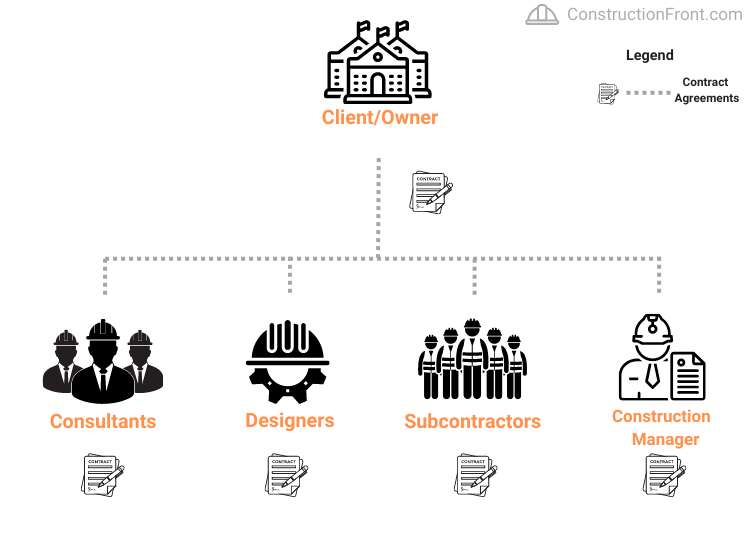
On the other hand, in the construction management approach, the contractor retains the “consultant” position, and the owner will be responsible for procuring, engaging and managing multiple sub packages (designers, consultants, engineers, etc) with the support from the construction manager (refer to the figure below)
Suggested Reading: Managing Contracting vs Construction Manager – Key Differences & Tips
Typically, clients also implement variations of these frameworks with risk-sharing mechanisms, such as:
- Construction Management At Risk (CMAR) – In this approach, the Construction Manager shares the risks with the Owner and a ceiling price is pre-established under the contract. In case project costs overcome this limit, the financial losses are borne by the contractor – Suggested Reading: Construction Manager at Risk (CMaR): What is it? How it Works?
- Alliancing Contracting with a Managing Contractor – This contract is generally executed with a Target Outrun Cost (TOC), a cost benchmark/ceiling used to govern a pain-gain mechanism. In case of cost overruns, losses are shared between the Owner and the Contractor. In case of cost underruns, savings are also shared (for more details, read this article: What is an Alliance Contract? (Pros, Cons & Examples)
- There are many other ad-hoc variants that can be implemented according to Clients’preference.
ECI contracting - Case Studies and Recent Projects
The cases detailed below are examples of the use of the ECI framework in significant infrastructure projects across the world:
What are the advantages and disadvantages of ECI Contracts?
The Pros of ECI Contracting
The table below summarizes key advantages of the ECI Contracting Approach.
Advantages | Description |
1. Risk Mitigation | ECI contracts allow early identification and mitigation of project risks, reducing the potential for costly issues later in the construction process. |
2. Risk sharing | Some Risk-sharing mechanisms can be embedded in ECI contracts to help distribute risks equitably among parties, ensuring a fair allocation of responsibilities. |
3. Improved Project Quality and Project Understanding | Collaboration from the outset fosters better project quality through early problem-solving, innovative solutions, and enhanced design. Further, the Contractor has a detailed understanding of the project’s development process, which is extremely helpful for the construction phase. |
4. Enhanced Communication | ECI promotes open and continuous communication among project stakeholders, reducing misunderstandings and improving project coordination. |
5. Innovative Solutions | Contractors’ early involvement encourages the exploration of innovative construction methods and materials, potentially leading to cost savings and improved project outcomes. |
6. Value Engineering | ECI contracts often involve value engineering, where contractors suggest cost-effective alternatives without compromising project quality. |
7. Cost Certainty | Contractors’ involvement in the planning phase enhances cost control, providing clients with more accurate cost estimates and minimizing budget surprises. |
8. Early Cost Transparency | Clients gain early visibility into project costs, helping them make informed decisions and secure financing more effectively. |
9. Reduced Claims and Disputes | Early collaboration helps prevent disputes and claims (i.e EOT Claims), saving time and resources that would otherwise be spent on legal matters. |
The Risks and Cons of ECI Contracting
As with any procurement methodology, some risks and issues should be monitored when implementing this commercial framework, such as:
|
Disadvantage |
Description |
|
1. Upfront Costs |
Contractors may face increased upfront costs due to their early involvement in project planning and design, potentially impacting their cash flow. |
|
2. Complex Contractual Arrangements (Legal and Administrative Burden) |
ECI contracts often require complex contractual arrangements, which can lead to legal and administrative challenges during implementation. |
|
3. Potential for Overcommitment |
Contractors may overcommit to certain design or cost aspects early in the project, leading to difficulties in later stages if changes are necessary. |
|
4. Collaborative Challenges |
Managing collaboration effectively among multiple stakeholders can be challenging and may lead to communication issues or conflicts. |
|
5. Uncertainty for Contractors |
Contractors may face uncertainties related to securing the project contract, as ECI involvement does not guarantee the final contract award. |
|
6. Limited Contractor Selection (Lack of competition during bidding phase) |
ECI contracts often limit the pool of potential contractors, as they require early selection, potentially missing out on competitive bidding. |
|
7. Potential for Scope Creep |
Despite early scoping efforts, scope changes can still occur, potentially leading to additional costs (i.e. Variation Orders / Claims) and delays. |
|
8. Potential for Misaligned Incentives |
Misaligned incentives among project stakeholders can hinder collaboration and innovation in some cases. |
|
9. Client-Contractor Relationship |
Misalignment or conflicts in expectations and goals can strain the client-contractor relationship if not managed effectively. |
When ECI Contracts should be used?
An ECI (Early Contractor Involvement) contract should be considered and used in construction projects under specific circumstances to maximize its benefits. Here are scenarios where an ECI contract is typically well-suited:
- Complex Projects: ECI contracts are particularly valuable for complex construction projects where early collaboration between the contractor, client, and other stakeholders is essential (i.e. Hospitals, Stadiums, etc.). These projects often involve intricate designs, specialized requirements, or challenging site conditions.
- Innovation and Value: When a project prioritizes innovation, value engineering, and cost optimization, an ECI contract allows the contractor to provide valuable insights and suggestions from the project’s outset.
- Risk Management: Projects with a high degree of risk, such as those in environmentally sensitive areas or projects with extensive regulatory requirements, can benefit from ECI. Early contractor involvement allows for thorough risk assessment and mitigation planning.
- Early Completion Requirements: In cases where early project completion is critical, ECI contracts can expedite the planning and design phases, helping meet tight deadlines.
- Limited Design Management Capability: When there is a shortage of design management expertise in the market, an ECI contract allows the contractor to take on a more active role in design development.
- Greenfield or Brownfield Projects: Both greenfield (new construction) and brownfield (renovation or expansion of existing facilities) projects can benefit from ECI contracts. Early involvement helps to investigate risks better and price them more accurately.
- Client-Contractor Collaboration: ECI contracts are well-suited for clients seeking a collaborative approach with contractors, where the contractor becomes a true partner in project planning and design.
- Client Program Risk Management: ECI allows the client to manage program-related risks, including the potential need for a secondary market process, if the initial lump sum offer or project solution is unacceptable.
FAQ - ECI Contracts
Is ECI a procurement method?
Yes, ECI is a procurement method. It differs from traditional methods by involving the contractor much earlier in the project, typically during the design phase, fostering collaboration and innovation.
What is the difference between early contractor involvement and design and build contracts?
Early contractor involvement (ECI) focuses on involving the contractor during the project’s planning and design phase, emphasizing collaboration and innovation. Design and build, on the other hand, typically involves the contractor in both design and construction but may have less emphasis on early collaboration.