

Construction projects are typically complex and require significant coordination between works on site, designers, consultants, subcontractors, and suppliers. More often than not, drawings are incomplete, details do not align, specifications leave too much open to interpretation, or the sequence assumed by one party does not reflect the realities of the works.
When situations like this arise, projects rely on a process called a Request for Information, or RFI. In construction, an RFI is a formal query raised by contractors or subcontractors to clarify gaps, ambiguities, or missing details in drawings, specifications, or contract requirements. While intended to resolve uncertainty, RFIs can significantly impact project timelines, coordination effort, and cost when volumes increase.
On complex projects, high volumes of RFIs are rarely just administrative; they are often a direct signal of incomplete design, coordination gaps, or unclear risk allocation under the contract. Although RFIs are often treated as routine administrative tools, they can have significant commercial and contractual consequences. If the missing information affects time, cost, sequencing, or responsibility under the contract, the issue may later develop into delay, disruption, variation, or entitlement disputes.
This is why an RFI should not be seen only as a technical question. It is also part of the contractual record. In this article, we explore what an RFI is, why it matters commercially, and how to manage RFIs in a way that protects project and contractual interests.
What is an RFI in construction?
An RFI in construction stands for Request for Information. It is a formal request used where the information available under the contract is not sufficient for a party to proceed properly, safely, or efficiently with the works.
In practical terms, an RFI is usually raised when the contractor, subcontractor, supplier, or consultant cannot confidently move forward because the information issued does not fully answer what is required on site.
That may be because the documents conflict with one another, because a necessary detail is missing, because the design intent is unclear, or because actual site conditions do not align with what was expected.
From a project-delivery perspective, the immediate purpose of an RFI is to obtain clarification. From a commercial and contractual perspective, however, the RFI also performs another function: it records when an issue was identified, what information was missing, whether the issue was raised promptly, and how the other party responded. That record may later become relevant to early warning notices, notice of delay, extension of time, variation, prolongation costs, and even liquidated damages.
Typical RFIs raised in a project
In practice, RFIs are commonly raised because of uncertainty in:
| Area of uncertainty | Example |
|---|---|
| Drawings | Architectural drawing shows one wall build-up, while structural or MEP drawings show a conflicting interface |
| Specifications | Specification requires a performance level but does not clearly state the material or standard to be used |
| Scope | It is unclear whether a builder’s work opening is included in the main contractor’s scope or the subcontractor’s scope |
| Design intent | The drawing shows a feature, but the intended function or construction methodology is unclear |
| Dimensions | Critical dimensions are missing, inconsistent, or do not reflect actual site conditions |
| Materials | The contract refers to a product type, but not the grade, finish, manufacturer standard, or approved equivalent |
| Interfaces between trades or design disciplines | Structural steel, façade, and MEP systems physically clash in the same zone |
| Site information | Survey, geotechnical, or as-built information does not match actual conditions encountered on site |
| Installation details | A detail is too generic for installation, fabrication, or procurement to proceed confidently |
| Sequencing assumptions | The drawings assume a sequence that is not achievable given access, temporary works, or trade interfaces |
| Others | Inconsistencies in schedules, BOQs, shop drawing requirements, temporary works assumptions, or testing requirements |
Practical Insights arising from Research on RFIs in construction projects
The practical importance of RFIs is supported by research, particularly because it shows that RFIs are not merely paperwork.
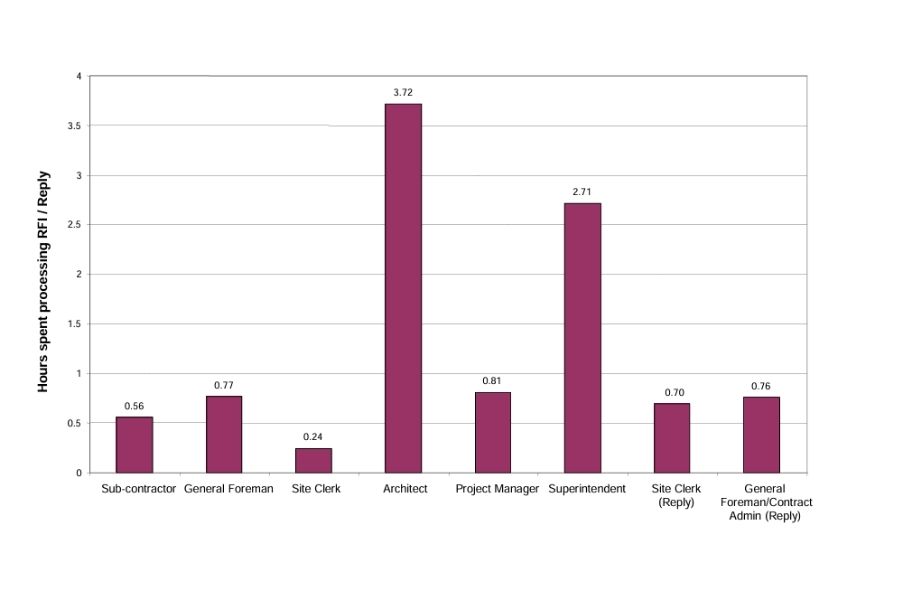
In Quantifying the time and cost associated with the request for information (RFI) process in construction, Mohamed, Tilley, and Tucker found that the RFI process consumes measurable project time and cost. That matters because many teams still underestimate the cumulative burden that large volumes of RFIs place on project administration, design coordination, management costs and decision-making. The same article identified that RFI processing can draw many hours from key project resources, with architects (designers) having a significant time allocation to respond and manage the requests (see picture below extracted from Quantifying the time and cost associated with the request for information (RFI) process in construction).
Similarly, in Request for Information (RFI) Management: a Case Study, Euysup Shim, Brad Carter, and Seongchan Kim analysed a project with 1,484 RFIs and found that the average response time was 11.5 business days, despite a 5-business-day target, and that 61.66% of RFIs were answered late.
From a commercial point of view, this is significant. A delayed RFI response may not only slow down technical coordination, but also affect procurement, labour productivity, sequence, and the strength of later time and cost claims.
A further useful perspective appears in Qualitative analysis of Request For Information to identify design flaws in steel construction projects, where Fokwa Soh, Barbeau, Dore, and Forgues link recurring RFIs to design flaws and document-quality issues. This is an important practical insight: a high number of RFIs may sometimes indicate that the design information issued for construction is incomplete, poorly coordinated, or not sufficiently buildable.
Taken together, these studies reinforce a simple point. RFIs are not just an administrative process. They are often a visible symptom of deeper information, design, and coordination issues that can have real contractual and financial consequences.
Dealing with RFIs and protecting your commercial interests
RFIs are a reality of almost every construction project. In general, the more complex the design, interfaces, sequencing, and stakeholder structure, the more RFIs a project is likely to generate. The real issue is therefore not whether RFIs will arise, but how they are identified, managed, and responded to.
As the research above suggests, RFIs are not commercially neutral. If handled poorly, they can contribute to delay, inefficiency, repeated redesign, and disputes over responsibility. If handled well, they can help clarify the contract requirements early, improve coordination, and protect the parties’ respective positions.
A proactive approach to RFI management can therefore reduce the likelihood of disputes or, if a dispute later arises, place a party in a stronger evidentiary position. This matters whether you are a contractor seeking to preserve entitlement for additional time or cost arising from missing information, or an owner or client seeking to ensure that the contract is being properly administered and that responses do not unintentionally expand scope or create avoidable delay.
If you are a contractor
From a contractor’s perspective, an RFI should not be treated as a routine email dressed up in a template. It is part of the project record, and, in fact, it should have a proper control system to ensure traceability and ownership. These may later support entitlement to financial compensation where the client, superintendent, or designer fails to provide adequate information within a reasonable time.
A contractor should therefore raise RFIs as soon as it becomes aware of an issue. This is important not only for project coordination, but also for protecting future entitlement. Many contracts, such as FIDIC templates, require the contractor to notify an issue “as soon as practicable” or within a defined period after becoming aware of it. Even if an RFI is not, by itself, the contractual notice required under the contract, it can still form an important supporting document to an early warning, a notice of delay, or another contractual notice.
From a practical and commercial point of view, a contractor’s RFI should usually include:
- the exact drawing, specification, clause, model reference, or instruction giving rise to the issue
- a clear explanation of the inconsistency, omission, ambiguity, or missing information
- the specific information required to proceed
- the part of the works affected
- why the issue matters now, including any effect on procurement, fabrication, access, sequence, or construction methodology
- the date by which a response is required to avoid impact
- any likely time or cost consequence, stated carefully and without exaggeration
- mark-ups, sketches, photographs, or extracts where these help explain the issue clearly
The key is to make the request specific enough that the recipient cannot later argue that the issue was unclear, insufficiently explained, or raised too late.
If you are an owner/client
From an owner’s, superintendent’s, or designer’s perspective, RFIs should also be treated seriously. A delayed or poorly considered response may have broader commercial consequences than simply slowing down a technical clarification.
Owners and designers should review RFIs carefully, ensure that the response is consistent with the contract requirements, and assess whether the answer may depart from the contracted scope of works or materially affect project timelines. This is important because a response that appears to be a simple clarification may, in substance, alter design intent, impose additional work, or change the sequence in which the works must be carried out.
In practice, this means owners and designers should:
- confirm that the RFI is answered by the appropriate person with the proper authority
- ensure the response is consistent with the contract documents and approved design intent
- avoid vague answers that create further ambiguity
- consider whether the issue requires a formal instruction, variation, or other contractual mechanism rather than an informal clarification
- assess whether delay, procurement, or cost impacts may follow from the timing or content of the response
- maintain a clear record of when the RFI was received, reviewed, and answered
A disciplined response process helps the owner protect the integrity of the contract while also reducing the risk of avoidable claims, scope creep, or arguments that the response itself created a compensable change.
Final Thoughts
An RFI is often viewed as a simple project-administration tool, but in practice it can carry much greater significance. It is one of the main mechanisms through which missing, inconsistent, or unclear information is identified and brought into the contractual record.
For contractors, a well-timed and well-drafted RFI can help preserve entitlement and strengthen the factual basis of later claims. For owners, designers, and contract administrators, a careful response can help avoid turning a clarification into a variation or a manageable issue into a dispute.
Ultimately, RFIs are not just about asking and answering questions. They are about managing information risk before that risk develops into delay, disruption, cost escalation, or contested responsibility under the contract.
Need Help?
Do not hesitate to contact us (click here) for specialised advice in the construction industry.
Sources
- Mohamed, S., Tilley, P. A., and Tucker, S. N., Quantifying the time and cost associated with the request for information (RFI) process in construction
- Shim, E., Carter, B., and Kim, S., Request for Information (RFI) Management: a Case Study
- Fokwa Soh, M., Barbeau, D., Dore, S., and Forgues, D., Qualitative analysis of Request For Information to identify design flaws in steel construction projects
Disclaimer: The articles on this blog are for informational and educational purposes only and do not constitute legal or technical advice. While we strive to provide accurate and up-to-date information on construction law, regulations may vary by jurisdiction, and legal interpretations can change over time.