

On many construction projects, the hardest procurement decision is often when to ask the market for a final price. If the contractor is required to submit a fully fixed price too early, the bid may include large contingencies for design uncertainty, procurement risk, and incomplete information. If the client waits too long, the project may lose time, market interest, momentum, or even become commercially unviable.
This guide how the two stage tender works, when it is used, how it relates to Design and Construct (D&C), Construction Manager at Risk (CMaR), and Guaranteed Maximum Price (GMP), and what the main commercial advantages and risks are in practice.
How does two-stage tendering work?
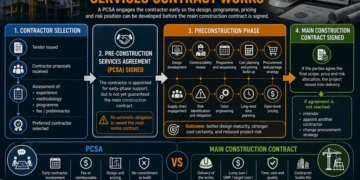
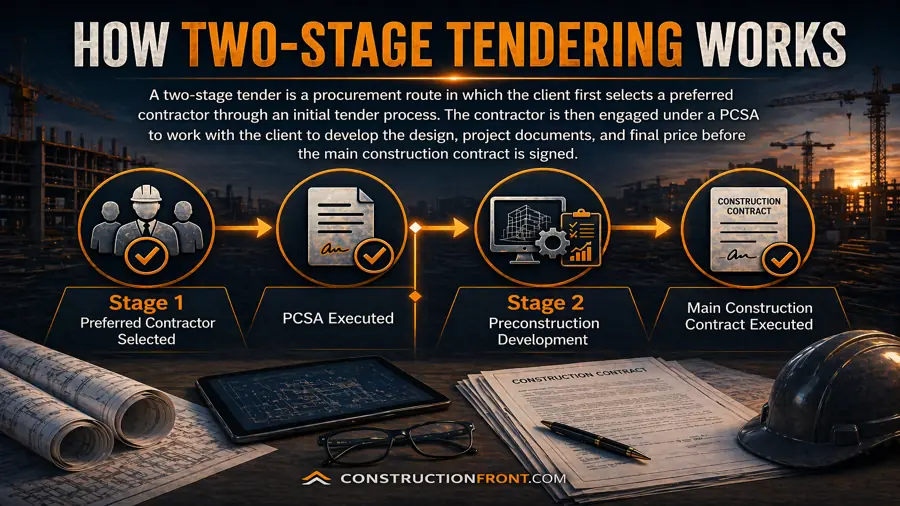
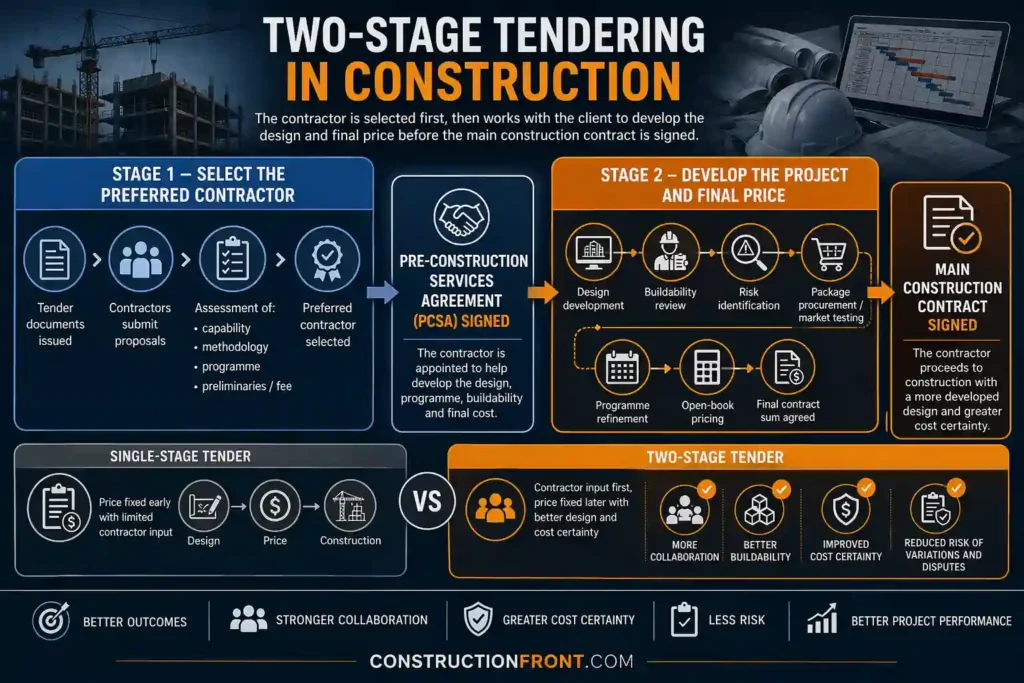
In practice, Stage 1 is the competitive process used to select the preferred contractor. Once that selection is made, the parties usually execute the PCSA and move into Stage 2. During this preconstruction phase, the contractor works with the client to refine the design, programme, package strategy, constructability, risk allocation, and pricing before the main construction contract is signed.
Stage 1: selection of the preferred contractor
At Stage 1, the client usually runs a competitive process to identify the preferred contractor. Because the design is often still incomplete, the contractor is not normally being asked to submit a final fixed price for the whole project. Instead, the assessment tends to focus on capability, team, delivery approach, and limited commercial inputs.
For example, where a project involves a complex stadium, solar farm, transport asset, or industrial facility, the client will often place significant weight on relevant experience, delivery performance, team capability, and the contractor’s ability to manage similar design, logistics, and programme risks.
Typical Stage 1 tender submissions may include:
- methodology
- programme approach
- key staff and project team
- design management proposals
- constructability and logistics thinking
- relevant experience
- package procurement strategy
- preliminaries
- overheads and profit
- pricing assumptions
- limited package pricing or early works pricing
As the Crown Commercial Service worked example makes clear, Stage 1 is primarily a contractor selection exercise rather than a final price commitment.
End of Stage 1: execution of the PCSA
At the end of Stage 1, the client will usually appoint the preferred contractor under a pre-construction services agreement, or PCSA.
The PCSA is the contract used to engage the contractor during the preconstruction phase before the main works contract is signed. It usually sets out the scope of the preconstruction services, fee structure, programme, deliverables, information requirements, pricing process, and the route to agreeing the final construction contract.
That distinction matters. The contractor is usually not yet engaged under the main construction contract at this stage. Instead, it is engaged under the PCSA so that Stage 2 can be used to refine the commercial and technical position of the project.
Stage 2: preconstruction development
Stage 2 is the preconstruction phase carried out under the PCSA. This is the stage in which the contractor works with the client and consultant team to develop the project to the point where the final contract sum and main contract terms can be agreed.
During Stage 2, the contractor may help:
- refine the design
- improve constructability
- sequence the works
- test logistics and temporary works assumptions
- engage with the supply chain
- tender work packages
- review long-lead items
- develop the construction programme
- support value engineering
- clarify risk allocation
- build up the final contract sum
This part of the process often involves open-book pricing, package-level review, programme development, and discussion of assumptions and risk allowances.
End of Stage 2: execution of the main construction contract
If Stage 2 is successful, the parties then execute the main construction contract. Depending on the project, that may be a lump sum contract, a target cost arrangement, or in some cases a Guaranteed Maximum Price (GMP) mechanism.
A simplified summary looks like this:
| Phase | Main purpose | Typical outcome |
|---|---|---|
| Stage 1 | Select the preferred contractor | Preferred contractor identified |
| End of Stage 1 | Execute the PCSA | Contractor engaged for preconstruction services |
| Stage 2 | Refine scope, programme, risk, and price | Final commercial and technical position developed |
| End of Stage 2 | Execute main construction contract | Contractor formally appointed for delivery of the works |
What are EOI and PQQ in this context?
An Expression of Interest (EOI) is usually an early market invitation used to identify interested and suitable bidders. A Pre-Qualification Questionnaire (PQQ) is a structured prequalification process used to assess capability, experience, financial standing, and other selection criteria before formal tenders are invited.
An EOI or PQQ may sit ahead of a two-stage tender, but neither should be confused with the two-stage tender itself. They are only early filtering tools. The two-stage tender is the process that begins when the client moves into preferred contractor selection and the structured preconstruction phase leading to the final contract.
Why do clients use two-stage tendering?
Clients usually use two-stage tendering where they want earlier contractor involvement but do not want to move immediately into a fully negotiated single-source construction contract. In practice, it is often used where:
- the design is not yet complete
- programme pressure makes early contractor input valuable
- constructability and logistics are important and may influence the design approach
- specialist subcontractor involvement is needed early
- the market is difficult or volatile
- package strategy needs development before final pricing
- a one-stage fixed-price tender would likely attract heavy contingency
Two-stage tender vs single-stage tender
The core difference is timing. Under a single-stage tender, the contractor is typically asked to submit a final price at the outset. Under a two-stage tender, the contractor is selected first, then works with the client to further develop the project and the final commercial position.
| Feature | Two-stage tender | Single-stage tender |
|---|---|---|
| Contractor selection | Earlier | Later |
| Final price timing | Later | Earlier |
| Constructability input before contract | Higher | Lower |
| Design maturity required at tender | Lower | Higher |
| Risk of contingency pricing | Usually lower | Usually higher |
| Procurement simplicity | Lower | Higher |
The issue is not which route is always better. It is which route better fits the maturity, urgency, complexity, and risk profile of the project.
How does a two-stage tender relate to ECI?
A two-stage tender is best understood as a procurement route used to achieve early contractor involvement. ECI is the broader concept. It describes the early involvement of the contractor so that it can contribute to design, buildability, sequencing, procurement planning, and risk management before the main construction contract is finalised.
Two-stage tendering is one of the most common ways of doing that. So the relationship is close, but they are not identical. ECI is the broader delivery philosophy, while two-stage tendering is one procurement route used to implement it.
How does it relate to D&C, CMaR, progressive design-build, and GMP?
A two-stage tender is not usually a delivery model in its own right. It is better understood as a route to appointment that can sit alongside different contract structures, which can be achieved in many ways.
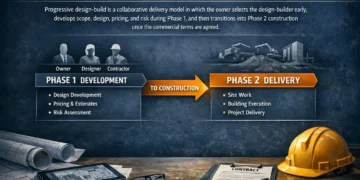
It often overlaps with Design and Construct (D&C), especially where the preferred contractor is selected before the design is fully resolved and then helps shape the final design position before the D&C contract is signed. It also sits close to progressive design-build, where the design-builder is selected early and the project is progressively developed before the final commercial commitment is made.
There is also strong overlap with Construction Manager at Risk (CMaR), particularly where Stage 2 culminates in a Guaranteed Maximum Price (GMP) or other later-developed pricing mechanism.
The key point is that two-stage tendering describes the procurement sequence, while D&C, progressive design-build, and CMaR describe broader contractual or delivery structures.
Why contractors may prefer two-stage tendering
Contractors often prefer two-stage tendering where the project is too immature for a sensible fixed-price offer at tender stage. Under a one-stage route, contractors may need to guess unresolved design issues, carry contingency for unknowns, or make aggressive assumptions to remain competitive.
Under a two-stage route, they usually have more time to understand the project before committing to the final price. That may allow:
- better understanding of scope and sequencing
- earlier supply chain engagement
- more realistic package pricing
- reduced need for blind contingency
- better visibility of programme risk
- more meaningful input into buildability and logistics
It is also worth noting that Stage 1 tendering can be less resource-intensive for contractors because they are not being required to fully price every unresolved risk at the outset. In addition, because a PCSA is usually in place for Stage 2, the contractor is typically paid to help develop the project and final commercial position, although the exact payment mechanism will depend on the terms of the PCSA.
Commercial advantages of two-stage tendering
The main advantages are usually practical rather than theoretical. A well-run two-stage tender can provide:
- better constructability and sequencing input, which can lead to more efficient design outcomes
- more realistic pricing because the contractor has a better understanding of the design and project requirements
- improved package planning
- earlier supply chain engagement, which may improve commercial outcomes
- better handling of long-lead items
- more transparent pricing where open-book methods are used
Main risks and drawbacks
Two-stage tendering also comes with real commercial risks. The main drawbacks usually include:
- loss of direct price competition after Stage 1, because only one contractor typically proceeds to Stage 2
- difficult or prolonged Stage 2 negotiations, which may stall project progress and delay construction or even investment approval
- unclear PCSA scope or deliverables
- weak governance over package tendering and open-book review
- client overreliance on the preferred contractor
- weaker negotiating leverage if Stage 2 does not go well
- risk that design development outruns commercial agreement
Once the preferred contractor is appointed, the client typically no longer has the same live competitive pressure it had at Stage 1. That means the PCSA needs to preserve fallback options if the parties cannot agree the final contract price or terms. In practice, that may include mechanisms dealing with:
- price ceilings or commercial benchmarks
- treatment of tendered package prices
- open-book access to pricing build-up
- retender rights if Stage 2 fails
- ownership and use of Stage 2 outputs
- clear off-ramp rights if the relationship breaks down
Commercial and contractual implications
As with any procurement route, two-stage tendering brings a number of commercial and contractual implications for both clients and contractors during both the procurement phase but also in the future project delivery.
Price certainty comes later
The client does not receive a final construction contract sum at the same point it would under a single-stage tender. That is not automatically a weakness, but it does mean the organisation must be comfortable with progressive pricing rather than immediate price lock-in. On some projects, that may directly affect whether the client is ready to proceed to a final investment decision.
Scope development becomes critical
Because the price comes later, the quality of Stage 2 scope development matters much more. If the project team does not define what is actually being priced, the Stage 2 negotiation can become difficult very quickly.
The PCSA matters more than people think
The PCSA is not just a holding arrangement. It is the contract that governs the preconstruction phase and preserves the client’s commercial position before the main works contract is signed. That is why it should deal clearly with services, deliverables, assumptions, package tendering, fees, programme, and fallback rights such as off-ramp clauses.
Contract administration starts early
Because the contractor is engaged earlier, commercial discipline also needs to start earlier. If pricing assumptions, design decisions, package awards, records, notices, and programme impacts are not properly managed during Stage 2, the same problems may later reappear during construction through variation requests, variation orders, extension of time claims, and broader construction claims and contract administration issues.
Practical examples of two-stage tendering
A few recent examples help show how the model is used in practice:
- GIICA Shortlists Two Bidders for the New Brisbane Stadium Under ECI Contract Model: a useful example of how some clients are trying to preserve competitive tension deeper into the process by retaining more than one bidder for part of the early contractor involvement phase.
- Ark Energy Appoints Elecnor as ECI Contractor for Richmond Valley Solar & BESS Project: an example of early contractor involvement being used on an energy project where design, constructability, packaging, and programme development are commercially important before final execution.
- AECOM Hunt-Turner JV Appointed as Construction Manager for Kay Bailey Hutchison Convention Center Expansion in Dallas: a practical example of an early appointment model sitting close to construction management and preconstruction services.
What projects suit two-stage tendering best?
As a practical rule, two-stage tendering is often better suited to:
- complex projects
- partially developed scope
- projects with major buildability or logistics issues, where contractor expertise can strongly influence the design
- schemes requiring early supply chain input
- projects with programme pressure
- projects involving long-lead packages
- clients capable of managing Stage 2 actively and commercially
It is generally less suitable where:
- the scope is already sufficiently mature for a clean fixed-price tender
- the client wants the earliest possible hard price certainty above all else
- the organisation is not equipped to manage the Stage 2 process properly
- there is no credible fallback strategy if negotiations fail
Final thoughts
A two-stage tender is best understood as a procurement route under which the client first selects a preferred contractor, then enters into a PCSA, then uses Stage 2 to refine the design, programme, package strategy, risk position, and final contract price before executing the main construction contract.
Its main strength is that it allows earlier contractor involvement without forcing a premature final price. Its main weakness is that once Stage 1 ends, competitive tension reduces and the client needs much stronger commercial discipline during Stage 2.
In short, a two-stage tender is not just a slower tender or a longer shortlist process. It is a different procurement strategy. Used well, it can improve pricing realism, buildability, and delivery planning. Used badly, it can simply defer procurement problems rather than solve them.
FAQ
What is a two-stage tender in construction?
A two-stage tender is a procurement process where the client first selects a preferred contractor and then engages that contractor under a pre-construction services agreement to help develop the project before the main construction contract is signed.
Is the PCSA executed at the end of Stage 1?
Usually, yes. In a typical two-stage tender, Stage 1 ends with selection of the preferred contractor and execution of the PCSA. Stage 2 is then carried out under that PCSA.
What happens during Stage 2?
During Stage 2, the contractor helps refine the design, construction programme, package strategy, buildability, risk position, and final contract sum. If agreement is reached, the parties then execute the main construction contract.
How is a two-stage tender different from a single-stage tender?
In a single-stage tender, the contractor usually submits a final price at the outset. In a two-stage tender, the contractor is selected first and the final price is developed later.
Is a two-stage tender the same as ECI?
Not exactly. ECI is the broader concept of involving the contractor early. Two-stage tendering is one procurement route commonly used to achieve that.
When should a client avoid a two-stage tender?
A client should think carefully before using it where the project is already mature enough for a straightforward fixed-price tender, where the organisation cannot manage Stage 2 properly, or where there is no credible fallback if final agreement is not reached.
Need Help?
Do not hesitate to contact us (click here) for specialised advice in the construction industry.
Sources
- RICS, Tendering Strategies, 1st edition
https://www.rics.org/content/dam/ricsglobal/documents/standards/tendering_strategies_1st_edition_rics.pdf Crown Commercial Service, Worked Example: Two Stage Tendering
https://assets.crowncommercial.gov.uk/wp-content/uploads/Worked-Example-Two-Stage-Tendering.pdf- Almohassen, A. S. et al., Evaluating Construction Contractors in the Pre-Tendering Stage Through an Integrated-Based Model https://www.sciencedirect.com/science/article/pii/S1110016823008645
Construction Front, What is an ECI Contract?
Construction Front, Design and Construct (D&C) Contracts
Construction Front, Construction Manager at Risk (CMaR)
Construction Front, Progressive Design-Build
Construction Front, Guaranteed Maximum Price
Construction Front, Managing Contractor
Construction Front, Construction Claims and Contract Administration
Construction Front, What is a Variation Order?
Construction Front, What is a Variation Request?
Construction Front, What is a Time Bar Clause?
Construction Front, Notice of Delay
Construction Front, What is an Extension of Time Claim (EOT)?
Construction Front, What is a Latent Condition in Construction?
- RICS, Tendering Strategies, 1st edition
Disclaimer: The articles on this blog are for informational and educational purposes only and do not constitute legal or technical advice. While we strive to provide accurate and up-to-date information on construction law, regulations may vary by jurisdiction, and legal interpretations can change over time.