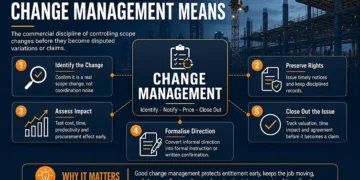


On a live project, a change order stops being routine paperwork the moment labour is already moving, procurement has started, and someone says, “Proceed now and we will paper it later.” That is usually where margin starts leaking. If the document is loose on scope, silent on time, or careless on reservations, the contractor can end up carrying unrecovered cost, unrecognised delay, and a later argument about whether the work was instructed at all.
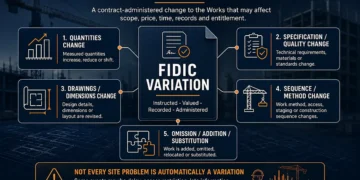
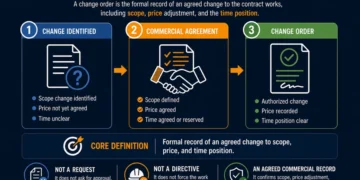
A construction change order is the written record of an agreed change to the contract scope, price, time, or any combination of those items. In many contracts the broader term is variation order. Avariation request is usually a contractor-initiated request seeking approval, while a construction change directive is an instruction to proceed before price or time is fully agreed.
What matters in practice is not whether the form looks polished. It is whether the document ties the changed work to contractual authority, defines exactly what is included and excluded, records valuation status properly, and avoids waiver language that weakens later entitlement. A construction change order example is only useful if it would still protect the commercial record when the project is under pressure months later.
Construction Change Order Example
A good construction change order example does not try to explain the whole change-management system. It should let a contractor, commercial manager, or contract administrator answer the execution-stage questions quickly:
- What was instructed or requested?
- What exactly changed?
- What has been agreed on cost?
- What has been agreed on time?
- What is still reserved or unresolved?
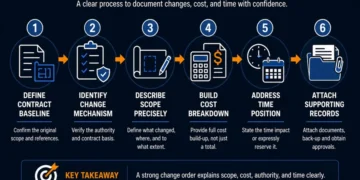
A practical construction change order format should usually include:
- Change order number and project reference
- Contract reference and clause basis
- Date of instruction, request, issue, and where relevant acceptance
- Origin of change: client instruction, consultant instruction, contractor request, design development, existing condition, or authority requirement
- Clear description of the changed work
- Agreed valuation, provisional valuation, or stated valuation method
- Time position, including whether extension of time remains open
- Statement of exclusions, assumptions, and reservations
- List of supporting records
- Approval and signature status
If those items are missing, the form may still look complete while failing commercially where it matters.


Construction Change Order Example
Project: Riverside Logistics Warehouse
Contract: CF-WH-2026-014
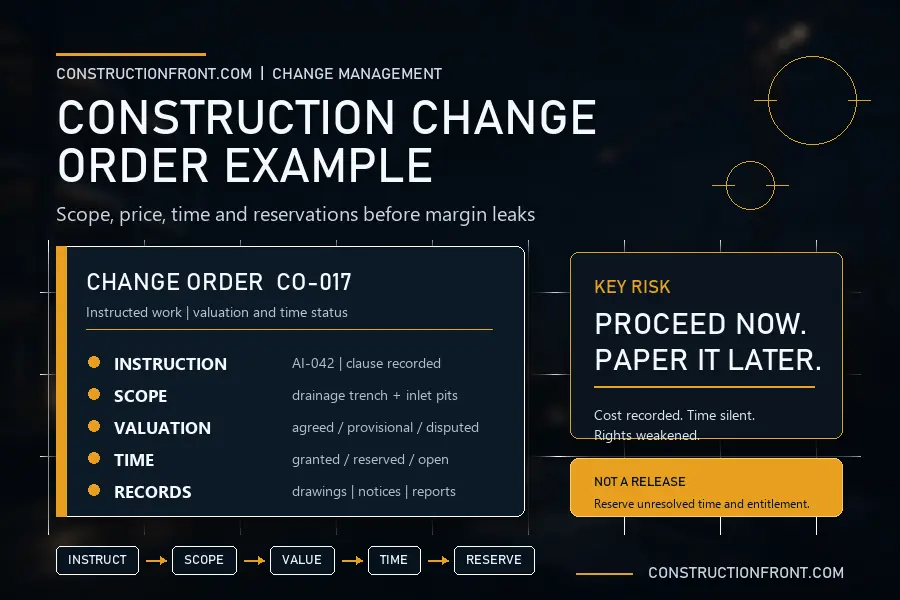
Change Order No.: CO-017
Date Issued: 14 May 2026
Related Instruction / Request: AI-042 dated 10 May 2026
Contractual Basis: Clause 13 — Variations / Changes
Title of Change: Additional drainage trench and revised inlet arrangement at loading yard
Reason for Change:
Following excavation in the loading yard, the Engineer instructed a revised drainage layout to address a conflict with identified underground services and revise the discharge route.
Description of Changed Work:
The Contractor shall:
- Excavate additional trenching in the loading yard work area as shown on sketch SK-042 Rev B
- Supply and install 18 linear metres of additional drainage line
- Remove the originally indicated inlet location
- Form and install two revised inlet pits
- Reinstate affected sub-base and yard surfacing within the revised work area
Excluded From This Change Order:
This Change Order excludes any delay, disruption, resequencing, or access-related consequences arising from restricted possession of the affected yard zone, any additional work not shown on sketch SK-042 Rev B, and any quantity growth beyond the stated scope unless separately recorded and agreed.
Cost Adjustment:
Agreed addition to Contract Sum: USD 28,450.00
Time Adjustment:
Extension of Time: Not yet agreed. The Contractor reserves all rights in relation to delay, programme effects, resequencing, and any associated prolongation consequences arising from this change pending further programme and record-based assessment under the Contract.
Supporting Documents:
AI-042 dated 10 May 2026 · Sketch SK-042 Rev B · Contractor quotation Q-117 Rev 1 · Site instruction record · Daily reports dated 10 to 13 May 2026
Status: Cost agreed. Time consequences under review.
Approval / Acceptance:
Issued by: Employer's Representative
Accepted by: Contractor, subject to stated exclusions and reservations
The full editable example includes exclusions, time reservation wording, supporting records structure and approval language.
How to Use This Change Order Example on a Live Project
A sample form only helps if the team uses it properly. On an execution-stage project, this example should be used as a check against five recurring drafting failures:
- The scope is described too loosely to measure or price properly
- The instruction trail is unclear
- Cost is recorded but time is left unstated
- Reservations are needed but not written clearly
- The sign-off wording settles more than the parties actually agreed
If the issue is still at request stage rather than approval stage, the document may need to be framed as a contractor variation request process step rather than as a completed change order. If the instruction has already been issued but price or time is still disputed, the wording may need to align more closely with a directive-style record than a final agreement.
Why the Format Matters Commercially
A weak sample change order usually fails in one of two ways. Either it is too thin, so nobody can tell what was actually agreed, or it is drafted too broadly, so one settlement phrase captures risk that was never properly priced or assessed.
In practice, the most commercially dangerous gaps are:
- The changed scope is described loosely
- The instruction or clause basis is missing
- Cost is agreed but the time position is left unstated
- The document does not distinguish agreed items from unresolved items
- The contractor signs acceptance wording that operates as a waiver
- There is no link back to notices, records, or direction history
- The valuation is recorded without its assumptions, qualifications, or basis of measurement
Example Wording for Common Change Order Scenarios
The wording below is intentionally practical. It is not a substitute for contract-specific drafting, but it reflects positions that routinely matter on live projects.
1. Approved Change Order With Cost and Time Agreed
Use this when scope, price, and time are all agreed.
Example wording:
“This Change Order records the agreed variation to the Contract Works described above. The Contract Sum is increased by USD 28,450.00 and the Time for Completion is extended by 4 calendar days. The varied work shall be carried out in accordance with sketch SK-042 Rev B and the supporting documents listed in this Change Order.”
This works because it records actual agreement and does not leave room for argument about whether money or time was settled.
2. Instructed Change With Disputed Entitlement or Valuation
Use this where the work has been instructed, but liability, valuation, or full entitlement remains disputed.
Example wording:
“The Contractor has proceeded with the instructed work without prejudice to its contractual entitlement. Issuance, acknowledgment, or performance of the work described in this document does not constitute agreement that the Employer’s stated valuation is full compensation, nor does it waive the Contractor’s rights to additional payment, extension of time, or other relief available under the Contract.”
This wording is often more accurate where the document is functionally closer to a construction change directive than a fully agreed change order.
3. Cost Agreed but Time Rights Reserved
Use this where the parties want to move the valuation, but the delay and programme consequences are still being assessed.
Example wording:
“The parties agree the valuation of the varied work stated in this Change Order. The effect of that varied work on progress, sequence, productivity, completion, and any associated prolongation consequences remains under review. The Contractor expressly reserves all rights in relation to extension of time and other time-related relief, subject to further programme and record-based assessment.”
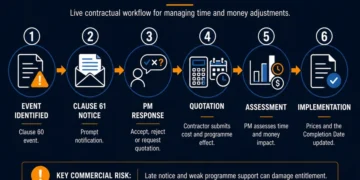
This matters because agreement on price does not automatically settle delay. If time may be affected, notice and records should continue in parallel with any notice of delay and broader programme analysis.
4. Verbal Instruction Later Formalised
Use this when the site team was told to proceed before the paperwork caught up.
Example wording:
“This Change Order records and formalises the verbal instruction issued on site on 10 May 2026 by the Engineer’s Representative regarding the revised drainage works in the loading yard. The Contractor commenced the instructed work to avoid further progress disruption. This document does not prejudice the Contractor’s rights arising from the timing, form, or late confirmation of that instruction.”
This wording helps establish that the work did not begin as a voluntary contractor act.
5. Contractor Variation Request Submitted for Approval
Use this where the contractor is seeking formal approval for work not yet agreed as a change.
Example wording:
“This document is submitted as a Contractor Variation Request for approval and does not constitute agreement that the varied work is authorised until confirmed in writing by the Employer or the Employer’s Representative. The Contractor’s pricing and time assessment are based on the assumptions and exclusions stated below.”
This distinction matters because a variation request is not the same thing as an agreed change order. It is a contractor-led request for approval and should be labelled accordingly.
Change Order vs Variation Order vs Variation Request vs Change Directive
These terms are often used loosely, and that creates avoidable drafting mistakes.
- A change order is best treated as the agreed written record of a change to scope, price, time, or a defined part of that position.
- A variation order is the broader international term commonly used in many forms of contract for instructed or agreed variations. See what is a variation order and how to write a variation order.
- A variation request is usually contractor-initiated. It asks for approval, valuation, or instruction before the change becomes an agreed variation. See variation request and contractor variation request process.
- A construction change directive is an instruction to proceed where price, time, or both are not yet agreed. See construction change directive.
The label matters because the wording should reflect the real commercial status. Calling a disputed instructed change a change order can make the record look more settled than it is. Calling a contractor-led request an approved variation creates the opposite problem..
Entitlement Risks in Poorly Drafted Change Orders
No written instruction trail
A verbal direction from the engineer, superintendent, or client representative may be operationally clear but commercially weak if no one ties it back to written authority. The longer that gap stays open, the easier it becomes to argue the work was already included, contractor-driven, or not authorised properly.
Unclear scope wording
If the scope says “additional drainage works as discussed,” the dispute is already built in. The document should define the work by reference to drawings, quantities, location, interfaces, exclusions, and assumptions.
Cost agreed but time position omitted
This is one of the most common failures in live administration. The contractor gets the money agreed to keep payment moving, signs the form, and later discovers the employer treats that as full settlement. If time remains open, the document should say so expressly.
No notice protection
A well-drafted change order does not repair a missed notice regime on its own. If the contract requires notice within a fixed period, that still needs to be protected separately. The risk increases where a strict time-bar applies.
Weak supporting records
A change order with no supporting records is difficult to defend when quantities, productivity loss, restricted access, or resequencing are disputed later. Daily reports, instruction logs, photographs, marked-up drawings, procurement records, and programme updates matter.
Signing away rights unintentionally
Watch carefully for wording such as:
- “full and final settlement”
- “no further entitlement”
- “all delay and disruption deemed included”
- “contractor accepts no extension of time arises”
- “this amount includes all direct and indirect consequences of the change”
If that language is accepted, it will usually be relied on later.
Missing valuation basis
An amount by itself is not enough. The document should make clear whether the valuation is lump sum, measured, provisional, daywork-based, or derived from contract rates. If the pricing depends on assumptions about access, quantities, working hours, or sequence, those assumptions should be stated.
Missing contractual references
The document should identify the relevant clause, instruction path, and authority. Otherwise, the other side may later argue that the change was processed outside the contract machinery.
Practical Failure Scenarios
Verbal site direction with no immediate record
The foreman is told to relocate installed conduits because another trade has taken the intended route. The team proceeds the same day to avoid slowing the area. Two weeks later, the consultant says the relocation was part of normal coordination and no variation is payable.
The commercial lesson is simple: issue a written record immediately, identify who instructed the change, tie it to the contract mechanism, and, if entitlement is not yet agreed, preserve that position in notices and follow-up correspondence.
Price agreed but programme effect left unstated
The parties agree USD 40,000 for changed facade support steel. Fabrication lead time pushes installation into a later access window and affects follow-on work. The signed change order says nothing about time. The contractor later seeks extension of time and prolongation costs, but the employer argues the change was already settled.
This is why the time position should always be stated expressly, even if the statement is only that it remains under review.
Small changes accumulate without administration discipline
No single change looks serious enough to escalate. A door shift here, extra fire stopping there, revised builder’s work openings elsewhere. By month-end, the contractor has absorbed substantial unpriced labour and lost clean cause-and-effect records.
This is where disciplined variation request management and notice tracking start protecting margin before the matter becomes a formal claim.
Key Points For Contractors
For contractors, commercial managers, and contract administrators, the priority is preserving entitlement without overstating it. A practical default is to make sure every change order, variation submission, or related notice records:
- who instructed the change
- what changed
- what is expressly excluded
- whether the valuation is agreed, proposed, provisional, or disputed
- whether time is agreed, not applicable, or reserved
- what records support the position
- what assumptions the pricing depends on
Do not let site urgency become a reason to sign broad settlement wording later. If the document is presented for signature with release language that goes beyond what has actually been assessed, mark the reservation clearly or refuse the wording and revise it.
Key Points For Owners and Clients
For owners, employers, and their representatives, a strong change order improves cost control and reduces downstream dispute risk. The document should define scope boundaries clearly, avoid double counting, identify valuation assumptions, and state whether time has been assessed, deferred, or excluded from agreement.
A vague form may feel flexible in the moment, but it usually stores up disagreement for later valuation, certification, extension-of-time review, or dispute discussions. Clear documentation protects owners as much as contractors because it narrows what was actually instructed and agreed.
Checklist Before Submitting or Signing a Construction Change Order
Use this checklist before issuing a construction change order or signing one received from the other side.
- Is the change order numbered and tied to the correct project and contract?
- Does it identify the triggering instruction, request, or directive?
- Is the document labelled correctly as a change order, variation order, variation request, or directive?
- Is the changed work described clearly enough for someone outside the site team to understand it?
- Are drawings, sketches, marked-up plans, specifications, or quantities referenced?
- Does it identify what is excluded?
- Does it state the contract clause or authority basis?
- Does it separate valuation from time?
- Does it state whether the valuation is agreed, provisional, or disputed?
- If time is unresolved, does it expressly reserve time rights?
- If entitlement is disputed, does the wording avoid accidental acceptance?
- Are notice requirements being protected separately where required?
- Are supporting records listed?
- Are pricing assumptions stated where access, quantities, or sequence affect valuation?
- Does the wording avoid unintended release language?
- Is the approval status clear: requested, instructed, proposed, agreed, or agreed subject to reservation?
That checklist is most useful when it is backed by live notice control and disciplined record capture, especially where instructed work starts before the commercial position is fully agreed.
FAQ
What is the best construction change order example for contractors?
The best example clearly records the changed work, contractual basis, valuation status, time position, and any reservations. For contractors, it should also show what remains unresolved so commercial rights are not signed away by accident.
What should a construction change order form include?
At minimum, it should include project details, change number, origin of change, clause reference, scope description, valuation position, time position, supporting documents, and approval status. If the effect on time is still being assessed, that should be stated expressly rather than left silent.
Is a variation order the same as a change order?
Usually they serve the same commercial purpose, but variation order is the broader term used in many international contracts. The drafting principle is the same: record scope, authority, valuation, time, and reservations clearly.
Can cost be agreed before time is agreed?
Yes, but the document should say that directly. If time is unresolved, the contractor should reserve rights expressly and continue proper delay and programme analysis in parallel.
What if the instruction was verbal?
Record it immediately in writing, identify who gave it, describe the work, and protect entitlement through follow-up records and notices. A later formal document is much stronger if it states clearly that it formalises an earlier verbal instruction.
Is a change order enough to protect entitlement?
Not always. If the contract contains notice deadlines, record requirements, or claims procedures, those still matter. A good form helps, but it does not replace disciplined commercial administration.
What is the most common drafting mistake in a change order?
One of the most common mistakes is agreeing cost while leaving the time position unstated. Another is signing wording that says the valuation is full and final when the programme and disruption effects have not yet been assessed.
Conclusion
A construction change order example becomes commercially useful only when it does more than show fields on a form. It needs to define the changed work properly, tie that work back to contract authority, separate valuation from time, and avoid settlement wording that gives away rights by accident.
On live projects, the biggest losses rarely come from dramatic disputes at the start. They come from ordinary changes recorded badly: verbal instructions never formalised, small changes not tracked, agreed prices signed without time reservation, valuation assumptions left unstated, and documents drafted loosely enough to invite argument later. That is why a strong change order format is not paperwork for its own sake. It is part of protecting entitlement before the issue hardens into a claim.

Sources
- Construction Front, Change Order in Construction: Meaning, Process, Pricing, Types, and Common Risks
- Construction Front, How to Write a Change Order in Construction
- Construction Front, What Is a Variation Order?
- Construction Front, How to Write a Variation Order
- Construction Front, Variation Request
- Construction Front, Contractor Variation Request Process
- Construction Front, Construction Change Directive
- Construction Front, Notice of Delay
- Construction Front, Time-Bar Clause
- Construction Front, Prolongation Costs
- Construction Front, Construction Claims and Contract Administration
Disclaimer: The articles on this website are for informational and educational purposes only and do not constitute legal or technical advice. While we strive to provide accurate and up-to-date information on construction law, regulations may vary by jurisdiction, and legal interpretations can change over time.