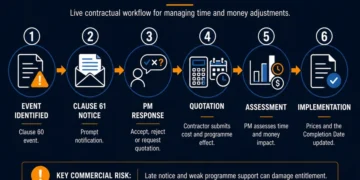

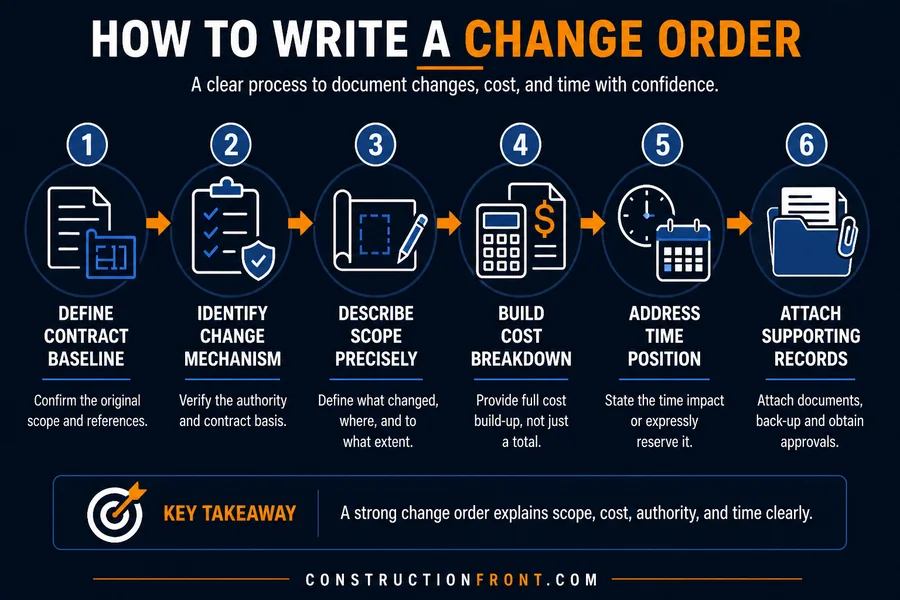

A change order usually gets drafted after the work has already moved beyond the assumptions priced at tender stage. The client changes finishes, the design team issues revised details, site conditions differ from the contract information, or access and sequencing force a different method of working. The drafting problem is not just recording that something changed. It is recording the change clearly enough that scope, cost, time, and entitlement remain defensible if the issue later turns into a valuation dispute or a claim.
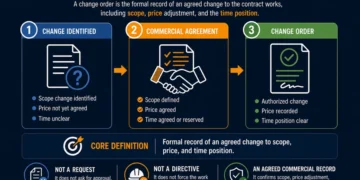
A change order is the formal written record of an agreed change to the contract works. In practice, it should define the changed scope, explain why it has arisen, state the agreed cost effect, address the time effect if that has been agreed, or expressly reserve it if it has not, and identify the contract basis for the adjustment. If your project uses broader variation terminology, the same drafting discipline still applies under a variation order or similar contract mechanism.
Poor drafting creates avoidable problems. A vague scope description leads to disagreement about what was actually changed. A lump-sum figure with no build-up creates valuation arguments later.
A change order that says nothing about time can cut across later reliance on notice of delay or prolongation costs. Good drafting does not solve every commercial problem, but it puts the record in a much stronger position.
This guide explains how to write a change order in construction, what to include, how to structure it, what mistakes to avoid, and what a usable template looks like in practice. It also sits alongside related ConstructionFront guidance on change orders, how to write a variation order, and wider construction claims and contract administration context.
What a Good Change Order Needs to Do
In most projects, a change order is typically issued by the owner, employer, or contract administrator to formalise an agreed change. Contractors more commonly initiate the process through a variation request, a quotation, or a structured contractor variation request process. This is important because the record should match the commercial reality rather than collapse request, instruction, and agreement into one document.
In practice, a good change order does four jobs at once:
- identify the change against the contract baseline
- define the commercial effect clearly enough to value it
- deal with time consequences honestly and expressly
- preserve a record that still makes sense later if the matter develops into a dispute
That is why a change order should not be treated as a quick admin form. On some projects, the practical difference between a recoverable change and an avoidable argument is the quality of the written record.
It is also why teams need to keep the terminology straight. A change order is an agreed change. A construction change directive is an instructed change issued before price or time is agreed. A variation request is usually a contractor-initiated request for approval or adjustment. A variation order is the broader international term that may cover agreed or instructed changes depending on the contract.
If the issue is still at proposal stage rather than formal adjustment stage, it is usually better documented first as a variation request or under a structured contractor variation request process.

What to Include in a Change Order
Before getting into drafting steps, it helps to be clear on what a construction change order should include. In most commercially sound records, the document should cover:
- project and contract details
- change order number and date
- the original contract baseline being changed
- a precise description of the revised work
- the reason for the change
- the contractual authority or change mechanism
- a cost build-up rather than only a total figure
- the time position, whether agreed or reserved
- the supporting documents and approval status
Those are the basics whether the project calls the document a change order or a variation order. If any of them are missing, the record becomes harder to value, review, and defend later.
Change Order Structure
Before drafting, it helps to separate the key sections that should appear in the document. The structure below keeps the record commercially usable rather than just formally complete.
| Section | What it should say | Why it matters | Common drafting weakness |
|---|---|---|---|
| Project and contract details | Project name, contract title, change order number, dates, parties, and reference documents. | Anchors the change to the correct contract and document trail. | Missing references, inconsistent numbering, or no link back to the underlying instruction or request. |
| Description of change | A precise statement of what work changes, where, to what extent, and from which baseline. | Prevents later argument over whether the priced work matched the actual change. | Using vague phrases like “additional works as required.” |
| Reason and authority | Triggering event, instruction source, drawing revision, and contract clause or mechanism relied on. | Supports entitlement and shows why the change sits outside the original scope. | No contract reference, or no explanation of why this is a genuine change rather than base contract work. |
| Cost and time | Breakdown of direct cost, indirect cost, and any time effect or reserved time position. | Keeps valuation and delay issues visible instead of burying them. | Single total figure with no build-up and no time statement. |
| Support and approval | Attachments, pricing backup, sketches, notices, and approval or signature fields. | Turns the change order into a usable contract record rather than a loose summary. | No attachment list, no approval trail, or unclear status between proposal and agreement. |
Step-by-Step: How to Write a Change Order in Construction
1. Start with the contract baseline
Before writing the change, establish what the original contract required. That means checking the relevant drawings, specification, scope narrative, bills or schedule items, qualifications, and correspondence trail. If the baseline is not clear, the change order will also be weak.
This matters especially where the issue began as a technical query. Many disputes start because a site team treats an issue as clarification while the contractor treats it as additional scope. If the issue evolved out of an Request from Information (RFI), it helps to understand when an RFI becomes a variation.
2. Identify the correct contract mechanism
The document should say why the adjustment is being made under the contract. Depending on the form used, that may be a change order, a variation order, a formal instruction, or a route that starts with a construction change directive if the work must proceed before commercial agreement is complete.
This is where many drafts go wrong. They describe the extra work but never state the contractual basis for recovery, or they label an instructed change as if it were already agreed. Even a short reference to the relevant clause, instruction, or contract mechanism improves the record significantly. Just as important, the label should match the commercial reality. If the parties have not agreed price, time, or both, the document should not be presented as a fully agreed change order.
3. Define the scope with precision
The best change orders describe the changed work in a way that another commercially aware reader can understand six months later without guessing. That usually means:
- location of the change
- original requirement
- revised requirement
- quantity or extent
- affected trade or package
- whether removal, rework, protection, testing, or resequencing is involved
Avoid catch-all wording. “Additional MEP modifications as required” is not a defensible description. “Revise chilled water branch routing at Level 6 east riser corridor to avoid newly issued structural opening reduction, including removal of installed supports, rerouting 18 linear metres of pipework, revised supports, insulation reinstatement, testing, and ceiling reinstatement interfaces” is much better.
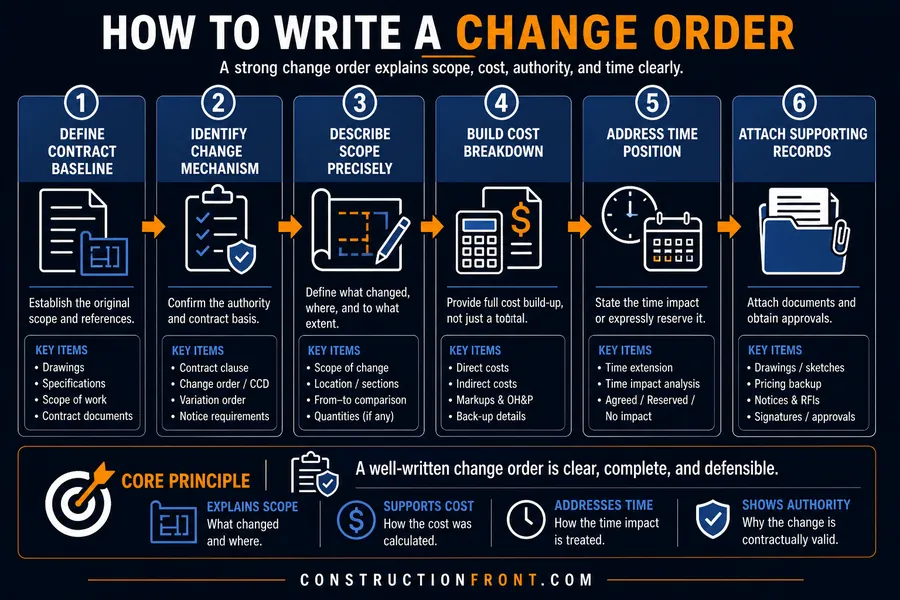
4. Explain why the change has arisen
A change order should not only say what changed. It should say why. The reason may be:
- client instruction
- revised design information
- authority requirement
- unforeseen condition (e.g. latent condition)
- coordination conflict
- access or sequencing issue
- quantity adjustment against a measured baseline
That explanation helps support entitlement and often becomes important if the file later connects with wider contract administration. It also helps separate owner-driven change from contractor-originated proposals and from issues that may actually sit within the contractor’s original scope.
5. Show the cost build-up properly
A change order should not hide valuation inside a single lump sum unless the contract and the commercial position genuinely justify it. In most live project situations, the better approach is to show:
- labour
- materials
- plant and equipment
- subcontractor cost
- waste, abortive work, or removal
- supervision or indirect cost where applicable
- time-related cost where justified and not yet dealt with separately
- mark-up if contractually allowed
If the job uses separate quotation and approval stages, the discipline used in the contractor variation request process is still useful when turning the agreed position into the final change order record.
A commercially credible build-up should also separate direct cost from indirect cost, and time-related cost from both. That distinction matters because the basis of recovery, level of proof, and review approach may differ for each.
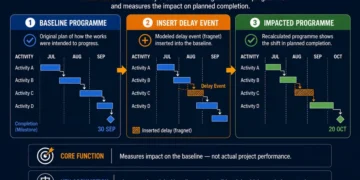
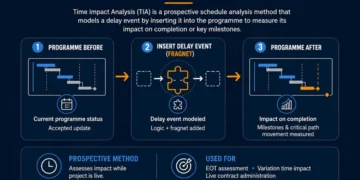
Where the change affects completion or critical path activities, the pricing should line up with a detailed time impact analysis or any other delay analysis method rather than burying programme consequence inside a general allowance.
6. State the time position expressly
If the change affects the programme, the change order should say so. If time is not yet agreed, the document should state whether:
- an extension of time is agreed
- the time effect is under review and expressly reserved
- the employer or contract administrator has not yet determined time
- the change is agreed on cost only, with no agreement yet on time
- the parties agree there is no accepted time effect
Silence on time is risky. If the change affects progress, procurement, access, sequence, or critical path activities, the record should tie back to notices of delay, if/where relevant.
It is also worth remembering that not every project change affects the critical path. Some changes may instead create disruption, loss of productivity, or inefficiency, and those issues can still become a subject of dispute between contractors and owners even where completion is not extended.
7. Attach the supporting record
A clean change order is not just a single page. It should point to the documents that support it, such as:
- revised drawings
- sketches
- marked-up plans
- take-offs
- quotations
- meeting minutes
- site instructions
- cost backup
- programme extracts
- notices
That support becomes even more important where delay cost or prolongation costs may be disputed later.
8. Make approval status clear
The drafting should show whether the document is:
- proposed
- agreed
- instructed pending valuation
- approved for cost only
- approved for cost and time
- under review
That distinction prevents a common site problem: teams assume a document is a fully agreed change order when it is really still only a request, a directive, or a provisional commercial record.
If the matter is not yet agreed, it is often cleaner to keep it within the contractor variation/change request process or instruction route until the commercial status is settled.
Change Order Template for Construction
Below is a usable change order template you can copy and adapt. It is written in a construction-friendly format rather than as a legal form.
CHANGE ORDER
Project: ___
Contract: ___
Employer / Client: ___
Contractor: ___
Change Order No.: ___ Date: ___
Related Instruction / RFI / Drawing Reference: ___
Contract Clause / Change Mechanism: ___
1. Description of Change
Describe the change clearly and specifically. State the original contract requirement, the revised requirement, the location, the quantity or extent, and any removal, rework, protection, testing, or resequencing involved.
2. Reason for Change
State why the change has arisen: Client instruction / Revised design issue / Authority requirement / Unforeseen site condition / Coordination conflict / Quantity adjustment.
3. Commercial Basis / Entitlement
State the contractual basis for the change. Identify the relevant clause, instruction, direction, or contract mechanism. If price or time is still unresolved, state that expressly.
4. Cost Adjustment
Direct Labour: $ / Materials: $ / Plant & Equipment: $ / Subcontractor Cost: $ / Removal & Abortive Work: $ / Indirect & Supervision: $ / Time-Related Cost: $ / Mark-up: $ / Total: $
5. Time Impact
No time impact / EOT of ___ days agreed / Time under review and expressly reserved / Cost agreed, time not yet agreed.
6. Supporting Documents
Drawings / Take-offs / Quotations / Programme extracts / Notices / Photos / Site records / Meeting minutes.
7. Status / Approval
Proposed / Agreed / Instructed Pending Valuation / Cost Agreed, Time Reserved / Fully Approved
Prepared by: ___ Reviewed by: ___ Date: ___
The full toolkit includes the complete editable template plus worked examples across multiple change order and variation scenarios — FIDIC, NEC4 and bespoke contracts.
This free change order template can be a useful starting point, especially for smaller projects or teams trying to bring more discipline into routine contract administration.
The limitation is that more complex scenarios usually need stronger drafting around authority, time, supporting records, and entitlement. If your contracts are administered under variation terminology, compare the wording against how to write a variation order before treating the template as final.
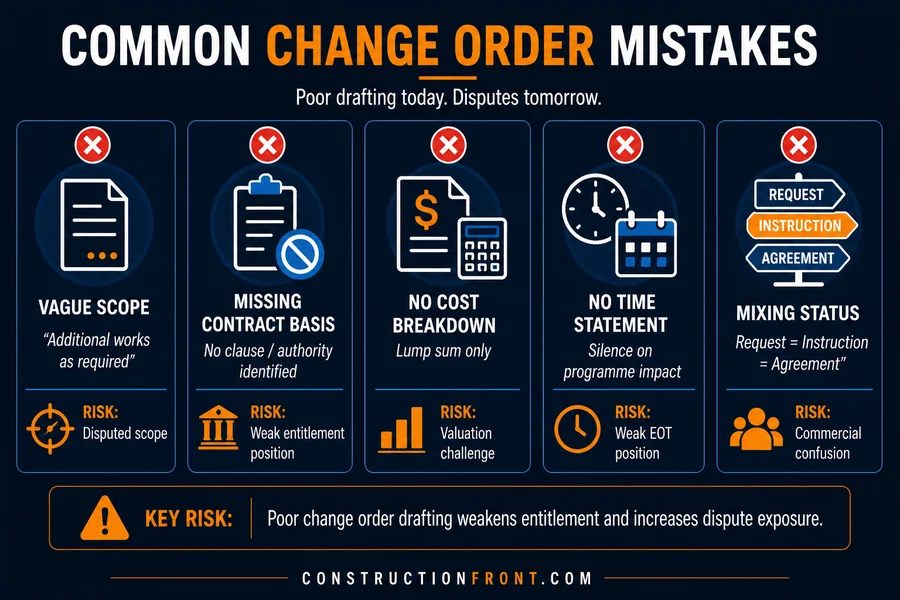
Common Mistakes When Writing a Change Order
Vague scope language
This is the most common problem. If the description says “carry out additional works as required,” the commercial record is already weak. The document should define scope, location, and extent.
Missing contractual basis
A change order without contractual footing is often just a description of extra work. It may still be useful operationally, but it is weaker commercially. If the issue is still only being proposed by the contractor, the better first step may be a variation request.
No cost breakdown
A single total figure invites challenge. Even when the parties expect to settle commercially, the file is stronger if the number can be traced and if direct, indirect, and time-related elements are not mixed together without explanation.
No time statement
If the change affects sequence, access, procurement, or completion, silence on time is a drafting error. Where timing is not yet fixed, reserve the position clearly and relate it to any schedule review or time impact analysis.
Weak supporting records
Good drafting cannot rescue poor records. If the backing documents are missing, later arguments over entitlement become much harder to resolve.
Mixing request, instruction, and agreement
A contractor request, an owner instruction, and an agreed change order are not the same thing. Mixing them in one document creates confusion. Teams should keep the status clear and, where relevant, follow a defined contractor variation request process.
How Proper Drafting Protects Entitlement
A properly drafted change order helps protect entitlement because it records the change while the facts are still clear. It shows what changed, why it changed, how it sits outside the baseline, how it is priced, and whether time is agreed, reserved, or still under review. That makes later recovery easier to explain and harder to dismiss as an afterthought.
It also reduces dispute risk. Many arguments in construction claims and contract administration are not really about whether work changed. They are about whether the record proves the scope, valuation basis, authority, and time consequence clearly enough.
Where delay exposure exists, disciplined drafting also helps preserve the bridge between the change itself, any notice of delay, and later assessment of prolongation costs. A bad change order can cut across that position. A good one supports it.
For Contractors
For contractors, the point is not usually to “draft your own change order” as if you are the issuing authority. More often, the contractor is receiving a client-issued change order, responding to a draft, or trying to move the issue from quotation or request stage into a properly agreed record.
That means contractors should review the document carefully before accepting it. In particular, they should check:
- whether the scope matches what was actually instructed or priced
- whether consequential work such as removal, protection, retesting, access changes, or resequencing has been captured
- whether the cost build-up reflects the real commercial effect
- whether time is agreed, reserved, or left unclear
- whether the wording cuts across any existing notice of delay or wider entitlement position
- whether the approval status accurately reflects what has and has not been agreed
If the issue is still developing and the contractor noted a change to its scope, it is usually cleaner to notify the owner as per the contract requirements and adhere to the contractor variation request process until the commercial position is mature enough to be formalised properly.
For Owners / Clients
For owners and clients, a good change order format helps control cost growth without creating unnecessary friction. Clear drafting makes it easier to see whether the proposed change is genuinely outside the original scope, whether the pricing logic is reasonable, and whether any time effect has actually been evidenced.
Owners should look carefully at:
- the change description
- the reason for change
- the contractual basis
- the pricing backup
- the time statement
- the approval status
If the owner needs the work to proceed before price or time is settled, the cleaner route may be an instructed mechanism such as a construction change directive rather than a document that incorrectly suggests everything is already agreed. That distinction is important both for immediate project control and contract administration.
Practical Checklist Before Issuing a Change Order
Use this checklist before sending or signing off a change order:
- Is the original contract baseline clear?
- Does the document describe exactly what changed?
- Does it explain why the change arose?
- Is the contract clause or mechanism identified?
- Does the label match the commercial status: request, instruction, or agreed change?
- Is the pricing broken down clearly?
- Are direct, indirect, and time-related costs separated where needed?
- Does the document deal with time impact expressly?
- Are notices, programme effects, or reserved time positions consistent with the drafting?
- Are supporting drawings, quotations, and records attached?
- Is the status clear: proposed, instructed, agreed, or partly reserved?
- Is the approval route clear and properly recorded?
Final Thoughts
Writing a change order well is not about making the document longer. It is about making it precise enough to survive commercial scrutiny later. Good drafting reduces ambiguity, protects entitlement, and gives both contractor and client a cleaner record of what changed and what the change means.
Change Order FAQ
How do you write a change order in construction?
You write a change order by identifying the original contract baseline, defining the revised scope clearly, stating the reason for change, linking it to the correct contract mechanism, showing a proper cost build-up, addressing time expressly, and attaching the supporting records.
What should be included in a change order?
A change order should include project and contract details, the change description, reason for change, contractual authority, cost adjustment, time position, supporting documents, and approval status.
Is a change order the same as a variation order?
In many practical cases, yes, they are being used to do the same job. The main difference is usually market and contract terminology. In US-style administration, “change order” is the more common term. In many international contracts, “variation order” or simply “variation” is more common. The exact legal effect still depends on the wording of the contract.
Can a change order reserve time for later?
Yes. If cost is agreed but the programme effect is still being reviewed, the change order should say that time is expressly reserved rather than staying silent or implying full agreement. [In some contracts, time impacts and cost impacts are dealt through different contract mechanims]
When should a change order not be used?
A change order should not be used as if it is a final agreed record when the issue is still only a contractor proposal or an owner instruction pending valuation. In those situations, a variation request or construction change directive may be the more accurate route first.

Sources
- Construction Front, Change Order
- Construction Front, What Is a Variation Order?
- Construction Front, How to Write a Variation Order
- Construction Front, Variation Request
- Construction Front, Contractor Variation Request Process
- Construction Front, When Does an RFI Become a Variation?
- Construction Front, Construction Change Directive
- Construction Front, Time Impact Analysis
- Construction Front, Prolongation Costs
- Construction Front, Notice of Delay
- Construction Front, Construction Claims and Contract Administration
Disclaimer: The articles on this website are for informational and educational purposes only and do not constitute legal or technical advice. While we strive to provide accurate and up-to-date information on construction law, regulations may vary by jurisdiction, and legal interpretations can change over time.