

On most projects, change does not begin as a formal dispute. It starts under delivery pressure: a drawing gap, a late instruction, an access restriction, an RFI response that changes quantities, or a client request that looks too minor to stop work. The commercial problem is that once the team proceeds before scope, price, and time position are properly captured, a manageable change can quickly become an entitlement argument.
Construction change management is the process of identifying, notifying, pricing, and closing out scope changes before they become disputed variations or claims. Most construction claims do not start as formal disputes. They start as informal instructions, unclear RFI responses, late notices, or weak records that were never properly controlled while the facts were still current.
This is important because projects rarely lose money on one obvious change alone. They lose margin through the accumulation of smaller events handled badly: verbal directions, unclear RFI responses, informal approvals, late notices, partial instructions, and site teams moving ahead of the paper trail. By final account stage, the contractor may have carried cost without approval, while the employer team disputes whether the work changed at all.
Good construction change management does not remove every disagreement, but it does reduce avoidable claims and strengthen the contractor’s position when a claim cannot be avoided. The practical objective is straightforward: preserve contractual position early, keep the job moving, and stop scope changes from turning into payment and time disputes months later.
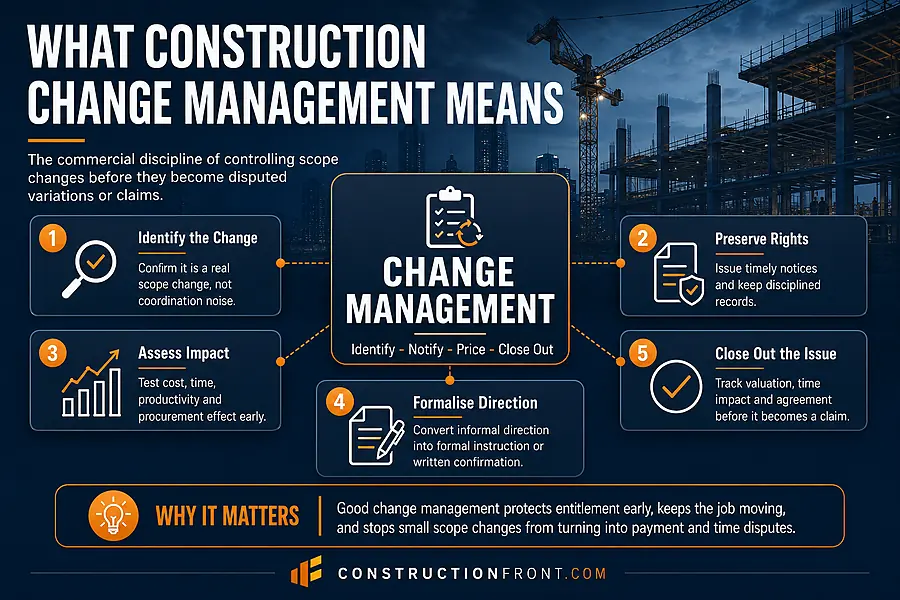
What Construction Change Management Means
In project terms, construction change management is not just an admin workflow. It is the commercial discipline of controlling what changed, who instructed it, what contractual mechanism applies, what it costs, whether it affects time, and what notices and records are required.
That can cover a wide range of events. Some changes are formal from the outset, such as a variation order or a change order construction instruction. Others begin less cleanly: an RFI response that alters design intent, a site direction from a superintendent, a revised detail issued after procurement, or a sequence change that forces labour and plant into a less efficient working pattern. ConstructionFront’s guide on when an RFI becomes a variation is useful because that boundary is where many teams lose control of entitlement.
A workable construction change management process usually has five commercial objectives:
- Identify whether the event is actually a scope change rather than coordination noise.
- Preserve contractual rights through timely notice and disciplined records.
- Assess cost, time, and productivity effects before positions harden.
- Convert informal direction into formal instruction or written confirmation.
- Close out the issue before it rolls into final account or a formal claim.
This is why change control needs to sit close to contract administration, RFIs, notices, programme review, and cost reporting. If those functions are disconnected, scope creep becomes almost inevitable. Work is done first, valuation is argued later, and the eventual claim is larger and harder to prove.
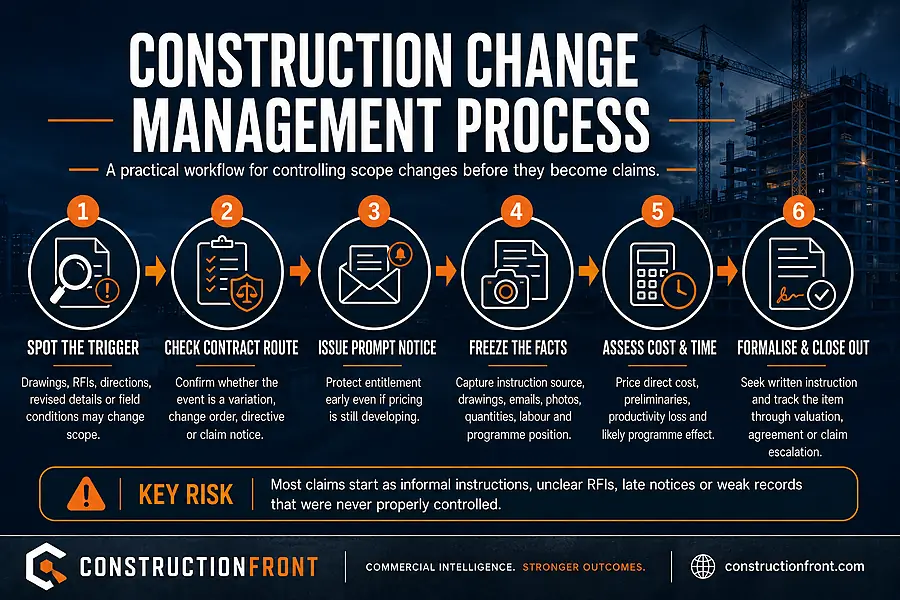
Construction Change Management Process
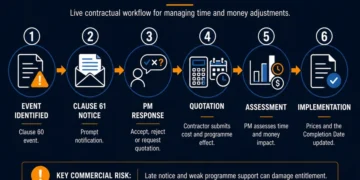
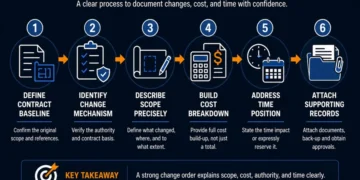
Construction change management is the process of controlling a scope change before it turns into a dispute. In practice, that means identifying the event early, checking the correct contract route, issuing notice on time, preserving records, assessing cost and time impact, formalising the instruction, and tracking the issue through to agreement or claim escalation.
Spot the trigger
Identify drawings, RFIs, site directions, revised details, client requests, or field conditions that may change scope, quantities, sequence, or productivity. Why it matters: It stops the team treating a commercial event as routine coordination.Check the contract route
Confirm whether the event should be handled as a variation, change order, construction change directive, RFI escalation, or claim notice. Why it matters: It aligns the response with the correct contractual mechanism and authority.Issue prompt notice
Send the required notice as soon as the issue is identified, even if pricing is still developing. Why it matters: It protects entitlement and reduces later time-bar arguments.Freeze the facts
Capture the instruction source, drawings, emails, photos, quantities, labour, plant, procurement status, and programme position before the record becomes unclear. Why it matters: It builds the evidence needed for valuation, causation, and authority.Assess cost and time
Price direct cost, preliminaries, productivity loss, procurement effect, and likely programme impact. Why it matters: It prevents underpricing and helps identify claim exposure early.Formalise the instruction
Seek written confirmation where the trigger came through a verbal instruction, field direction, or informal approval. Why it matters: It reduces disputes over authority, scope, and whether the work was actually instructed.
Worked Example: How a Manageable Change Becomes a Claim
A mechanical subcontractor is installing services in a commercial fit-out. During coordination, the consultant issues an RFI response revising the route of several ductwork runs to avoid clashes with structural steel and ceiling features. The revised route increases offsets, adds fittings, changes hanger locations, and slows installation in a congested zone.
At first, the site team treats it as a design clarification. Workfaces are live and the area is on the critical path, so the supervisor tells labour to proceed to avoid immediate slippage. The engineer keeps the issue in the RFI trail, but no variation notice is issued because the team expects the cost to be sorted out later. A few days later, a client-side representative verbally accepts that there will “probably be some extra cost,” but no formal instruction follows.
This is where construction change management either works or fails.
The Risk of Proceeding Without Formal Change Control
If the contractor controls the event properly, it should do four things immediately. First, identify that the RFI response has crossed into changed scope and reduced productivity, not simple clarification. Second, issue a variation notice or reservation of rights while the instruction is still live. Third, record revised quantities, labour hours, access restrictions, additional fittings, and any resequencing effect. Fourth, assess whether the impact is limited to measured work or also affects disruption, preliminaries, and completion risk.
If that does not happen, the downstream argument is predictable. At valuation stage, the employer team may say the revised route was part of normal design development and already included in the subcontract scope. They may argue the subcontractor should have allowed for coordination complexity. They may also reject disruption elements because there is no timely record showing reduced productivity or sequence impact. If the contract contains strict notice provisions, they may further argue that time or loss-and-expense entitlement was lost by late notice.
The contractor is then forced to rebuild the case retrospectively. It must show that the tender allowance was based on a different route, that the revised information changed quantities or method, that labour inefficiency was caused by the instruction rather than poor planning, and that the people who gave direction had authority or were later adopted by the employer team. That is a much weaker position than dealing with the event properly in real time.
A Stronger Commercial Response
A stronger commercial path would look different. The contractor would issue a written notice the same day or next day, reserving rights and identifying likely cost and time effect. It would log the revised layout, labour hours, additional materials, congestion, and access restrictions in daily records.
It would seek confirmation that the revised route constitutes a variation or other compensable change and, if the employer wanted immediate progress without prior agreement, push for a written instruction equivalent to a construction change directive. If the resequencing also affected completion risk, it would align that record with notice and programme analysis rather than waiting for claim stage.
The practical lesson is simple. The technical change is only half the issue. The other half is whether the contractor converts the event into a documented commercial position before memory, authority, and causation become disputed.
Why Poor Change Control Turns Scope Changes Into Claims and Disputes
Most construction claims process problems do not begin because the contractor missed a major variation. They begin because the team treated change as operational noise instead of a commercial event.
- The first failure point is undocumented change. A supervisor is told to proceed, a revised sketch is circulated informally, or a coordination issue is resolved in a site walk without a clear written instruction. The work is carried out, but the evidential trail is thin. Later, the employer may say the work was already included, was only a clarification, or was done at the contractor’s own initiative. At that point, the dispute is no longer about what happened on site. It is about what can be proved.
- The second failure point is informal approval. A common pattern is that the contractor submits a cost indication or variation request, receives verbal encouragement to proceed, and assumes formal agreement will follow. Often it does not. The employer team later challenges scope, rates, causation, or authority. That is why a disciplined contractor variation request process matters. It moves the job from assumption to documented position.
- The third failure point is misuse of RFIs. RFIs are meant to resolve information gaps, not absorb commercial consequences. On pressured projects, teams sometimes leave a change inside the RFI construction workflow even after the response has altered scope, sequence, specification, or quantities. If the response causes out-of-scope construction work, the issue needs to move out of the RFI stream and into change control. If that handoff does not happen, cost and time exposure can build without formal recognition.
- The fourth failure point is late notice. Many contracts require prompt notice of variation, delay, or claim events. If the contractor waits until monthly valuation, final account, or dispute stage, entitlement may already be weakened by a notice failure or time-bar argument. That is why teams need to understand both the mechanics of issuing formal notices when required, such as notices of delay, and the practical effect of time bars may have when these notices are not issued.
- The fifth failure point is treating cost and time separately. Many teams are alert to direct cost but slower to assess programme consequences. A scope change that affects access, resequencing, labour loading, or procurement may justify more than a measured variation value. It may also support delay and disruption elements, time entitlement, and potentially prolongation costs. If time impact is not captured early, the contractor loses the chance to build a credible cause-and-effect record, including appropriate programme analysis, and, where required, delays analysis.
In practice, claims escalate when several of these failures overlap. A verbal instruction is acted on quickly, the RFI trail is unclear, notice is late, cost records are incomplete, and programme effect is assessed only months later. By then, what should have been a controlled change is being advanced as a retrospective claim with avoidable weaknesses.

Variation Orders, Change Orders, and Claims
On active jobs, teams often use the terms variation order, change order, and claim loosely. That creates confusion at exactly the point where clarity matters.
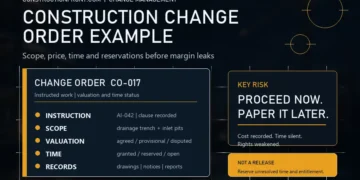
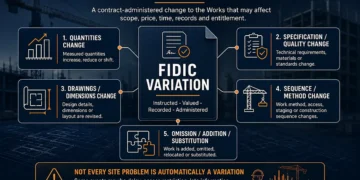
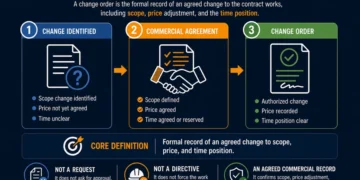
- A variation order usually refers to the formal instruction changing the contracted work. The exact wording depends on the contract, but the key point is that the scope has changed through an identified contractual route. If the team needs a clearer process for documenting and pricing that event, ConstructionFront’s guide on how to write a variation order is useful.
- A change order construction mechanism is similar in commercial effect, although the term is used differently across markets and contract forms. In both cases, the contract recognises that the work, price, time, or all three may need adjustment.
- A claim is different. A claim usually arises where entitlement, valuation, or time effect is disputed, unresolved, or never properly closed out through the change process. In that sense, weak construction change management is one of the main routes by which a variation becomes a claim.
That distinction matters commercially. If the contractor treats every issue as a claim from day one, the process becomes more adversarial than necessary. If it treats obvious scope changes as ordinary coordination, it gives away leverage. The stronger approach is to manage the event first as a change, with disciplined notices and records, while preserving the ability to escalate into a formal claim if agreement is not reached.
The highest-risk categories are usually the least formal ones:
- Verbal instruction construction events where work proceeds before written confirmation.
- Field instruction construction directions used to maintain progress but not tied to clear commercial authority.
- RFIs that alter scope without being recognised as change events.
- Late-issued design information that compresses sequence or creates out-of-scope work construction.
- Partial approvals that encourage work to proceed without resolving time or cost consequences.
These categories are risky because they create ambiguity. Ambiguity is what allows one side to say the work was included and the other to say it was changed. Good change control reduces that ambiguity by forcing the team to define the event early.
For commercial managers, the priority is not paperwork for its own sake. It is to create a clean chain from event to notice, from notice to instruction, and from instruction to valuation. When that chain breaks, the dispute often expands beyond direct work value into delay, disruption, and final account arguments. That is where broader contract administration discipline becomes critical.
Conclusion
Construction change management matters because the real commercial risk is not that change happens, but that it happens quickly, informally, and under delivery pressure. That is why small failures in notice, instruction, and recordkeeping often become larger claims later.
For contractors, the discipline is straightforward even when the project is not. Spot the change early, treat unclear instructions cautiously, move RFI-driven scope changes into the proper contractual route, and record both cost and time effects while the facts are still fresh. That will not remove every dispute, but it will put the team in a much stronger position than trying to reconstruct entitlement after the work is complete.
FAQ
What is construction change management?
Construction change management is the process for identifying, assessing, documenting, instructing, and closing out changes to the agreed construction scope. It covers cost, time, authority, records, and contractual notices, not just design updates.
When does a scope change become a claim?
A scope change usually becomes a claim when entitlement, valuation, or time impact is disputed or left unresolved. That often happens where there are weak records, unclear instructions, late notices, or disagreement over whether the work was actually out of scope.
Is an RFI the same as a variation notice?
No. An RFI asks for information or clarification. A variation notice preserves the contractor’s commercial position that a change has affected scope, cost, or time. If an RFI response changes the work, the issue may need to move into formal change control rather than stay in the RFI stream.
Why are verbal instructions risky in construction?
Verbal instructions are risky because they create uncertainty over authority, scope, and what was actually directed. If the contractor proceeds without written confirmation, it may later struggle to prove entitlement to payment or time.
What should a contractor record when a change happens?
At minimum, record the source of the instruction, date, affected drawings or specifications, labour and plant used, changed quantities, procurement effect, location, photographs, programme position, and all related correspondence. The objective is to preserve facts before they become disputed.
Can late notice defeat an otherwise valid variation or claim?
It can. Some contracts apply strict notice requirements and time bars. Even where entitlement is not fully lost, late notice can materially weaken leverage and make recovery slower and more contentious.

Sources
- Construction Front, What Is a Variation Order?
- Construction Front, How to Write a Variation Order
- Construction Front, Variation Request
- Construction Front, Contractor Variation Request Process
- Construction Front, When Does an RFI Become a Variation?
- Construction Front, Change Order in Construction
- Construction Front, Construction Change Directive
- Construction Front, Notice of Delay
- Construction Front, Time-Bar Clause
- Construction Front, Are Time Bars Enforceable in Construction Contracts?
- Construction Front, Time Impact Analysis
- Construction Front, Prolongation Costs
- Construction Front, Construction Claims and Contract Administration
- Construction Front, RFI Construction
Disclaimer: The articles on this blog are for informational and educational purposes only and do not constitute legal or technical advice. While we strive to provide accurate and up-to-date information on construction law, regulations may vary by jurisdiction, and legal interpretations can change over time.