

A construction change directive is one of the most commercially sensitive documents on a project. It directs the contractor to proceed with changed work before the parties have agreed the final adjustment to contract price, completion dates, or both. In U.S. contract administration, that makes the CCD a formal directed-change mechanism, not just a project memo.
If the directive is handled poorly, the contractor performs first and argues later. The usual result is disputed pricing, missed notice deadlines, incomplete force-account records, weak time-impact support, and avoidable arguments about scope, productivity, and whether the work changed at all. If it is handled properly, the construction change directive becomes a controlled mechanism for keeping the project moving while preserving the right to recover money and time.
In U.S. contracts, the most common reference point is AIA terminology. As AIA Contract Documents explains, a Construction Change Directive is used when changed work must proceed before agreement is reached on Contract Sum or Contract Time.
On many public projects, the same operating concept appears under labels such as work change directive or unilateral change directive. The USDA work change directive form shows the same U.S. contract-administration function in a government form. Internationally, the same commercial problem is often dealt with through variation or instruction mechanisms. For readers working across forms, ConstructionFront’s guide to what a variation order is is the closest equivalent concept.
What Is a Construction Change Directive (CCD)?
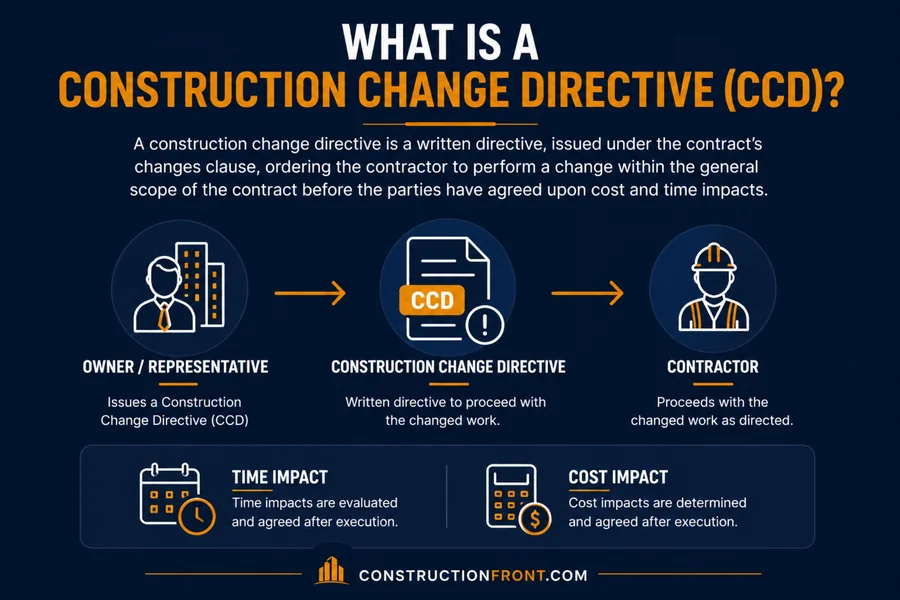
A construction change directive is a written directive, issued under the contract’s changes clause, ordering the contractor to perform a change within the general scope of the contract before the parties have agreed upon cost and time impacts.
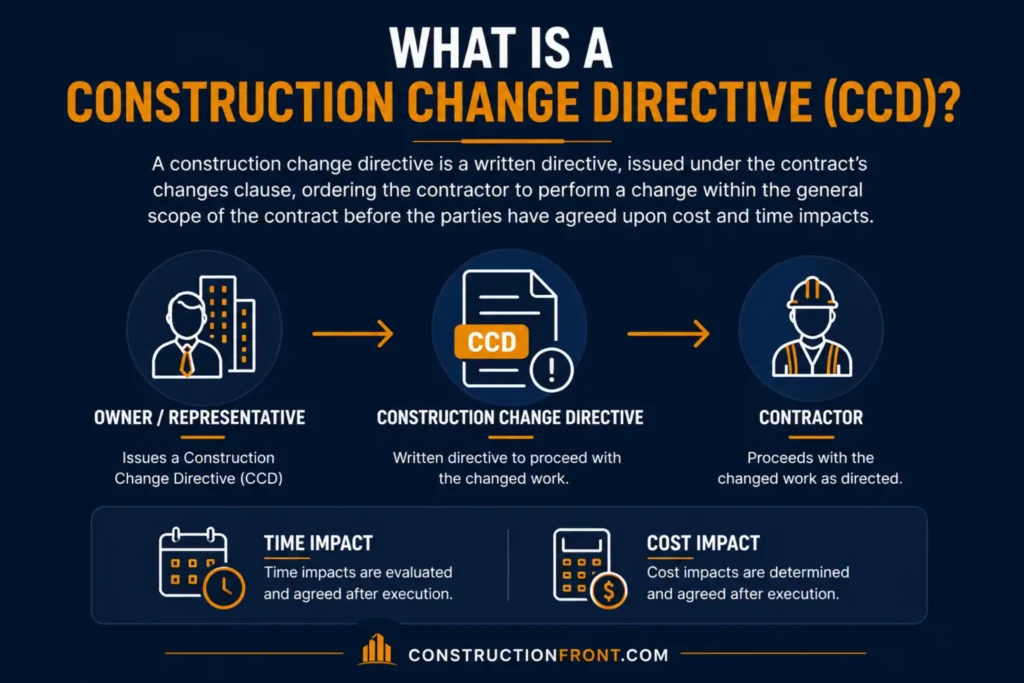
That definition matters. A construction change directive is not simply a record that the parties disagree. It is a formal contract-administration device that allows the owner side to direct performance first and resolve valuation afterward.
In the AIA model, the CCD is ordinarily prepared by the architect and signed by the owner and architect, then issued to the contractor. Under other U.S. forms, the issuing authority may be the owner, contracting officer, engineer, or construction administrator, but the commercial function is the same: proceed now, value later.
The Minnesota State CCD process guide shows that operating logic in practice: the CCD is issued, the contractor proceeds, and the final price is later reviewed and rolled into a Change Order. The USDA work change directive form is equally direct: the contractor is instructed to proceed promptly, while the method for determining the change in price may be unit prices, lump sum, or cost of the work.
Commercially, that means a construction change directive is a live risk event, not just an administrative instruction. It affects:
- scope definition
- pricing basis
- time entitlement
- notice compliance
- labor and equipment records
- disruption and productivity arguments
- later claim positioning
A construction change directive should not be confused with an informal site instruction, a casual email, or a field conversation. It also should not be confused with a constructive change. A CCD is an express written direction issued under the contract.
It arises when the contractor is effectively required to perform beyond the contract requirements because of conduct, interpretation, defective design information, interference, or informal direction without proper formal change documentation. If the work changed but the paperwork did not, the issue may shift into a variation request dispute or a constructive change argument instead of a clean directed-change process.
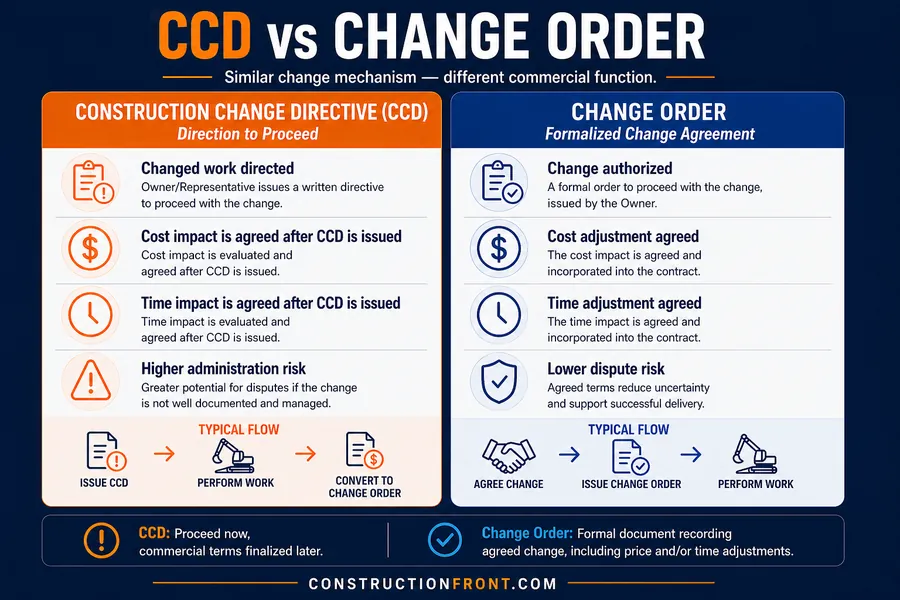
Construction Change Directive vs Change Order
The practical difference in a construction change directive vs change order analysis is straightforward:
- A Change Order records agreement.
- A Construction Change Directive records unilateral direction under the contract before agreement.
According to AIA Contract Documents, a Change Order is executed when the owner, contractor, and architect agree on the terms of the change, including the adjustment to Contract Sum and Contract Time.
A CCD is used when the change must proceed even though that agreement has not yet been reached. That distinction changes the contractor’s commercial posture and evidentiary burden.
With a Change Order:
- scope is usually defined more clearly
- valuation is agreed up front
- time consequences are usually agreed up front
- payment path is clearer
- dispute risk is lower
With a Construction Change Directive:
- the contractor may have to mobilize before the price is settled
- time impact may remain unresolved
- valuation may depend on contract rates, force-account records, or later cost proof rather than pre-agreed price
- the owner may accept the need for the work but dispute the amount due
- the project team may under-document acceleration, disruption, or resequencing effects
The Alberta change directive process flowchart captures this well. It treats the directive as an urgent-change mechanism used to avoid delay, with the final quotation and later authorization or change order following afterward.
The distinction from a constructive change is different again:
- A CCD is formal written direction under the changes clause.
- A Constructive Change is a claim theory used when the contractor performed changed work without a properly issued formal change document.
In short, a Change Order closes commercial issues before execution. A construction change directive keeps the job moving while leaving those commercial issues open. A constructive change dispute usually exists because the project did not use the formal directed-change process properly.
Contractor Rights Under a Construction Change Directive
Contractor rights under a construction change directive are not unlimited, but they are commercially significant if preserved properly.
- First, the contractor generally has the right to rely on the fact that the owner-directed work is being treated as changed work rather than uncompensated original scope, provided the directive is validly issued and the work remains within the contract’s scope-of-change authority. The BC Construction Association puts the point plainly: a change directive is the owner’s acknowledgement that the work is a change to the contract, even though it requires performance before price is finalized.
- Second, the contractor typically has the right to pursue adjustment for:
- direct cost of the changed work
- time consequences caused by the change (i.e. extension of time for completion)
- field overhead and supervision impacts where the contract permits
- downstream prolongation and extended performance costs where supported
- unresolved valuation through the contract’s claims procedure if agreement is not reached
Under the AIA framework described above, the contractor may request payment for CCD work while the total cost determination remains pending, with the architect making an interim determination of the amount reasonably justified. That does not eliminate disputes, but it matters for cash flow and record-based recovery.
- Third, the contractor retains the right to preserve time entitlement. A construction change directive is not only a pricing issue. If the directed change affects sequence, access, procurement, manpower loading, inspections, turnover logic, or completion, the contractor should preserve its position on schedule impact with the same discipline used for cost. ConstructionFront’s articles on what an extension of time claim is, notice of delay, and delay analysis methods are directly relevant here.
- Fourth, the contractor has the right to have valuation determined using the contract mechanism, not by hindsight impression. Common pricing methods include unit prices, lump sum, and cost of the work. The method matters. Recovery often rises or falls on whether the contract requires pre-agreed rates, fixed markups, daily signed force-account tickets, tracked actual cost, or some hybrid approach.
- Fifth, if the parties cannot resolve the adjustment through ordinary change administration, the contractor usually retains the right to escalate through the contract’s claims procedure. That right, however, is often conditioned on strict compliance with conditions precedent, such as notice requirements, recordkeeping rules, and time bars.
What the contractor does not have is any safe assumption that entitlement will take care of itself. A construction change directive is strong evidence of directed changed work. It does not, by itself, prove the amount due, the time owed, the reasonableness of the costs, or compliance with contractual notice conditions.
How to Protect CCD Entitlement Under a Construction Change Directive
The fastest way to lose CCD entitlement is to treat the directive as a field instruction instead of a claims-sensitive contract event. Protecting entitlement under a construction change directive requires discipline in five areas.
1. Confirm the instruction and scope
As soon as the CCD is issued, confirm:
- what changed
- where it applies
- what drawings, sketches, specifications, or marked-up details support it
- whether the work is temporary, permanent, or investigative
- whether there are exclusions or assumptions
- whether the directive identifies the pricing method or valuation basis
- whether the directive reserves contract time for later determination or is silent on schedule effect
The USDA work change directive form specifically provides for attachments supporting the change. That is a useful reminder that scope should never sit in one short sentence if the work is commercially significant. If scope boundaries remain vague, the later dispute shifts from pricing to whether particular labor, equipment, delay, or rework belonged to the CCD at all.
2. Issue contract-compliant notice
A construction change directive does not remove the need for notice. If the contract requires notice for cost, time, delay, disruption, inefficiency, or claims escalation, give it in the required form and within the required deadline.
This is where many contractors weaken recovery. They assume the directive itself is enough. It is not. Many U.S. contracts impose short notice windows and treat late notice as an entitlement risk or express time bar. If the change affects completion, resequencing, access, manpower efficiency, procurement, or critical path activities, a separate entitlement-preservation notice is usually needed. ConstructionFront’s guide to notice of delay is directly relevant.
At minimum, the notice should identify:
- the CCD reference
- the changed work being directed
- the contractor’s reservation of rights on cost and time
- the likely impact areas, even if quantification is preliminary
- the contract clauses being invoked
- the need for continuing records and later quantified adjustment
If the contract requires follow-up particulars within a second deadline, calendar that deadline immediately. Many otherwise valid construction change directive recoveries are weakened by missed follow-up notice dates rather than by the merits of the change itself.
3. Build a dedicated cost code and record set
Do not bury CCD work in ordinary production records. Open a separate code or ledger for:
- labor hours
- equipment hours
- material quantities
- subcontract costs
- supervision time
- temporary works
- rework
- standby
- resequencing impacts
The Minnesota State CCD process guide reflects a structured workflow in which the contractor proceeds and later finalizes price. That only works if the records exist.
For U.S. projects, this usually means daily force-account discipline where the contract calls for it. If the pricing mechanism depends on actual cost, daily signed or at least promptly submitted labor, equipment, and material records become central evidence. If the contract instead relies on unit prices or agreed markups, the records still matter because they establish installed quantities, changed means and methods, out-of-sequence work, and reasonableness of time requested.
4. Preserve time impact in parallel with cost
A construction change directive frequently causes more than extra scope. It can change the order of work, consume program float, disrupt crews, delay procurement, increase inspections, and push completion risk into later milestones. If you wait until the end of the job to describe the effect, the evidentiary position is usually weaker.
That is why schedule analysis should start early. ConstructionFront’s resources on concurrent delay, delay analysis methods, and prolongation costs matter most when the change is still live, not after memories fade. In practice, preserving time entitlement means identifying:
- the activities directly affected
- whether the change consumes float or affects the critical path
- whether the contractor had mitigation options and at what cost
- whether resequencing created inefficiency or acceleration pressure
- whether other project delays are running in parallel
A construction change directive may support time entitlement, but only if the contractor can connect the directed change to actual schedule consequence under the contract standard.
5. Convert the construction change directive into a priced Change Order as soon as possible
The CCD is not the commercial finish line. It is a temporary operating mechanism. The Alberta process flowchart and the AIA explanation point in the same direction: move from directive to finalized valuation, then into formal change documentation.
The longer a construction change directive remains unresolved, the greater the risk of:
- pricing drift
- scope disagreement
- missing backup
- untracked compounded impacts
- end-of-project leverage disputes
- payment delay
If agreement still does not happen, the contractor should not let the matter sit indefinitely. It should move the issue into the contract’s claim-escalation process before any claim deadline, final payment waiver, or closeout release prejudices recovery.
Construction Change Directive Process: Typical CCD Workflow
A typical construction change directive process follows a predictable pattern even though contract forms differ.
- A change is identified that cannot wait for full commercial agreement.
- The owner, architect, engineer, or other authorized contract administrator determines the work must proceed to avoid delay or operational disruption.
- The directive is drafted with supporting documents describing the changed work and citing the contract authority for the directive.
- The directive states the provisional pricing basis or the method that will be used to value the work.
- The contractor is instructed to proceed.
- The contractor issues any required reservation-of-rights, cost, time, delay, or claims notices within contract deadlines.
- The contractor performs the work while maintaining dedicated cost and time records.
- Interim payment may be assessed or certified depending on the contract mechanism.
- The contractor submits final pricing and, where relevant, time-impact support.
- The parties negotiate the final adjustment.
- The unresolved directive is converted into a Change Order or, if necessary, escalates into a claim.
This is consistent with the Minnesota State CCD workflow, which shows the contractor proceeding first and final price being reviewed afterward, and with the USDA work change directive, which identifies the pricing method at directive stage and contemplates later Change Order treatment.
The commercial lesson is simple: speed at the front end has to be matched by structure at the back end.
Common Construction Change Directive Mistakes That Damage Recovery
The most expensive construction change directive failures are usually ordinary contract-administration failures.
Treating the CCD as enough notice
It rarely is. If the contract requires notice of delay, disruption, cost increase, differing site effect (e.g. latent condition), or claim, the contractor should issue it separately and on time. On many projects, late notice is not just a procedural defect. It is an express entitlement risk.
Starting work without clarifying scope boundaries
If the changed work is described loosely, valuation disputes multiply later. The argument shifts from price to whether the work was even directed and whether resulting impacts were within the CCD’s scope.
Failing to record labor, equipment, and supervision daily
The BC Construction Association notes that change directives require the contractor to keep expenditure records to support the later price adjustment. If those records are thin, recovery weakens quickly. That is especially true where the contract uses force-account or cost-of-the-work valuation.
Ignoring time impact until project closeout
A construction change directive can trigger critical path effects, resequencing, procurement delay, or inefficiency that are much harder to prove months later. This is where delays, disruptions, and liquidated damages become commercially connected.
Letting the owner use the CCD as a long-term substitute for a Change Order
A directive is not supposed to become a holding pattern for indefinite commercial disagreement. The longer it remains unresolved, the more bargaining power usually shifts away from the performing contractor, and the closer the issue gets to waiver, release, or claim-deadline problems.
Confusing a formal CCD with a constructive change
A CCD is an express written direction. A constructive change arises where conduct, instructions, interference, or defective information changes the contractor’s obligations without formal written change documentation. If the project team skips formal paperwork, what should have been a clean CCD may turn into a harder-to-prove constructive change dispute.
For Owners / Clients
Owners use a construction change directive for a valid reason: the project cannot stop every time valuation is disputed. But speed should not come at the expense of commercial control. Owners should use a construction change directive only when:
- the change is genuinely urgent
- the work is within contract scope authority to direct
- the commercial basis for later valuation is identified
- the project team can administer records properly
- the directive is likely to be converted to a priced Change Order promptly
The Alberta flowchart frames the process around urgency and authorization. That is the right discipline. Use the directive to avoid delay, not to postpone decision-making indefinitely.
Owners should also understand the time consequences. If a CCD changes sequence, access, procurement, inspection logic, or completion logic, it may generate legitimate time entitlement and related exposure to liquidated damages. Refusing to engage with that reality early usually increases final account friction, not leverage.
A sound owner approach is simple:
- define the changed work clearly
- identify the pricing method
- require disciplined records
- assess schedule impact early
- close the directive into a Change Order quickly
Owners also need to administer notice provisions consistently. If the contract requires contemporaneous records, force-account tags, or formal follow-up submissions, the project team should require them while the work is live, not after the record is already incomplete.
For Contractors
For contractors, a construction change directive is where disciplined contract administration separates recoverable change from absorbed cost – the commercial trap is obvious.
You are being told to proceed before price and time are settled. If you perform without structuring the entitlement file, you may finish the work and still spend months arguing over what should have been straightforward recovery.
Contractors should respond to every construction change directive by asking five immediate questions:
- What exactly has changed?
- What notice does the contract require, and by when?
- What pricing method applies?
- What is the likely time impact?
- What records must be kept daily from today?
This is where claims and contract administration becomes practical rather than theoretical. The contractor should treat the CCD as the start of a controlled entitlement pathway, not just an instruction to mobilize.
That also means watching the boundary between directed change and constructive change. If the project team begins issuing informal revisions around the CCD without matching paperwork, the dispute can widen from one priced instruction into a broader scope-and-entitlement fight.
Contractors should also be realistic about rights language. A construction change directive usually strengthens the contractor’s position that the work was directed as a change, but recovery still depends on contract compliance, proof of causation, proof of amount, and timely escalation if agreement is not reached. Strong entitlement files are built contemporaneously, not reconstructed at closeout.
Construction Change Directive Example and Documentation Checklist
Mini construction change directive example
A contractor is installing underground utilities on a public infrastructure project. During excavation, the owner directs a redesign of a utility corridor to avoid a conflict with an unforeseen field condition.
The revised alignment requires additional trenching, new fittings, extra survey setout, traffic-control revisions, and resequencing of paving works. The owner issues a construction change directive so the utility work can proceed immediately.
At that point, the contractor should not just perform the work. The contractor should:
- acknowledge receipt of the CCD
- issue formal notice reserving rights to cost and time within the contract deadline
- request the exact revised sketch set and specification references
- confirm the pricing basis, including whether force-account records are required
- open a dedicated cost code for the CCD work
- record labor, equipment, material, supervision, and subcontract cost daily
- obtain daily signed records where the contract requires them
- track out-of-sequence work and any effect on paving and completion logic
- submit interim pricing if the contract permits
- prepare a later Change Order submission with backup for direct cost, time effect, and any prolongation or disruption component
- escalate to a formal claim before any time bar, release, or closeout deadline if the adjustment remains unresolved
If the contractor skips the notice, blends the hours into normal production, and waits until project closeout to quantify the delay effect, the entitlement case is materially weaker even though the owner clearly directed the change.
CCD documentation checklist
Use this checklist on every live directive:
- Copy of the executed CCD with date and reference number
- Drawings, sketches, marked-up details, and specification references
- Written scope clarification and assumptions log
- Contract notice issued within the required period
- Calendar of follow-up notice, pricing submission, and claim deadlines
- Pricing method identified: lump sum, unit price, cost of the work, or other contract basis
- Dedicated cost code opened
- Daily labor records by worker, trade, and activity
- Daily equipment logs by item, hours, and use
- Material delivery tickets and invoices
- Signed force-account tags or daily tickets where required
- Subcontractor daily records and notices
- Site photos tied to dates and locations
- Daily report narrative describing changed activities and effects on planned work
- Schedule fragnet or time-impact note identifying affected activities
- Record of standby, resequencing, lost access, or disrupted productivity
- Interim payment submission, if allowed
- Final Change Order or claim package cross-referencing all backup
CCD – Commercial and Contractual Implications
The commercial importance of a construction change directive is bigger than the form itself.
A construction change directive affects risk allocation in real time. It pushes performance ahead of agreement. That can create pressure on cash flow, valuation, and schedule certainty. It also creates evidentiary asymmetry: the party performing the work must prove the consequence later.
That is why the difference between a clean directed change and a messy unresolved instruction matters so much. If the directive is well administered:
- the project continues without stoppage
- the change is documented as owner-directed
- cost and time are captured in an organized way
- the later Change Order has a factual basis
- claim risk is reduced
If it is badly administered:
- original scope and changed scope become blurred
- pricing turns into a leverage exercise
- time entitlement is left unsupported
- notice defenses become available
- liquidated damages exposure grows
- the contractor’s case shifts from documented change to disputed claim
In international terms, practitioners may see similar disputes arise under variation or instruction procedures. The language changes, but the commercial problem does not. Whether you call it a CCD, variation order, or work change directive, the entitlement issue is the same: proceed now, prove later. That is why disciplined records, notices, valuation logic, and deadline control matter more than labels.
FAQ
What is a construction change directive?
A construction change directive is a written instruction issued under the contract’s changes procedure directing changed work to proceed before the parties have agreed on the final adjustment to contract price and/or completion dates.
What is the difference between a construction change directive and a change order?
A Change Order reflects agreement on the change, including price and time. A construction change directive directs the change before that agreement exists.
Does a contractor have to perform work under a construction change directive?
Under contracts that authorize a CCD or equivalent unilateral directed-change mechanism, the contractor is generally required to proceed with the directed changed work while preserving its rights on price and time through the contract process. The exact duty depends on the contract language and the validity of the directive.
Can a contractor get paid before construction change directive pricing is finalized?
Potentially yes. AIA Contract Documents notes that under AIA A201 the contractor may request payment for CCD work while the total cost determination is still pending, with interim certification of the amount reasonably justified.
Can a construction change directive include time entitlement?
Yes. A construction change directive is not only a cost issue. If the directed change affects completion, sequence, procurement, or critical path activities, the contractor should preserve entitlement to time as well as money, subject to the contract’s notice and proof requirements.
What is CCD entitlement?
CCD entitlement is the contractor’s right to recover the justified cost and time consequences of owner-directed changed work carried out before final agreement is reached, assuming the contractor complies with the contract’s notice, recordkeeping, and claims procedures.
What is a construction change directive example?
A common construction change directive example is an owner-directed redesign issued during construction so the contractor must proceed immediately, while the final price and time adjustment are negotiated afterward.
Constructive change vs construction change directive: what is the difference?
A Construction Change Directive (CCD) is an express written directive issued under the contract requiring changed work to proceed, often before the parties agree on price or time adjustments.
A constructive change arises when, without formal written change documentation, the owner’s conduct, interference, interpretations, or informal directions effectively require the contractor to perform work beyond the contract requirements, potentially giving rise to an entitlement for additional cost or time
Sources
- Alberta Government, Change Directive Process Flowchart
- AIA Contract Documents, Changes to the Contract: Differences Between Change Orders and Construction Change Directives
- BC Construction Association, Construction File: A Guide to Standards & Practices in the Construction Industry
- Minnesota State, Construction Change Directive (CCD)
- USDA Rural Development, Work Change Directive
- Construction Front, What Is a Variation Order?
- Construction Front, Variation Request
- Construction Front, What Is an Extension of Time Claim?
- Construction Front, Liquidated Damages in Construction Contracts
- Construction Front, Delays, Disruptions, and Liquidated Damages
- Construction Front, Delay Analysis Methods
- Construction Front, Prolongation Costs
- Construction Front, Notice of Delay
- Construction Front, Construction Claims and Contract Administration
- Construction Front, Concurrent Delay
Disclaimer: The articles on this blog are for informational and educational purposes only and do not constitute legal or technical advice. While we strive to provide accurate and up-to-date information on construction law, regulations may vary by jurisdiction, and legal interpretations can change over time.