

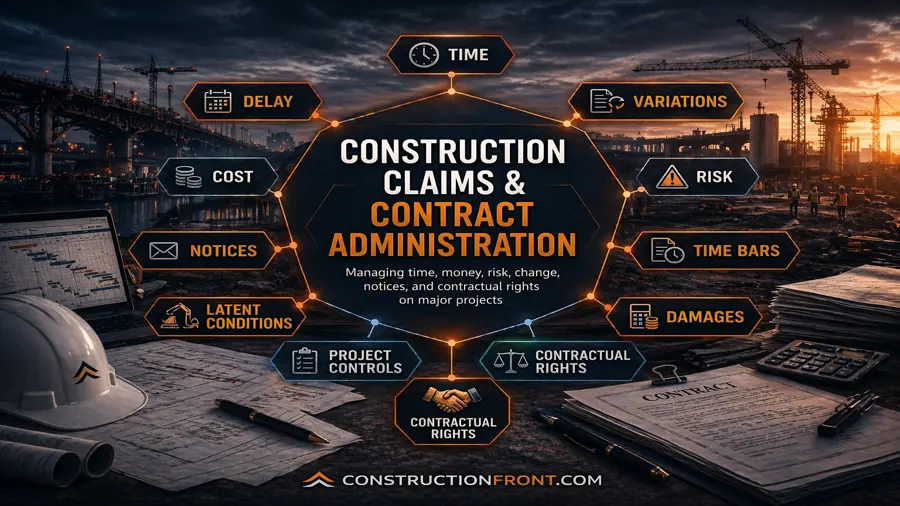
Construction claims and contract administration are the systems project teams use to manage time, money, risk, change, notices, and contractual rights during a construction project. In practical terms, they matter because many disputes over delay, variations, latent conditions, liquidated damages, and prolongation costs do not begin as legal problems. They begin as project delivery problems that were not administered properly while the works were live.
On major infrastructure, energy, and industrial projects, that makes construction claims and contract administration central to delivery rather than peripheral to it. If notices are missed, scope changes are poorly controlled, records are weak, or delay events are not properly tracked, otherwise manageable issues can quickly become expensive claims and disputes. The better the contract administration, the stronger the project’s ability to manage entitlement, allocate responsibility properly, and keep commercial risk under control.
This guide explains what construction claims and contract administration are, why they matter, and how the main issue areas fit together in practice. It is designed as the central hub for Construction Front’s wider claims and contract administration content, connecting the deeper guides on extension of time claims, variation orders, time bar clauses, latent conditions, liquidated damages, and related subtopics.
What Are Construction Claims and Contract Administration?
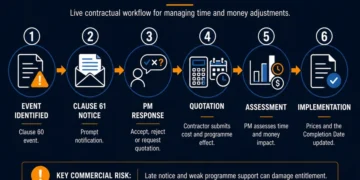
Contract administration is the broader discipline of operating the contract properly while the project is being delivered. It includes issuing notices, responding to instructions, tracking changes, managing payment procedures, maintaining records, monitoring programme obligations, and making sure that the contract’s risk allocation is actually reflected in day-to-day project management. In that sense, contract administration is the operating framework within which claims either become manageable or become disputes.
Construction claims are formal assertions made under the contract when one party says it is entitled to additional time, additional money, relief from liability, or some other contractual remedy. In practice, those claims usually arise because the project has moved away from the assumptions behind the original contract price, scope, sequence, or completion date. A contractor may claim for delay, change, latent conditions, prolongation, or disruption. An owner may claim for defects, late completion, or damages.

How Construction Claims and Contract Administration Connect
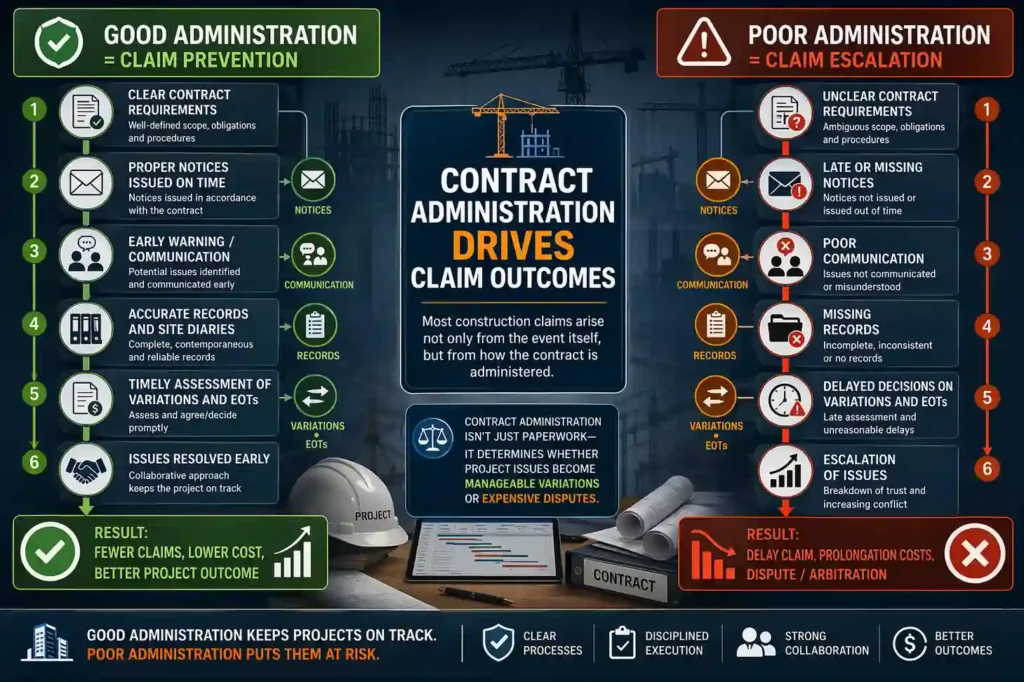
These two topics are inseparable because most claims depend on administration long before they become formal claim submissions. A contractor may have a strong basis for an extension of time claim, but if it misses the notice requirement, fails to keep programme records, or cannot explain critical path impact, the claim becomes much weaker.
The same applies on the owner’s side. An employer may believe it has a clear right to liquidated damages, but if it has not controlled changes properly or has contributed to delay, its position may be exposed.
In other words, claims are rarely just about the event itself. They are about the event plus the administration around it. That is why strong contract administration is not separate from claims management in construction. It is what gives claims their structure, evidence base, and procedural footing.
Common Types of Construction Claims
At a high level, the most common construction claim categories include:
| Category | Typical issues |
|---|---|
| Time-related claims | Extension of time claims, notice of delay, concurrent delay, delay analysis |
| Change-related claims | Variation orders, variation requests, RFIs becoming variations |
| Condition-related claims | Latent conditions, unforeseen utilities, subsurface surprises |
| Cost consequence claims | Prolongation costs, demurrage claims, Eichleay formula |
| Rights-preservation issues | Time bar clauses, early warning notices, estoppel |
| Damages issues | Liquidated damages, disruption, employer and contractor financial exposure |
A quick summary table helps show how these issues usually map onto the main contractual tools used to manage them:
| Claim Type | Typical Cause | Main Contract Tool |
|---|---|---|
| Delay Claim | Late drawings, access issues, late approvals | EOT claim / Notice of Delay |
| Variation Claim | Scope change, revised details, instructed change | Variation Order / Variation Request |
| Latent Condition Claim | Unexpected ground conditions, buried services | Latent condition notice |
| Cost Claim | Prolongation, disruption, extended preliminaries | Prolongation costs / claim notice |
| Damages Issue | Late completion, contractual breach | Liquidated damages clause / damages provisions |
Why Contract Administration Matters in Construction Projects
Contract administration matters because most claims do not start with a final account argument or a formal dispute notice. They start earlier, when a project event occurs and the team either handles it properly or lets it drift. On major infrastructure and energy projects, where values are high, interfaces are dense, and programmes are long, weak administration can create serious commercial consequences very quickly.
A late drawing issue may affect procurement, sequence, and labour productivity. A scope change may be implemented informally without proper valuation. A delay event may be discussed in meetings, but not notified under the contract. A latent condition may be identified on site, but not properly recorded or linked to the contractual mechanism for relief.
Each of those situations can begin as a manageable live-project issue. What turns them into disputes is often not the event alone, but the failure to administer the contract around the event.
A simple example makes the point:
- Imagine a contractor encounters an unforeseen buried service that delays excavation. The site team records the issue in daily reports and recognises that it may amount to a latent condition claim, but no formal notice is issued under the contract.
- Two months later, the contractor submits a claim for additional time and cost, relying on the factual records and arguing for an extension of time claim and associated prolongation costs.
- The underlying event may be genuine, but the position is now weaker because the contract required notice within a short period and the owner can argue that the time bar requirements have not been met.
- That is a practical example of how a live project issue becomes a claims problem through weak contract administration rather than through the event alone.
Why poor administration leads to claims and disputes
Poor contract administration usually leads to claims because it breaks the connection between what happened on site and what the contract requires. If notices are missing, records are incomplete, changes are not formalised, or programme evidence is unreliable, the parties stop arguing only about the event and start arguing about process, entitlement, and credibility as well.
That is especially important on major projects because contractual rights and obligations are often closely tied to formal procedure. If the procedure is not followed, even strong factual events can become hard to recover under.
Common Contract Administration Failures
The most common practical failures include:
- failure to issue notices on time
- unclear treatment of changes in scope
- inadequate records of progress, access, or disruption
- poor coordination between engineering, site, planning, and commercial teams
- reliance on informal instructions
- weak programme updating and logic maintenance
- misunderstanding of time bars and condition precedents
These are not minor issues. They are often the actual roots of claims escalation.
Extension of Time and Delay Claims
Time sits at the centre of every major construction project. Completion dates, sectional milestones, commissioning windows, access arrangements, handover obligations, and liquidated damages all depend on the programme. That is why delay and extension of time issues are among the most important parts of both construction claims and contract administration.
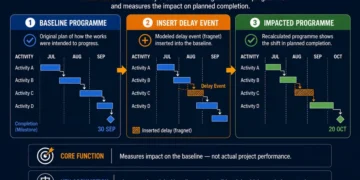
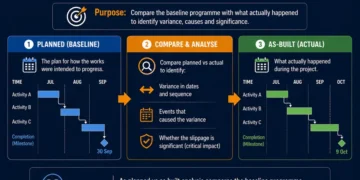
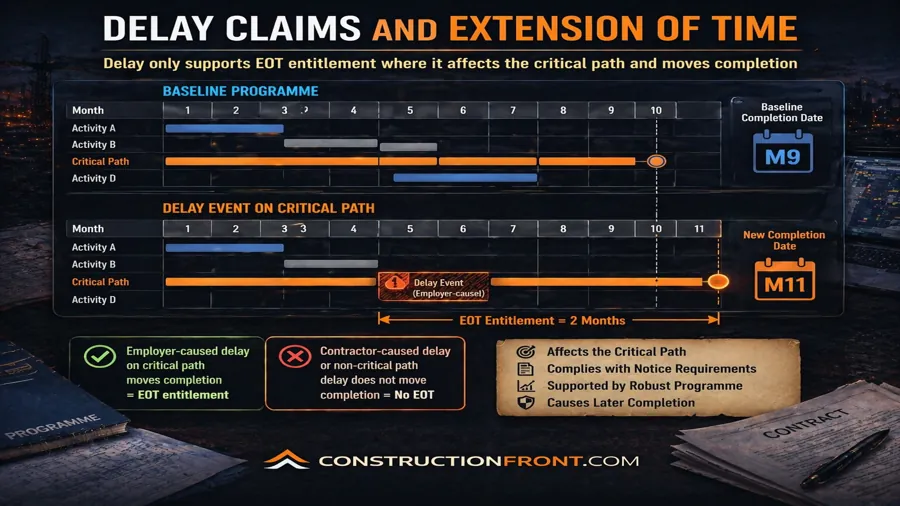
An Extension of Time claim is the process by which a contractor seeks additional time where completion has been affected by an event for which it is not contractually responsible. In practice, however, an EOT claim is rarely just a question of “was there a delay?” It is usually a question of critical path impact, notice compliance, programme quality, causation, and whether the delay affected completion or simply affected part of the work without moving the finish date.
Critical path and delay analysis
The quality of delay analysis usually determines the credibility of the claim. The broader guide on Delay Analysis Methods explains the main approaches, while the article on the Window Analysis Method looks more closely at one of the most widely used techniques for more complex delay disputes. The article on Float in a Construction Program also matters because many time disputes turn on whether a delaying event consumed available float or genuinely delayed completion.
Delay, disruption, and concurrent delay
Delay and disruption are often linked, but they are not the same issue. Delay is mainly concerned with time and completion. Disruption is more about loss of productivity, inefficient working, and interference with planned methods. That distinction matters because different evidence may be needed for each, and the commercial consequences can also differ. The article on Delays, Disruptions, and Liquidated Damages in Construction Contracts takes that further.
The picture becomes more complicated when more than one cause of delay is being argued at the same time. Concurrent Delay is particularly important because it sits at the overlap between programme logic, responsibility allocation, and entitlement. It is not just a planning issue. It is also a commercial and contractual one.
Notice requirements and prolongation costs
Strong delay claims are built on more than programme theory. They also require disciplined notice compliance and good records. The guide on Notice of Delay shows why timely notification matters in practice. If compensable delay also causes the contractor to remain on site longer than planned, then the financial side becomes central too. That is where Prolongation Costs and Claims in Construction Contracts and the Eichleay Formula become important deeper resources.
The practical point is simple: delay claims depend on administration. Without notices, records, and a credible programme, even a real delay event can become difficult to sustain.
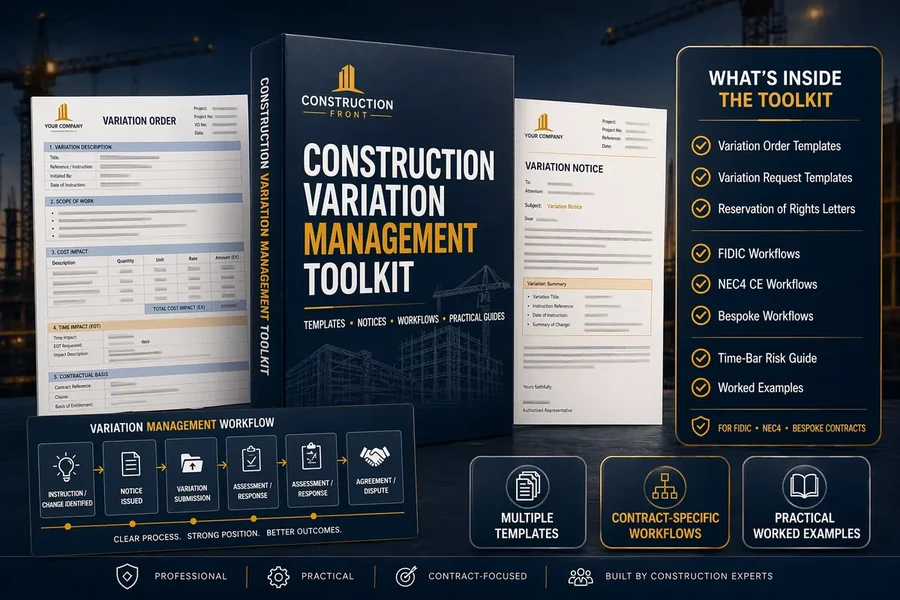
Variation Orders and Scope Changes
If delay claims are driven by time, variation claims are driven by scope. Most major projects change during delivery. That may be because design develops, stakeholder requirements shift, interfaces move, or practical delivery issues require the work to be done differently from how it was originally priced or planned. That makes variation management one of the core disciplines of contract administration in construction projects.
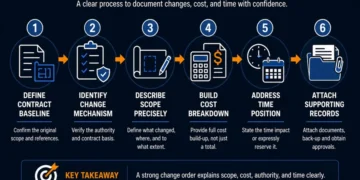
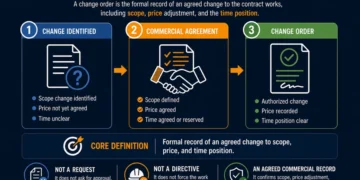
A Variation Order is the formal mechanism used to record and direct a contractual change. A Variation Request usually sits earlier in the process, identifying the potential change and its likely time and cost consequences before it is formally resolved.
Why Variations Are Commercially Sensitive
Variations are commercially sensitive because they affect much more than measurement and valuation. A change may affect design, temporary works, procurement, sequence, labour loading, access, productivity, and overall programme logic.
That means disputes over variations are rarely just about whether extra work was carried out. They usually include discussions about whether the change was within original contracted scope of works, whether there has been a formal instruction by the Principal/Owner/Employer, and whether the contractor preserved its entitlement to money and time compensation in accordance with the contract.
RFIs and scope clarification
On this topic, it is important to visit issues associated with RFIs. An RFI (request for informaiton) is meant to clarify information, not automatically create a variation. But in practice, some responses introduce new details, upgraded performance requirements, changed sequence assumptions, or additional work content. That is exactly the issue examined in When Does an RFI Become a Variation?.
Common causes of variation disputes
Variation disputes often grow from a few recurring failures:
- incomplete design at award
- unclear original scope boundaries
- informal instructions
- poor change logs
- delayed valuation
- weak communication between site and commercial teams
- failure to recognise when clarification has become change
The stronger the variation control process, the less likely it is that scope drift/creep becomes a major commercial dispute.
Time Bars, Notices and Contractual Rights
Many claims are not undermined by the factual event itself. They are undermined by the way the contract required the event to be notified and administered. It is very important to highlight the importance of time bars and notice provisions under construction contracts.
A Time Bar Clause requires one party to notify the other within a set timeframe if it wants to preserve a claim or claim-related right. Depending on the wording, failure to comply may weaken the claim or extinguish entitlement entirely.
The article on Are Time Bars Enforceable in Construction Contracts? explains why that depends on wording and legal context, but the project-level lesson is clear: if the contract contains procedural deadlines, they need to be treated seriously.
Why notice compliance matters
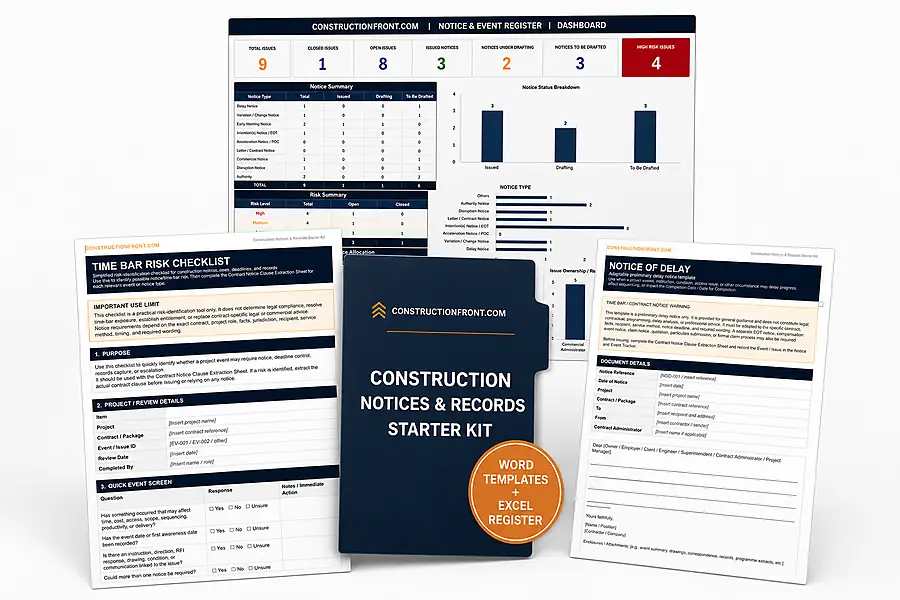
Notices matter because they allow issues to be investigated while events are still current. They also give the parties a chance to mitigate, assess risk early, and keep the project record clean.
In practical terms, the relevant notice may be a Notice of Delay, an Early Warning Notice, or some other contract-specific communication. Those are not always substitutes for each other, and that is where project teams often get caught out.
Early warning, estoppel, and contractual procedure
The notice topic also overlaps with wider procedural and legal concepts. Early Warning Notices are often part of proactive contract administration and risk management rather than claims alone, while Estoppel in Construction Contracts becomes relevant where inconsistent conduct may affect how strict contractual rights are later argued, and this is especially relevant for Employers, which might set dangerous legal precedents without being aware.
These are exactly the kinds of issues that show why weak administration often creates risk well beyond the underlying event. In practice, rights are often lost in the process, not the principle.
Latent Conditions and Defects
Latent conditions and defects are a major source of claims because they involve problems that are not obvious when the project starts or when the works are priced. On infrastructure and energy projects, that often means ground conditions, buried utilities, contamination, hidden obstructions, or concealed defects that only become apparent once the work is underway.
The guide on What is a Latent Condition in Construction? provides the practical starting point. A latent condition is generally something that could not reasonably have been identified from the available information or ordinary inspection at tender stage, but which later affects the work. These issues often lead directly to delay, changed methodology, increased cost, and arguments about responsibility allocation.
Geotechnical risk and unforeseen conditions
Latent condition issues are especially important on civil and energy projects because geotechnical and underground risks can have a major impact on programme and cost. A buried service, unexpected rock profile, contaminated material, or unstable ground condition can quickly affect access, excavation, disposal strategy, temporary works, and construction sequence. These are not small technical corrections. They are often project-shaping events.
Patent vs latent defects
This broader area also overlaps with defects. The distinction between Patent vs Latent Defects matters because visible defects and hidden defects are treated differently both commercially and legally. A team needs to know whether it is dealing with an unforeseen site condition, an obvious quality problem, or a concealed defect discovered later, because the contractual route may be different in each case.
As with other claim areas, entitlement here depends heavily on administration. The event needs to be identified properly, notified correctly, and supported by records of its actual time and cost impact.
Damages and Financial Consequences
Claims and contract administration always come back to money. Even when the starting point is a delay event, a notice issue, or a latent condition, the question usually becomes who bears the financial consequence. Hence why damages and cost exposure are central to any practical discussion of construction contract claims.
Liquidated damages
The most familiar damages mechanism is Liquidated Damages in Construction Contracts. These are pre-agreed sums payable if the contractor does not achieve completion by the contractual completion date. They matter because they create direct financial exposure for delay. But their application depends heavily on extension of time entitlement, programme evidence, employer-caused delay, and sometimes concurrent delay.
Prolongation, disruption, and cost recovery
On the contractor side, compensable delay may create Prolongation Costs, including extended site overheads, supervision, preliminaries, insurances, and financing costs. In some cases, home office overhead recovery may also be argued through the Eichleay Formula. Those claims require careful proof. They are not automatic simply because delay exists.
Demurrage and specialist cost exposure
Some financial consequences are more specialised but still highly relevant, especially on energy and logistics-heavy projects. Demurrage claims are a good example where port, marine, transport, or unloading delays create direct cost exposure. These claims often arise from the same underlying administration weaknesses seen elsewhere: poor interface planning, delayed access, weak communication, or unclear responsibility.
The broader message is that financial exposure is often the downstream consequence of weak contract administration. If time, change, and risk are poorly controlled, money usually follows.
Commercial and Contractual Implications
Construction claims and contract administration are not separate conversations. Claims depend on administration, and weak administration increases contractual risk across the whole project. That risk does not usually appear in one clean category. It spreads across entitlement, programme, scope, responsibility allocation, and financial exposure.
Claims and entitlement
A claim is only as strong as the contract administration that supports it. If notices are late, records are weak, and the event is not tied clearly back to the contract, even a reasonable entitlement can become hard to recover. This is one of the core practical realities of construction contract claims: substance matters, but so does process.
Delay and programme risk
Poor administration of time-related issues increases delay risk quickly. Weak programme updates, untracked access problems, and late notices make it harder to establish entitlement to time and easier for disputes to grow around critical path impact, prolongation costs, and liquidated damages.
Variations and scope control
Poor scope control is one of the biggest drivers of claims growth. If variations are not identified early, formalised properly, and linked to cost and time consequences, the project can drift into disputes about whether the work was already included, whether it was instructed properly, and whether entitlement was preserved.
Responsibility allocation
Many construction disputes are really arguments about responsibility allocation. Who carried the risk for the delay? Who carried the risk for the latent condition? Was the change within original scope? Was the disruption contractor-caused or employer-caused? Strong contract administration helps answer those questions while the evidence is still current.
Financial exposure and dispute risk
The consequences of weak administration are not theoretical. They often include rejected claims, unrecoverable prolongation costs, liquidated damages exposure, disputed final accounts, and a weaker negotiating position if the project moves into formal dispute. That is why project teams should treat contract administration as a commercial control function, not just a correspondence function.
Common Mistakes in Claims and Contract Administration
Across major projects, the same mistakes appear repeatedly. They are usually not sophisticated legal mistakes. They are practical delivery failures that weaken commercial positions later.
- not reading the contract properly at the start
- failing to issue notices on time
- poor records of progress, access, and impact
- assuming an instruction automatically creates entitlement
- allowing scope to shift without formal change control
- relying on retrospective programme reconstruction
- weak communication between site and commercial teams
- treating claims as something to assemble only after the job has gone wrong
One of the most damaging patterns is the disconnect between teams. The site team often knows the facts first. The commercial team usually knows what the contract requires. If those teams are not aligned, the result is often missed notices, weak records, and claims that start too late.
Best Practices for Managing Construction Claims
Good claims management in construction starts early. It does not begin with the formal claim submission. It begins with understanding the contract, setting up the right project controls, and making sure the team can connect technical events to contractual processes in real time.
Strong record keeping
Contemporaneous records are the backbone of serious claims. That includes diaries, photographs, meeting records, progress reports, correspondence, access logs, cost records, and credible programme updates.
Early notices
Notices should be issued promptly and in the required form. Even where the full impact is not yet known, preserving rights early is usually better than waiting for a complete narrative that arrives too late.
Integrated commercial and project controls teams
Claims are stronger when planning, engineering, site, and commercial teams work together. Delay, change, cost, and contractual procedure should not be treated as separate silos.
Clear variation management and live programme discipline
Variation control needs to be disciplined, and the programme needs to remain a real management tool. Formal change control and credible delay analysis are two of the strongest foundations of a defensible claims position.
| Best practice | Why it matters |
|---|---|
| Read the contract early | Clarifies rights, risks, and claim routes |
| Issue notices promptly | Preserves entitlement and improves investigation |
| Keep strong contemporaneous records | Supports causation and valuation |
| Maintain a credible programme | Strengthens EOT and delay positions |
| Integrate site and commercial teams | Reduces missed events and fragmented claims |
| Manage variations formally | Prevents scope drift and valuation disputes |
| Track costs as events develop | Improves quantum support and commercial control |
Conclusion
Construction claims and contract administration are central to successful project delivery because they govern how time, money, change, risk, and responsibility are managed while the project is still live.
On major infrastructure, energy, and construction jobs, disputes rarely appear out of nowhere. They usually grow from missed notices, unclear scope changes, weak records, poor programme management, and a failure to administer the contract properly from the start.
That is why good contract administration is not only about protecting a future legal position. It is about running the project with enough discipline that delay, variation, latent conditions, and commercial risk are identified early, managed properly, and recorded clearly.
FAQ
What are construction claims?
Construction claims are formal requests or assertions under the contract seeking additional time, money, relief from liability, or some other contractual remedy.
What is contract administration in construction?
Contract administration is the day-to-day process of operating the contract properly during delivery, including notices, records, instructions, payment procedures, and change management.
What are the most common construction claims?
The most common construction claims involve delay, extension of time, variations, latent conditions, prolongation costs, liquidated damages, disruption, and defects-related issues.
Why is contract administration important in construction projects?
It is important because weak administration often turns manageable project issues into claims and disputes by undermining notices, records, and entitlement.
What happens if a contractor misses a notice deadline?
That depends on the contract and the law, but missing a notice deadline can seriously weaken or even extinguish entitlement where the clause operates as a time bar or condition precedent.
What is the difference between delay and disruption?
Delay is mainly about time and completion. Disruption is more about interference, inefficiency, and loss of productivity. They often overlap, but they are not the same thing.
Why do construction disputes often start with poor contract administration?
Because missed notices, unclear scope control, poor records, and weak programme management often undermine the parties’ ability to manage issues while they are still current.
Ready to go further?
Two practical resources built for live project use across NEC4, FIDIC and bespoke contracts.
Sources
- Society of Construction Law, Delay and Disruption Protocol
- FIDIC, Frequently Asked Questions on FIDIC Contracts
- Construction Front, What is an Extension of Time Claim (EOT)?
- Construction Front, What are the existing Delay Analysis Methods?
- Construction Front, What is the Window Analysis Method?
- Construction Front, What is the Float in a Construction Program?
- Construction Front, Notice of Delay: What is it? How to Draft one?
- Construction Front, Prolongation Costs and Claims in Construction Contracts
- Construction Front, Eichleay Formula: What is it? How to use?
- Construction Front, What Is Concurrent Delay in Construction?
- Construction Front, Delays, Disruptions, and Liquidated Damages in Construction Contracts
- Construction Front, What is a Variation Order?
- Construction Front, What is a Variation Request?
- Construction Front, What Is an RFI in Construction?
- Construction Front, When Does an RFI Become a Variation?
- Construction Front, What is a Time Bar Clause?
- Construction Front, Are Time Bars Enforceable in Construction Contracts?
- Construction Front, What is an Early Warning Notice?
- Construction Front, Estoppel in Construction Contracts: How do they work?
- Construction Front, What is a Latent Condition in Construction?
- Construction Front, Patent vs Latent Defects
- Construction Front, Liquidated Damages in Construction Contracts
- Construction Front, What is a Demurrage Claim?
Disclaimer: The articles on this blog are for informational and educational purposes only and do not constitute legal or technical advice. While we strive to provide accurate and up-to-date information on construction law, regulations may vary by jurisdiction, and legal interpretations can change over time.